Spotted seatrout
Cynoscion nebulosus · Sciaenidae
- Saltwater
- Coastal
- Medium
- Size
36–100 cm
- Weight
0.5–7.9 kg
- Lifespan
18 years
Where to fish
- Estuary
Habitat icons: Flaticon
Inhabits river estuaries and shallow coastal waters over sandy bottoms, often associated with seagrass beds. Also occurs in salt marshes and high-salinity tidal pools.
Calendar
Recorded in 2 countries
GBIF occurrence records — native and introduced populations combined.
Its range
New York to southern Florida, plus the whole of the Gulf of Mexico: that is the native range, and it is a warm one, running from 42 degrees north down to 15.
Added to it is a recent and unexpected entry — the estuary of the Guadalquivir, in southern Spain. How the fish got there is not on record. Its congener crossed the Atlantic through deliberate introduction; this one simply turned up. Either way a drum of this genus in a European estuary is no longer something to dismiss out of hand, and both species now have to be considered when one appears.
Identifying it
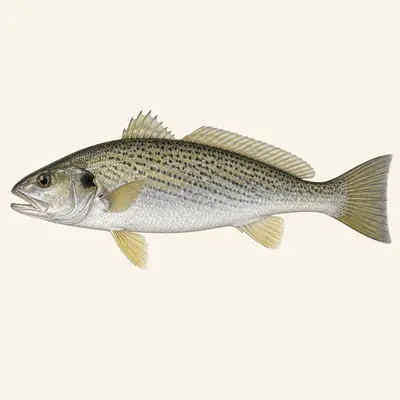
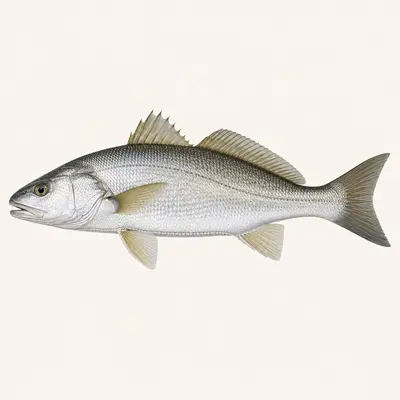
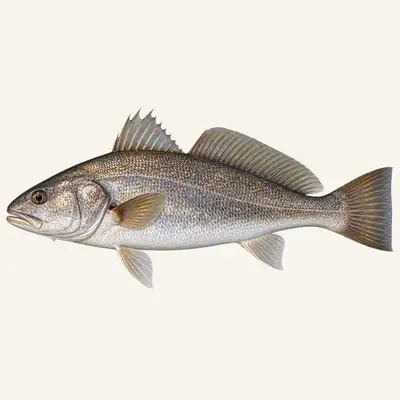
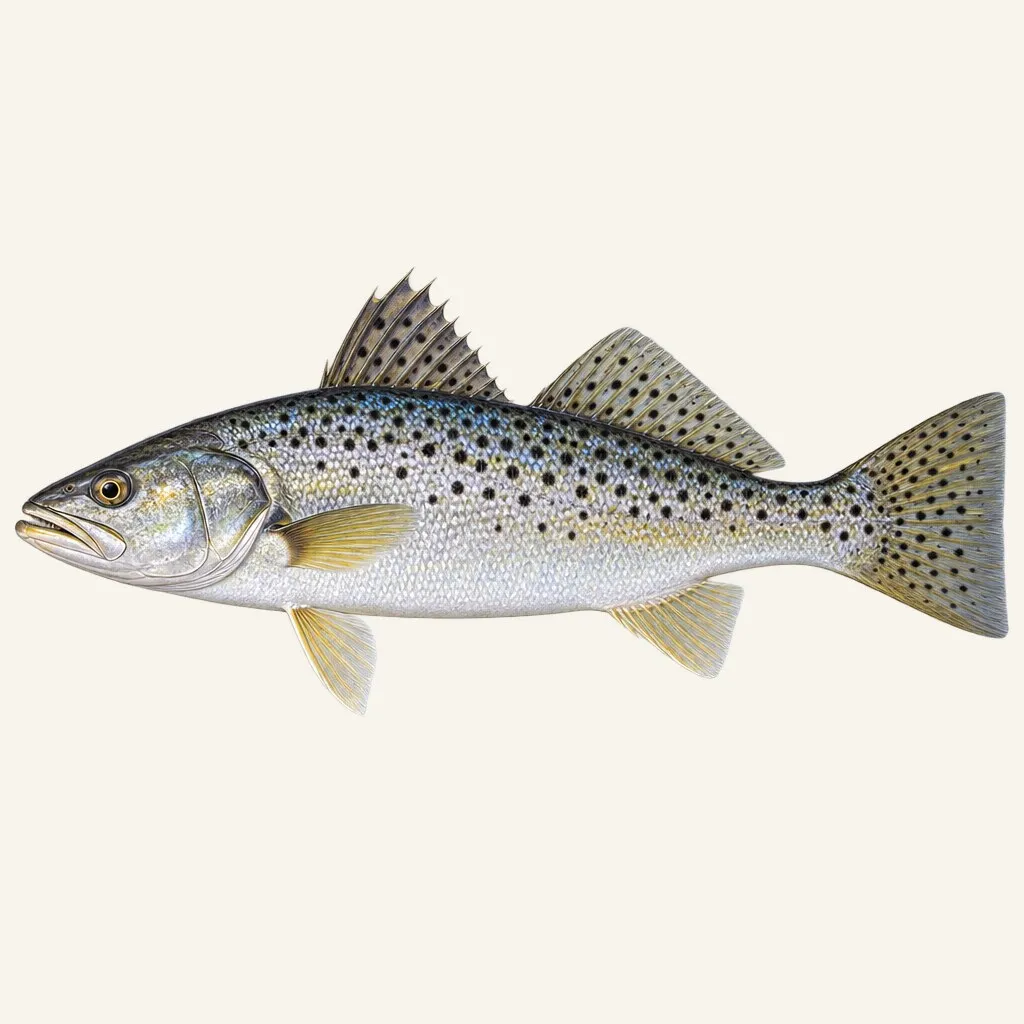
The spots are round, scattered at random, and they do not stop at the body. Numerous black spots sit irregularly over the upper half of a dark grey back with bluish reflections, and they carry on out onto the dorsal and the caudal fin. That continuation is the criterion: on the weakfish the marks fall into wavering dotted rows and keep clear of the fins entirely.
The spinous dorsal is dusky and the remaining fins run pale to yellowish over a silvery body.
The gape is wide and tilted with the lower jaw set forward. Two large canines stand at the front of the upper jaw, which settles nothing: the whole genus has them. What is worth looking at is underneath, where the lower jaw carries an enlarged inner row of teeth, even in size and closely set. The published description of the weakfish records no such row, and this is the character to work from on a fish whose spotting has faded.
Small details separate the two where the colour is gone: the snout bears two marginal pores where the weakfish bears one, the chin bears none, and the soft portion of the dorsal fin is unscaled.
The fin counts run too close to be decisive on their own. The first dorsal varies between nine and 11 spines, where its congener is fixed, and behind two anal spines there are only ten or 11 rays.
The water it needs
Estuaries and shallow coastal water over sand, with seagrass beds as the determining element. Salt marshes and tidal pools of high salinity come into it as well.
The grass is the fact that pays. The beds hold the shrimp the fish lives on and the cover it hunts them in, and bare sand next to a bed will not keep it there. Reading the bottom therefore matters more than reading the depth.
And it does not migrate. Where the weakfish runs out to sea and back on an annual schedule, this one stays put: a resident of one estuary, one bay, one grass flat, present through the year. That single difference reorganises how it is found — the same ground can be worked across seasons instead of intercepted on a passage.
Areas
- Coastal seagrass beds
- Shallow estuaries
- Coastal lagoons
- Channels between seagrass beds
Techniques
- Casting shrimp-imitating soft lures
- Live shrimp fishing
- Topwater surface fishing
- Light jigging along seagrass edges
Baits
- Live shrimp
- Shrimp-style soft lures
- Live killifish
- Bloodworms
What it eats
Crustaceans lead the diet and fish follow.
The two canines in the upper jaw are there to hold prey that is fighting to get away. That is the equipment of a shrimp and fry hunter working inside a weed bed, where the grab has to succeed on the first attempt: a prey that comes loose in cover is a prey that is gone.
How to catch it
Shallow grass flats are the ground, and on the Gulf coast this is one of the most closely followed sport fish there is.
The crustacean half of the diet points as much at shrimp imitations as at anything shaped like a baitfish, and the strike inside a bed comes at close quarters.
Because the species does not migrate, the same water is worth working through the year: a flat that produced in one season is not vacated in the next, and the fish moves within the system rather than out of it. That is a rare thing among coastal predators and it changes what local knowledge is worth.
First maturity comes at about 27 cm, in a range of 25 to 35, against a common length of 36 cm and an oldest reported age of 18 years. An ordinary fish is therefore a mature fish, and a potentially long-lived one.
The mouth is as tender as its congener's and forgives nothing at the strike. Force at the wrong moment simply pulls the hold out.
Conservation
Dependence on seagrass is the main pressure, and it operates independently of any fishing. Turbidity, dredging and nutrient enrichment destroy the beds, and the shrimp and the shelter go with them. A lost bed is not compensated by the clean sand beside it, because clean sand is precisely what the species does not use.
Residency compounds it in a way the migratory members of the genus escape. A fish that stays in one bay makes each bay its own stock: what is removed there is replaced from there or not at all, and effort concentrated on one system is not spread over a coastline. Local depletion is a real outcome even where the species as a whole is abundant.
Against that, early maturity and 18 years of potential life give a population that responds well to being left alone — on the sole condition that the grass is still standing when it does.
Regulations
Check the local regulations in force (legal size limits, closed seasons, bag limits).
For guidance only. Legal sizes, quotas and open seasons vary by location and season: always check the local regulations in force before fishing.
Other names
Spotted seatrout is the standard English name and speckled trout the common alternative. Both are doubly misleading: the animal is not a trout and not even a salmonid but a drum, in the family of the croakers.
The confusion gets worse rather than better with familiarity. On the Gulf coast the name is often shortened to trout, or to speck, and sea trout in British usage means a migratory brown trout — so the same two words name unrelated fish on opposite sides of the Atlantic. Spanish usage has corvina, which at least keeps the fish in the right family. Spotted weakfish is the form used where a fisheries document needs the ambiguity taken out.
The epithet nebulosus means clouded, after the spotting.
Sources: fishbase.se · api.gbif.org