Souffia chub
Telestes souffia · Cyprinidae
- Freshwater
- Carp & coarse
- Easy
- Size
15–20 cm
- Weight
0.0–0.1 kg
- Water temp.
10–20 °C
Where to fish
- River
Habitat icons: Flaticon
Small torrent fish - Indicator of very good water quality
Calendar
Recorded in 5 countries
Austria · France · Germany · Italy · Switzerland
GBIF occurrence records — native and introduced populations combined.
Its range
Three corrections sit inside the published range statement, and each one has spoiled records.
The first is French. Older literature places the fish in the Tarn, in the Garonne drainage; those records in fact belong to the Hérault. The two systems each have a tributary named the Dourbie, and a locality repeated on two rivers carried a species across a watershed on paper.
The second is Bulgarian. A report from the Aegean basin there rests on a misidentification of a fish that may not yet have a name of its own.
The third is not an error but a boundary. In the Var, in France, and in the Soča, on the Italian and Slovenian side, this species meets Telestes muticellus and the two exchange genes. Specimens from those two drainages sit between the diagnoses rather than inside one of them, and no amount of counting will resolve them.
What is left after the corrections is a range spread over slopes that do not connect: Mediterranean France and Switzerland, the Adriatic by way of the Soča, the uppermost Rhine, and the Danube through its western tributaries and the upper Tisza. A fish of clear middle reaches does not cross a divide, so that pattern is a record of how the divides themselves have moved.
Identifying it
A live fish and a museum fish are described in opposite terms, and both descriptions are correct.
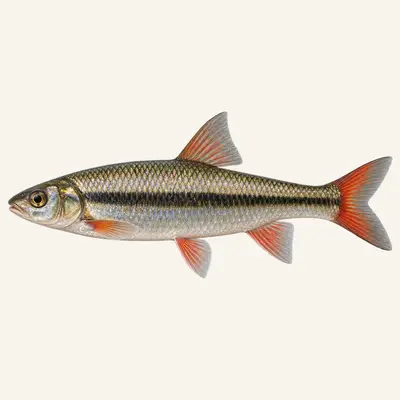
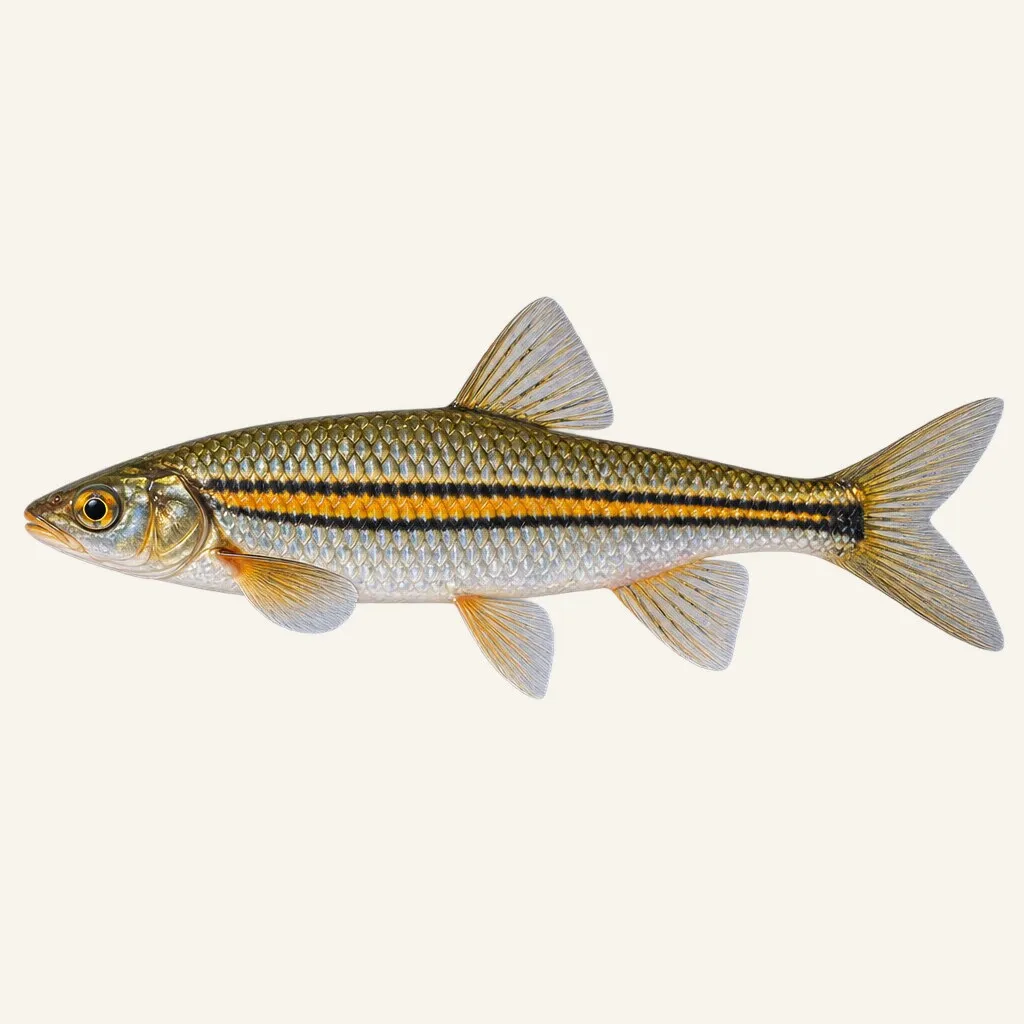
Alive, the middle of the flank carries a broad gold to orange stripe, and the lateral line is yellow with a narrow black border on each side of it. Preserved, the gold has gone: what remains is a conspicuous black midlateral stripe with a second black line along the lateral line. The diagnosis of the genus is written from the second state. Every fish that comes out of a net is in the first.
The characters that survive both are these. The snout tip is rounded or blunt and projects in front of the upper lip, so the mouth opens under an overhang. The eye goes 4.0 to 4.6 times into head length. The anal fin usually carries nine and a half branched rays. The lateral line holds 44 to 57 scales plus two or three more, most often 50 to 57, with four and a half to five rows between it and the origin of the pelvic fin. Vertebrae number 41 or 42; the tail carries 17 to 21 rays.
The water it needs
The published thermal envelope is ten degrees wide, from 10 to 20, and that window is the whole species.
Adults hold the middle reaches of streams and rivers where three things coincide: clear water, moderately swift current and a gravel bed. They stay in groups the year round. Breeding happens in fast water over the same gravel, so feeding station and spawning ground are one address rather than two.
The catalogue calls the fish an indicator of very good water quality, and the three requirements explain why that reputation attaches here rather than to its neighbours. Clarity, flow and clean gravel have to be present together. Losing any one of them is losing the fish, and the other two cannot compensate.
Areas
- Torrents
- cool mountain streams
Techniques
- Worms
- Maggots
- Larvae
Baits
- Caddisfly larvae
- Bloodworms
- Maggots
- Small insects
What it eats
Invertebrates and algae, in that order in the record.
The plant fraction is not harvested the way the specialist grazers of these rivers harvest theirs. The published diagnosis of this genus records no horny sheath on the lower lip — the structure a nase carries and uses to scrape stone — so the algae here are taken as they come, off a surface the fish is already working over for insects.
Both halves of that diet fail for one reason. Algae in fast water grow on stone the current keeps swept, and the invertebrates live in the spaces between the same stones. Fine sediment settling into a gravel bed removes the crop and the fauna in a single stroke, and there is no third resource to fall back on.
How to catch it
The record is blunt about the fishery: of no interest. It records in the same breath that the flesh is excellent and that the species is used as bait. Those three statements describe a fish nobody has ever fished for on its own account.
Where it is taken deliberately, the tackle is small. Caddis larvae, bloodworm, maggots and small natural insects match a diet of stream invertebrates, on hooks proportioned to a fish of about 15 centimetres. The water to search is the clear gravelly middle reach with moderate current — not the trout headwater above it and not the deeper slower river below.
The shoal decides the session. These fish are together or they are absent, and a swim that gives nothing in the first quarter of an hour is unlikely to change its mind.
Conservation
The species is described as locally threatened, and the pressure that is specific to it comes from the bait line rather than from any fishery.
A fish taken for bait is taken outside every mechanism that regulates a catch. It is not counted, it is not sized, it is not restricted to a season, and — the part that matters most here — it is carried. The Var and the Soča already hold fish of mixed ancestry where the two European Telestes meet naturally. A bucket moved between catchments creates contacts that were never natural, and nothing in the appearance of the resulting fish records which kind it came from.
Everything else that acts on the species acts through the gravel. Flow regulation removes the flushing flows that keep a bed clean, aggregate extraction removes the bed outright, and fine sediment seals whatever is left. Since no fishery counts this fish, none of that appears in any catch series: a reach can lose its population without a single figure moving.
Regulations
Check the local regulations in force (legal size limits, closed seasons, bag limits).
For guidance only. Legal sizes, quotas and open seasons vary by location and season: always check the local regulations in force before fishing.
Other names
The name most often applied to the Danube and Rhine populations is Telestes souffia agassii, and the record disposes of it twice over. There is no published evidence that those fish differ from the Rhône populations at all; and were a separate species ever justified, the correct name for it would be Telestes rysela, not agassii. A subspecies name that is both unsupported and, under priority, the wrong one is nonetheless the name a great deal of central European literature uses.
English has no vernacular of its own here, since the fish has never occurred in British water. The catalogue writes souffia chub, taking the French epithet and attaching an English group word to it. German goes to the habit instead, with Strömer, built on the word for a current.
Italian produces the collision worth knowing about. It calls this species vairone, without qualification, and reserves vairone italiano for Telestes muticellus — which is to say the unmarked name belongs to the species that is not the Italian endemic, and the endemic is the one carrying the national adjective. Anyone reading an Italian record has to check the drainage before accepting the name.
Sources: fishbase.se · api.gbif.org