Silver carp
Hypophthalmichthys molitrix · Cyprinidae
- Freshwater
- Carp & coarse
- Hard
- Size
50–110 cm
- Weight
1.6–27 kg
- Lifespan
20 years
- Water temp.
6–30 °C
- Depth
0–20 m
Where to fish
- Lake
- River
Habitat icons: Flaticon
A plankton filter feeder - Leaps out of the water when startled (can be dangerous)
Calendar
Recorded in 14 countries
Belgium · China · Denmark · France · Germany · Hong Kong SAR China · Japan · Moldova · Netherlands · New Zealand · Poland · Russia · Ukraine · United States
GBIF occurrence records — native and introduced populations combined.
Its range
The native range is a series of eastern Asian rivers, from the Amur in the north to the Xi Jiang and Hanoi in the south. All of them drain to the Pacific, all are long, all swing widely in level — which is the exact profile its reproduction requires.
The rest of the world received it for two separate reasons. The first is food: it stands among the three or four cyprinids whose world aquaculture production passes a million tonnes a year. The second is service. It was introduced to clear reservoirs and other standing waters of clogging algae, and that capacity has often been valued above its flesh.
Escapes from fish farms have been documented for decades, and the fish has also been stocked directly into large rivers. More than one receiving country has since recorded ecological damage. The Mississippi basin is the most extensive case outside Asia: a long river with pronounced floods and a floodplain beside it, which is the North American equivalent of the rivers it came from and one of the few places beyond Asia where the whole cycle closes at scale.
Identifying it
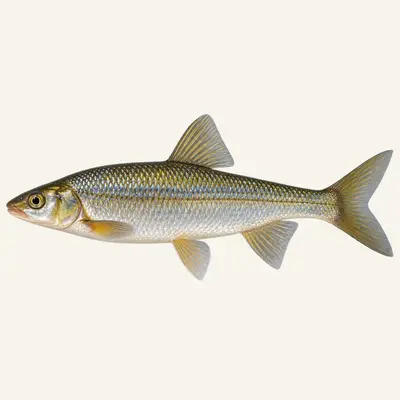
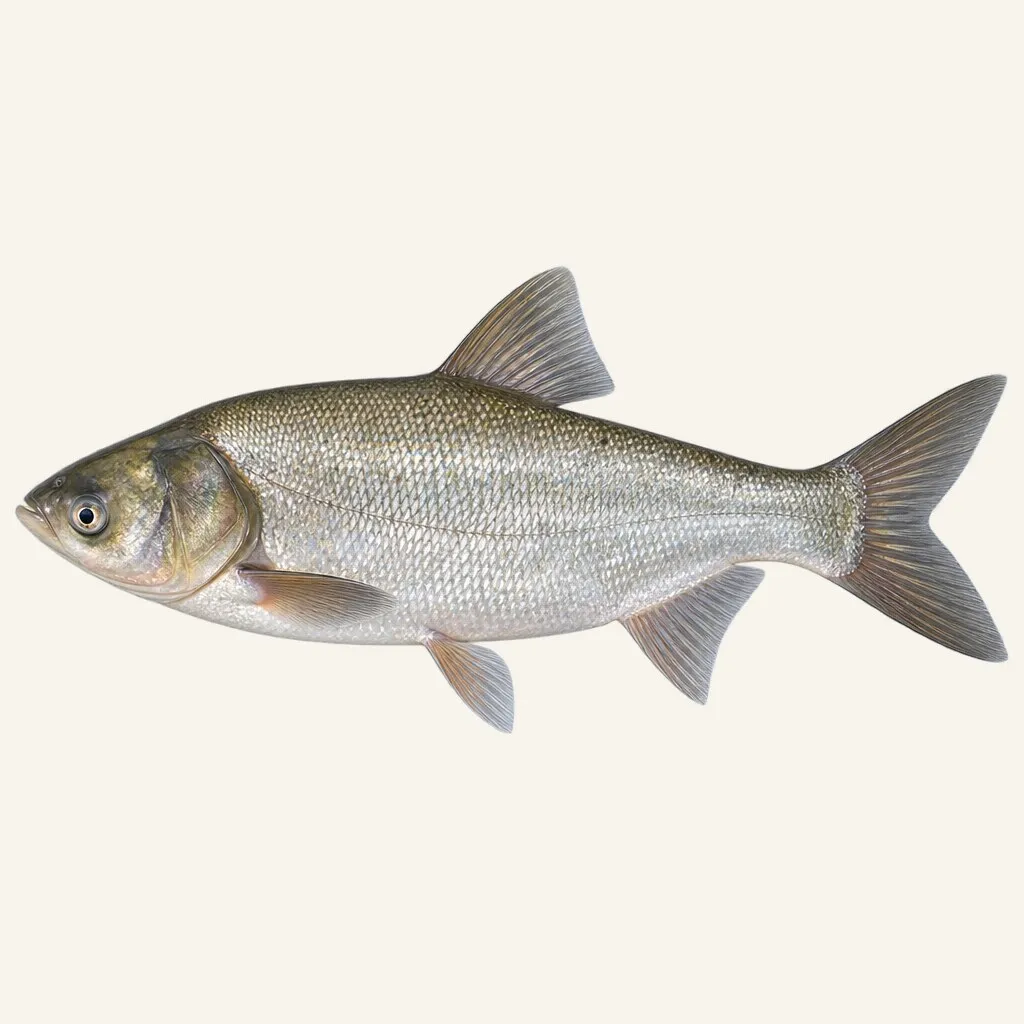
The belly is a blade. A sharp, scaleless keel runs from the pectoral region to the origin of the anal fin, the entire length of the underside, and it is felt before it is seen: one hand along the bottom of the fish settles the identification.
The rest is unusually plain for a cyprinid. No barbels. No spot, no marbling, no bar — greenish grey above, whitish below, and nothing else at all. The last simple ray of the dorsal is not serrated, which rules out the true carps that carry that saw.
The head takes up 24 to 29 per cent of standard length and the eye is set low, distinctly below the axis of the body. The counts are those of a fish with no spines anywhere: seven to ten soft rays in the dorsal, 11 to 17 in the anal.
But the organ that defines the species is only visible under the gill cover. Between 650 and 820 long slender gill rakers form a sieve of a fineness that has no equivalent in the family.
Breeding
Spawning is triggered by a flood, in the strict sense of the word. The level has to rise 50 to 120 cm above normal, the current has to reach between half a metre and 1.7 m per second, and the water has to be turbid, well oxygenated and above 15 degrees — 18 to 26 in practice. Mature fish run far upriver from the beginning of the rise, clearing obstacles a metre high in a single leap.
Release takes place in the upper layer, sometimes at the surface itself, over shallow rapids of gravel or sand. And it is interruptible: if conditions change, and the species is particularly sensitive to a falling level, spawning stops dead and resumes only on the next rise. A short flood produces nothing.
The larvae then drift downstream and come to rest in floodplain lakes, shallow shores and backwaters with little or no current. The cycle therefore demands a long river, open and alive: a rise to set it off, a current to carry it, a floodplain to receive it. First maturity comes at around 52 cm.
The water it needs
It feeds high and shallow: half a metre to a metre of water, in backwaters, lakes and flooded ground with a slow current, above 21 degrees. Outside the spawning season it swims just beneath the surface, and that is where it is seen.
Autumn reverses the picture entirely. Adults move to the deeper places in the main course of the river and spend the cold season there without feeding at all. A filter feeder that works continuously for six months stops completely for the other six.
Salt is not an absolute barrier. In culture the species survives up to 7 parts per thousand, which is enough for it to persist in an estuary or a coastal lake that it has been released into.
Areas
- Large reservoirs and lakes
- Open-water zones
- Downstream of dams
- Wide river meanders
Techniques
- Special plankton techniques
- Bread
- Paste
Baits
- Asian techniques
- Special hooks
What it eats
The switch happens at about a centimetre and a half. Below that, the larva and the small juvenile chase zooplankton. Above it, the fish takes phytoplankton and nothing else, and it never goes back — a vertebrate of over a metre built entirely on microscopic algae.
That is what 800 rakers are for. They retain a fraction of the plankton that almost no other fish can capture, which opens an enormous resource with no direct competitor in it. The price is the absence of any fallback: an animal that can only eat what it strains depends completely on the primary production of its water.
It is also why the two filtering Asian carps travel as a pair. This one takes the plant plankton; the bighead sieves more coarsely and stays on animal plankton all its life. Two different meshes in one pond compete for nothing, and a farmer stocking both works two storeys of the same water. That is a piece of pond-culture arithmetic, and it ended up being applied at the scale of entire river basins.
How to catch it
It jumps, and that is the first thing to know before a boat goes on the water. The behaviour is recorded as obstacle-clearing during migration, a metre of height in one bound. The same reflex fires when an outboard passes: an entire shoal leaves the water around the hull, and a fish of several kilos arriving on board at that speed breaks tackle and injures people. This is not a curiosity but a hazard, and it is managed by cutting speed where the species is dense.
Hooking one then poses a problem few species pose: it attacks nothing. There is no prey to imitate and no scent of flesh to work with, only water full of particles that the fish draws in as it swims. Everything that works comes down to manufacturing that suspension — a cloud of fine particles held in mid-water at a set depth, with the hook caught up in the middle of it.
The calendar follows from the diet. It needs more than 21 degrees to feed, it fasts through the winter in the deep holes, and it filters in a metre of water over slow ground. Those three conditions overlap in summer, on the margins of the river, and nowhere else in the year.
Conservation · Near Threatened (IUCN) — This species is in decline. Release your catch quickly and handle it with care — wet hands, as little time out of the water as possible.
Conservation
Everything about this fish reverses from one river to another. In the eastern Asian rivers it came from, the species is retreating; across parts of North America and Europe the effort goes into holding it back.
What presses on it at home is the loss of the flood. Its spawning needs a rapid rise, a strong current and a floodplain downstream to catch the larvae, and a river that has been embanked, regulated and partitioned removes all three at once. There is no reserve mode of reproduction: without the right hydrology the population stops renewing itself, whatever number of adults are standing in it. The reference assessment dates from 2011, which is old for basins that have been heavily engineered since.
Elsewhere the problem is inverted, and fishing alone does not answer it. A filter feeder at density strips out the phytoplankton on which the larvae of local species depend, along with the invertebrates that live on the same crop. The competition is not between adults but at the base of the chain, which is where it is hardest to see and slowest to reverse.
Regulations
Variable regulations / Sometimes classed as a pest
For guidance only. Legal sizes, quotas and open seasons vary by location and season: always check the local regulations in force before fishing.
Other names
Silver carp in English, Silberkarpfen in German, carpa plateada in Spanish, carpe argentée in French: every language settles on the colour for want of anything else to settle on. It is the name of a fish with no mark on it.
The genus name does better. Hypophthalmichthys means roughly fish with the eye set underneath, and it refers to that low insertion below the body axis which gives the head its particular profile. Both filtering species share it, and it is about the only thing a quick glance credits them with in common.
A last point of usage. Asian carp names a group and not a species — the eastern Asian cyprinids moved together for aquaculture — and within that group this fish and the bighead are confused constantly, technical literature included.
Sources: fishbase.se · api.gbif.org