Southern Iberian chub
Squalius pyrenaicus · Cyprinidae
- Freshwater
- Carp & coarse
- Medium
- Size
26 cm
- Lifespan
7 years
Where to fish
- Estuary
- River
Habitat icons: Flaticon
Found in small to medium-sized streams with a Mediterranean water regime. May be confined to very small pools during summer.
Calendar
Its range
The range covers the peninsula from the Tagus and lower Ebro southwards, and it is the holes in it that are worth knowing. The Mediterranean slope is empty between the Mijares and the Vinalopo, although the upper Jucar has the fish; and empty again between the Guadaiza and the Guadiaro, near Malaga. The Ebro records may be introductions.
Gaps that precise, in an otherwise continuous distribution, point at hydrographic history rather than at climate. A temperature or rainfall limit produces a boundary; a set of drainages that were never connected at the right moment produces a chequerboard, and that is what the southern Mediterranean slope shows.
Identifying it
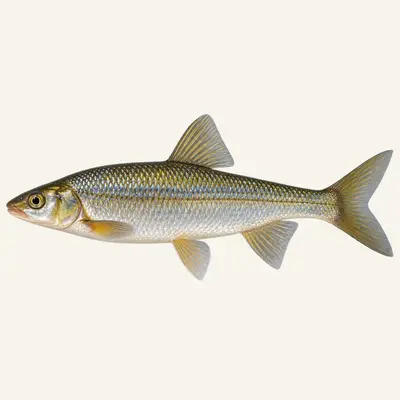
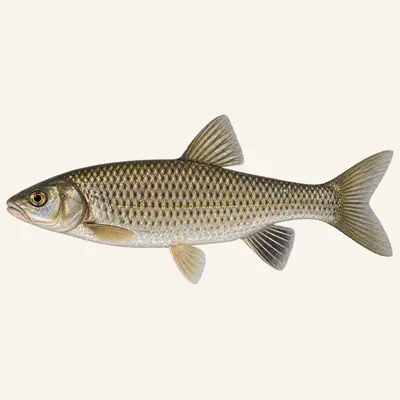
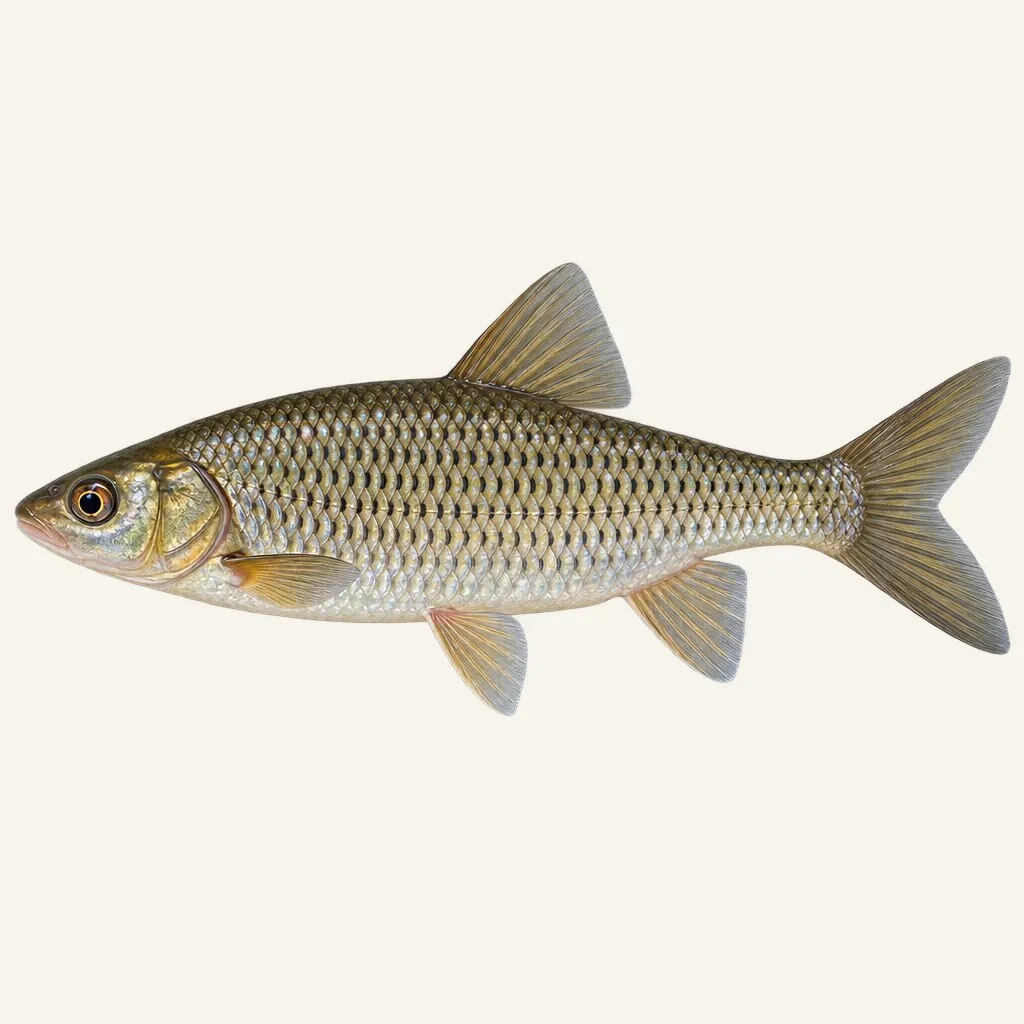
A black crescent sits on the pocket of every scale down the side, repeated often enough to build a legible pattern over the whole flank. The catch is that it is frequently indistinct on a living fish and comes up clearly on a preserved one, so a specimen in a jar and a specimen in a net can look like two different animals.
The head is the reliable part. The snout is pointed and the mouth terminal, sitting at the very front of it. Head length runs about equal to body depth, and the caudal peduncle is 2.0 to 2.6 times longer than it is deep.
The bone that decides the species is the infraorbital series, and here it is broad: bones 2 and 5 come out at four to five times the width of the sensory canal crossing them. The supraethmoid is wide and short, and the preopercular-mandibular canal connects with the infraorbital canal.
Counts: 37 to 42 lateral-line scales plus two or three, three to five rows down to the origin of the pelvic fin, six to nine soft rays in the dorsal, seven to nine in the anal, 37 to 40 vertebrae.
Breeding
Spawning goes on over stone and gravel, in shallow riffles with fast water over them — which for a Mediterranean stream means a window rather than a place. The gravel has to be swept and flowing at the right week of spring, and that is only true of these rivers for part of the year.
First maturity arrives at 7.5 cm. Against a reported lifespan of seven years, that is very early indeed, and it has a practical consequence: almost every fish encountered, at almost any size, is a breeding adult. There is no size below which a captured individual can be treated as a juvenile that has not yet contributed.
The species also belongs to the Iberocypris alburnoides complex, the set of hybrid Iberian cyprinid lineages that reproduce by using a parent species without permanently taking on its genes. Membership complicates identification and it complicates counting, because part of what swims in these rivers is not attributable to a single species at all.
The water it needs
Rivers and marshland, and small to medium streams with a Mediterranean regime — which is to say a flow that swings from abundant in winter to minimal in summer. The species is described as ubiquitous within that setting, and the setting is the constraint.
What follows is the fact that matters most about this fish. In summer, individuals can be confined to very small pools. A river that stops running does not kill them; it locks them in, and they wait there for the water to come back. A stream bed that looks finished in August can hold its entire chub population in a handful of standing basins a few metres across.
Adults feed mainly on small arthropods, which is less a preference than an inventory of what such a basin still produces.
Areas
- Gravelly shallows
- Riverside edges
- Moderate current areas
- Tributary mouths
Techniques
- Float fishing
- Bolognese
- Bottom fishing
- Light feeder
Baits
- Maggots
- Bloodworms
- Bread flake
- Small earthworms
How to catch it
The residual summer pools are the single most useful piece of field knowledge here. A Mediterranean watercourse that appears dry can concentrate everything it holds into a few pockets, and those pockets are findable on foot in an afternoon.
They are also fragile in a way that ought to govern behaviour. Fish crowded into a few cubic metres of warm water are already at their limit, and repeated handling in those conditions is a different proposition from the same handling in April.
Fine tackle is imposed by the animal. A small mouth and a diet of arthropods mean tiny hooks and slender baits, and the early maturity means that size sorting is no guide at all to what is being returned.
Conservation · Vulnerable (IUCN) — This species is threatened with extinction. Always release it (no-kill), handle it with the utmost care and check local rules — fishing for it may be prohibited.
Conservation
Pollution is the recorded pressure, and this fish is unusually exposed to it — not because it is delicate, but because of where it spends August.
A species that passes the summer shut in a residual pool receives every discharge at maximum concentration. The volume that would have diluted it has gone. A load that a winter river absorbs without trace becomes lethal at the same place, in the same quantity, three months later. Abstraction for irrigation works through the identical arithmetic, one step further on: it removes the pools themselves.
Habitat destruction and introduced species complete the list. Between them these three pressures act on a fish whose whole recovery capacity depends on those isolated basins refilling, and on nothing else.
Regulations
Check the local regulations in force (legal size limits, closed seasons, bag limits).
For guidance only. Legal sizes, quotas and open seasons vary by location and season: always check the local regulations in force before fishing.
Other names
Southern Iberian chub in English; bordalo and cachuelo in Portuguese and Spanish depending on the district, both of which are also used for other small cyprinids.
The scientific name is straightforwardly misleading. Nothing about this fish is Pyrenean — the range starts at the Tagus and runs south, and the northern part of the peninsula belongs to a different species. The epithet has been carried since the original description and cannot be changed, so the only defence is knowing that it is wrong.
Sources: fishbase.se · api.gbif.org