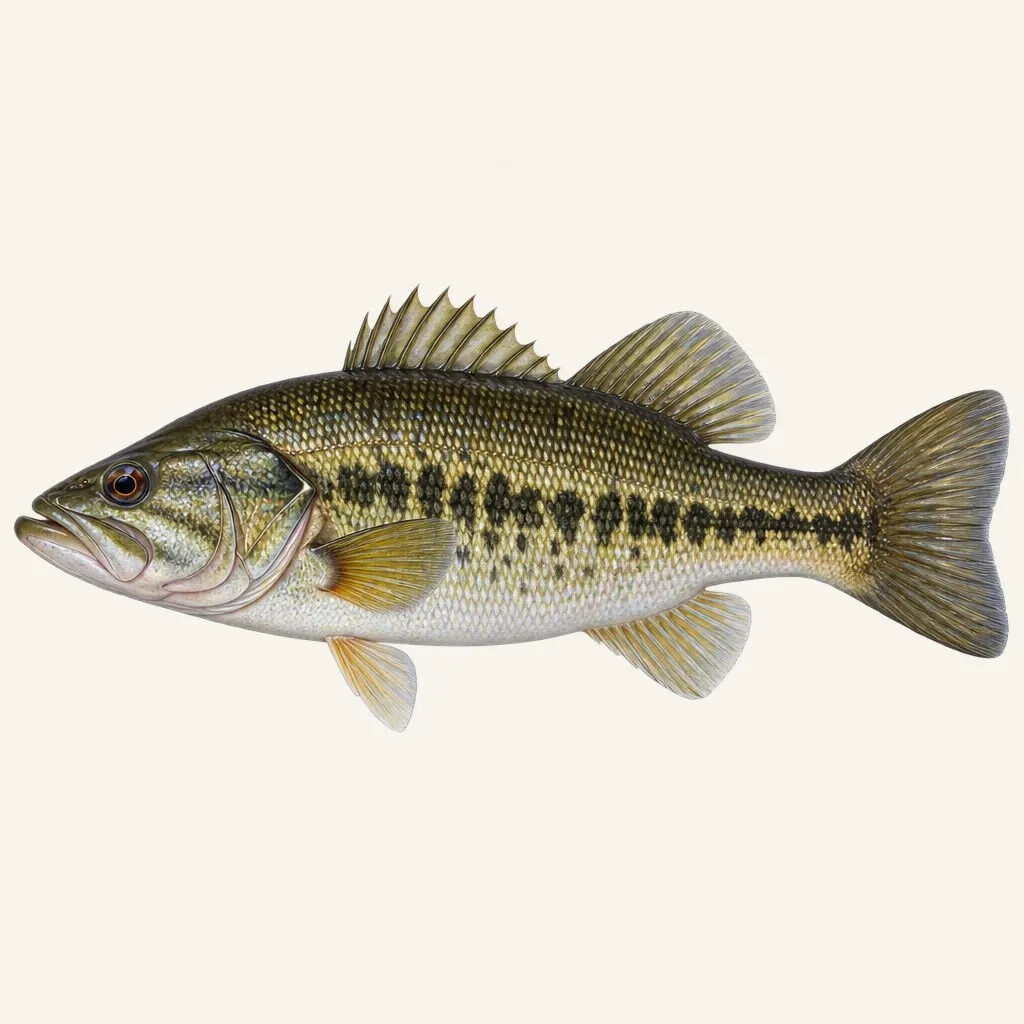
Shoal bass
Micropterus cataractae · Centrarchidae
- Freshwater
- Predators
- Hard
- Size
61 cm
- Weight
4.0 kg
Where to fish
- River
Habitat icons: Flaticon
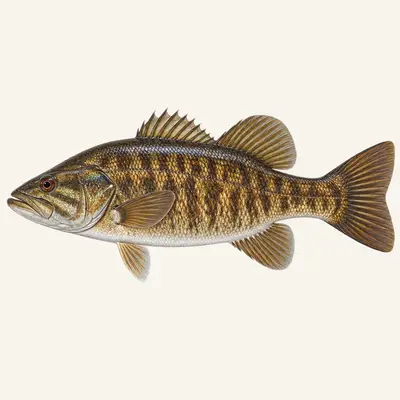
The shoal bass is a robust centrarchid with an elongated body adapted to strong currents, featuring a dark olive coloration with distinct lateral markings on the flanks.
Calendar
Recorded in 1 country
GBIF occurrence records — native and introduced populations combined.
The water it needs
The name is the habitat. Cataractae is Latin for waterfall, and shoal bass says the same thing in English: a shoal, on a river of the American Southeast, is a broad sheet of exposed bedrock that the water runs across in fast broken sheets. That is the whole of this animal's address.
Such a place needs three things at once — rock at the surface, enough fall in the bed to break the flow, and a river wide enough to spread over it. Rivers supply that combination at intervals rather than continuously, and the reaches between are of no use to the fish. So the habitat is not a length of river. It is a series of separate places, and they can be counted.
Which is also why it is scarce. A bedrock constriction with fall in it is the cheapest site an engineer can find for a dam, so the habitat and the reservoir site are the same landform. Above the wall the shoal lies under still water; below it, the flow becomes whatever is released. Either way the broken sheet stops existing, and nothing has to be done to the fish at all.
Stated positively, the requirement is current over hard bottom in the open, in water shallow enough to break — the inverse of everything the two famous members of the genus are fished in.
Areas
- Rocky rapids and ledges
- Below falls and cascades
- Gravel banks in current
- River confluences
Techniques
- Soft lures in current
- Hard crankbaits
- Fly fishing (streamer)
- Topwater at rapid edges
Baits
- Soft lures (creature, crayfish)
- Spinning spoons
- Live crayfish
- Worms
How to catch it
Fishing in current, over rock, at close quarters. A fish holding in fast water is not swimming in it: it sits behind something and lets the flow bring food past, so the cast is aimed at the edge of the current rather than into the middle of it, and the lure has to be working from the moment it lands.
Access is the constraint. A shoal cannot be motored across and is awkward to wade at anything but low flow, so the fishing is done from a shallow-draught boat worked downstream or on foot between the slabs, and the river level decides which of the two is possible. That is where the reputation for difficulty comes from; it has nothing to do with the fish's willingness.
Spring concentrates everything on the same ground. Spawning happens in the shoals the fish already occupies, which means the spawning sites, the spring fishery and the summer holding water are all the same countable handful of places on a given river. There is no second set of them further up.
It reaches a size the headwater members of the genus do not, and that follows from the size of the water rather than from anything about the animal — a bigger river with more flow across more rock feeds a bigger fish.
Conservation · Near Threatened (IUCN) — This species is in decline. Release your catch quickly and handle it with care — wet hands, as little time out of the water as possible.
Conservation
What is on record for this species is its standing rather than its biology. The main reference carried for it is a continental review of imperilled North American freshwater and diadromous fishes — not a life-history study, not a stock assessment. There is no spawning description, no age data and no diet on file. What has been published about it is a judgement about its prospects.
The mechanism behind that judgement needs no fishing to operate, and it is the one set out above: impoundment removes shoals by definition, because the feature that makes a shoal is the feature that makes a dam site. What happens between the dams adds to it — water released on a schedule that suits generation rather than a river, and fine sediment off the surrounding land filling the spaces between the stones, which is the one insult a hard-bottom habitat cannot absorb.
The name is also the argument for what to do about it. A shoal cannot be restocked, moved or rebuilt. It can only be left.
Regulations
Check the local regulations in force (legal size limits, closed seasons, bag limits).
For guidance only. Legal sizes, quotas and open seasons vary by location and season: always check the local regulations in force before fishing.
Other names
Shoal bass, after the landform, and cataractae, the epithet, meaning waterfall. The genus has a settled habit of naming its species after the drainage each one occupies; this one is named after a habitat type instead, and it is the more useful convention of the two, because it tells a reader where to fish.
The word shoal is worth untangling for anyone reading fishing English. It means a school of fish; it means shallow water and a hazard in navigation; and it means an outcrop of rock in a riverbed. All three descend from the same idea of shallowness, and it is the third that is meant here — a fact that has misled more than one reader into expecting a schooling fish.
The species itself was only described at the very end of the 1990s, which for a large sport fish in the eastern United States is remarkably late. The rivers it lives in were dammed long before it had a name of its own.
Sources: fishbase.se · api.gbif.org