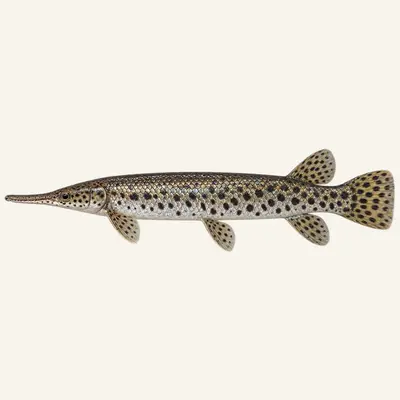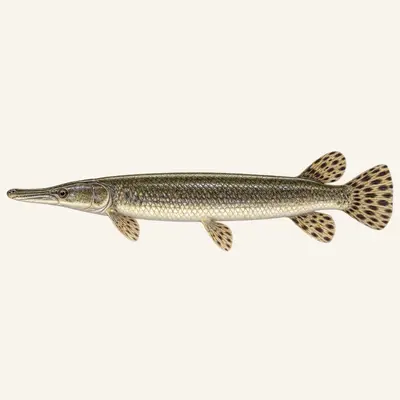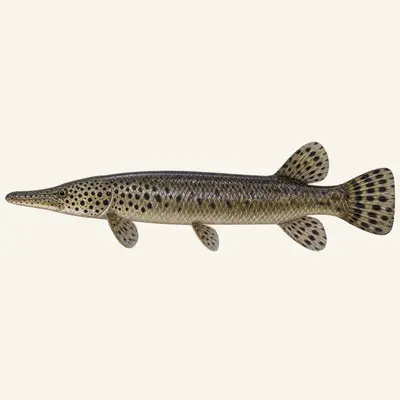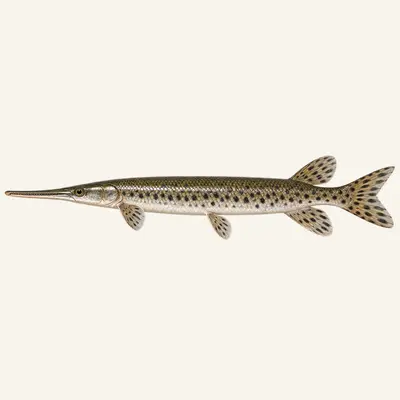
Shortnose gar
Lepisosteus platostomus · Lepisosteidae
- Freshwater
- Predators
- Medium
- Size
63–88 cm
- Weight
1.1–2.6 kg
- Lifespan
20 years
- Water temp.
10–18 °C
Where to fish
- River
Habitat icons: Flaticon
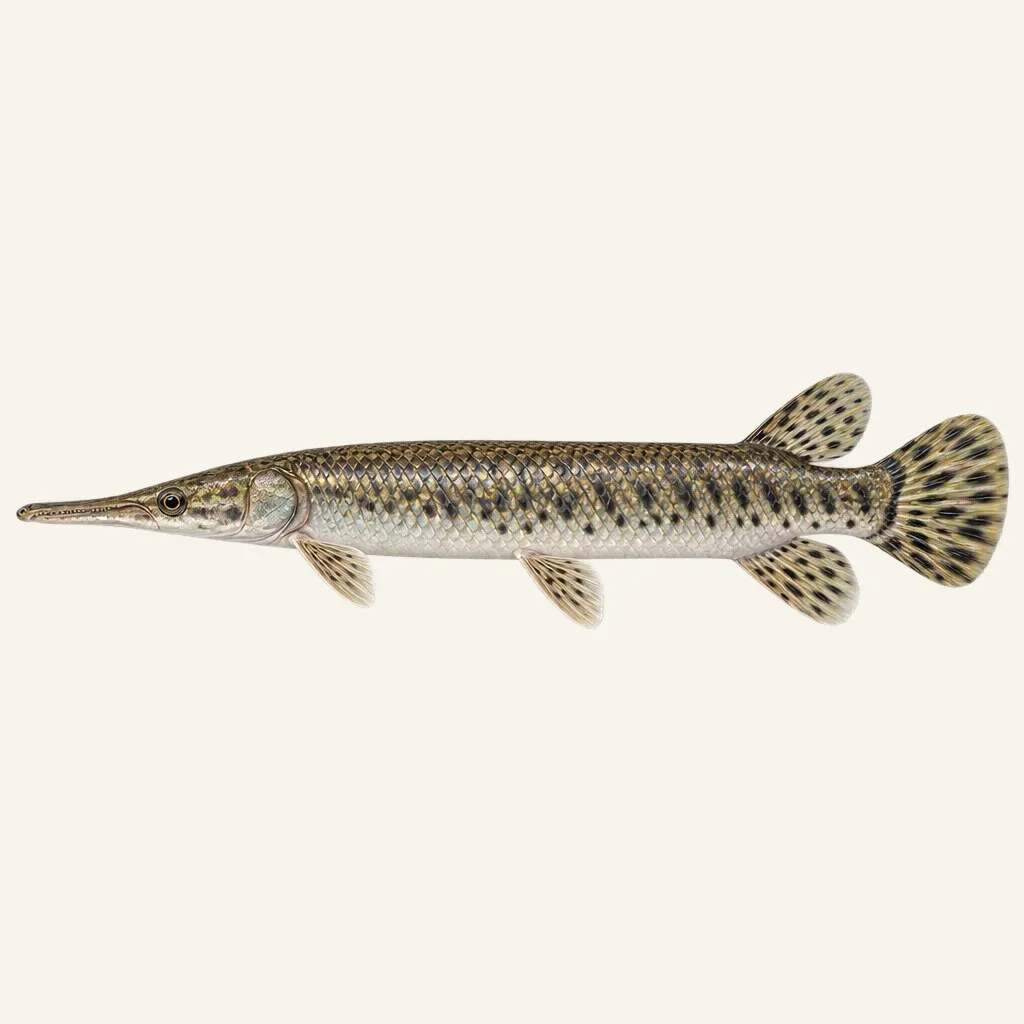
Primitive fish with an elongated body covered in hard, diamond-shaped ganoid scales, recognisable by its short, broad snout typical of gars. Inhabits slow-moving backwaters and marshy areas of major North American river systems.
Calendar
Recorded in 1 country
GBIF occurrence records — native and introduced populations combined.
Its range
The range is the Mississippi basin and very little else: from south-central Ohio, northern Indiana and Wisconsin west to Montana, south to northern Alabama and Louisiana. Add the Lake Michigan drainage in Wisconsin, and the Calcasieu and Mermentau rivers on the Louisiana Gulf coast.
Two things follow from that. The distribution is strictly continental — unlike its congeners this gar is not recorded from brackish water at all, and the coastal entries are river systems rather than estuaries. And the thermal band assigned to it, 10 to 18 degrees, is the coolest in the genus, which is consistent with a fish whose centre of gravity sits well up the basin rather than on the Gulf.
Breeding
Eggs are laid over vegetation or over other submerged objects, and they stick to whatever they land on. That choice of support decides where the fish is at the season: it needs drowned cover, and the overflow areas of large streams supply it in spring, while the water is on them.
Every gar carries the same warning, and it belongs here rather than at the end of the page. The eggs of this genus are toxic to people. The flesh is food and is sold as such; the roe is not, at any stage of preparation, and a ripe female is worth recognising before it is cleaned.
The water it needs
Quiet pools and backwaters of creeks and of rivers small to large, swamps, lakes, and the overflow areas of large streams. Within them, the fish is generally close to vegetation and to sunken timber.
The overflow areas are what set this species apart from the rest of the genus. This is a floodplain animal: it depends on the river still reaching its margins, and on the drowned grass and brush of those margins being there when the eggs need something to stick to.
Air-breathing is facultative, as in the other gars, and it is what makes those shallow, warm, poorly flushed margins usable in the first place. A backwater that runs out of oxygen in July does not exclude a fish that can take a breath from above it.
Areas
- Floodplains
- Large turbid rivers
- Secondary channels
- Moderate current areas
Techniques
- Live bait mid-water
- Surface lures
- Float fishing with live bait
- Deadbait retrieve
Baits
- Small live fish
- Earthworms
- Small soft plastic lures
- Shrimp
What it eats
The diet is other fish and insects.
That second item is the notable one. Its larger relatives are described as taking fish and crustaceans; this gar takes insects as a matter of course, which is consistent with the smallest mouth and the smallest body in the genus — common length is around 62 cm. It is a predator working at a scale where an aquatic insect is still worth the strike.
How to catch it
Sunken wood and the vegetated edges of backwaters are the places, and in spring the flooded margins are better than either.
Being the smallest gar allows lighter gear than its congeners require, without touching the central difficulty: a bony beak set with fine teeth gives a hook point almost nowhere to go, and losing fish at the strike is the normal outcome rather than a bad day. Nothing about a lighter rod improves that geometry.
Two cautions attach to a landed fish. The ganoid scales are hard-edged and cut skin, so a hand laid flat along the flank is a poor idea; and the roe, as above, is not food. Twenty years is the maximum reported age, which is a great deal for a fish that stays under a metre, and it is worth weighing before one is killed.
Conservation
The dependence on overflow areas is the weak point, and it is specific enough to be actionable. A gar that spawns on floodplain vegetation needs the river to still flood, at the right date, and needs its side waters to remain reachable when it does.
Levees and flow regulation on the Mississippi have removed a large share of that surface. The adults are unaffected in the short term: they persist in the channel, they are caught there, and they give the impression for years that the population is intact while the cohorts behind them are thinning. Twenty-year longevity is exactly what makes the diagnosis late.
Regulations
Check the local regulations in force (legal size limits, closed seasons, bag limits).
For guidance only. Legal sizes, quotas and open seasons vary by location and season: always check the local regulations in force before fishing.
Other names
Shortnose gar in English, and the name only means anything against its neighbour: this fish shares its rivers with the longnose gar, and the two are separated at a glance on that one proportion. Where both are present, snout length is the first and usually the last question.
The epithet is built from the Greek for flat and for mouth, describing the broad, blunt beak — the same character the English name uses, arrived at independently. Older American angling literature is careless with all of these names, and unqualified references to a gar in a Mississippi context cannot be assigned to a species without a snout measurement.
Sources: fishbase.se · api.gbif.org · fishbase.se