Spotted bass
Micropterus punctulatus · Centrarchidae
- Freshwater
- Predators
- Medium
- Size
30–64 cm
- Weight
0.4–4.7 kg
- Lifespan
7 years
Where to fish
- Lake
- River
Habitat icons: Flaticon
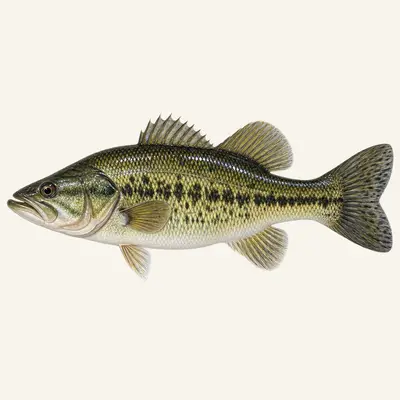
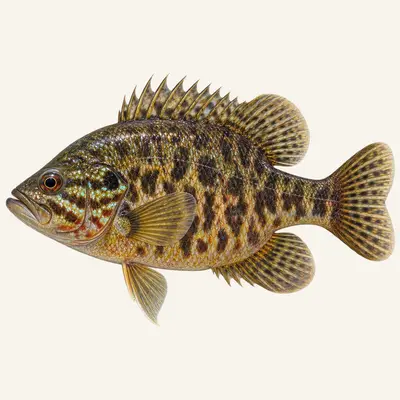
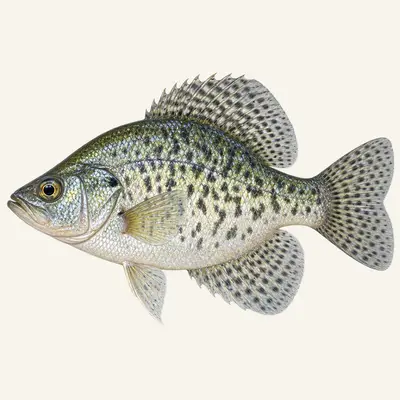
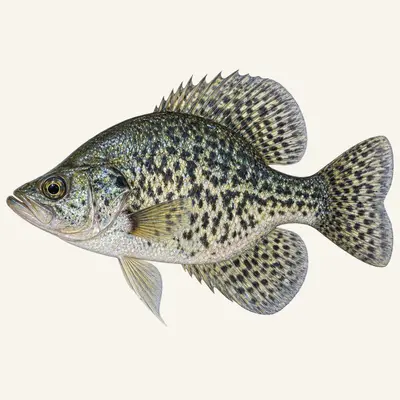
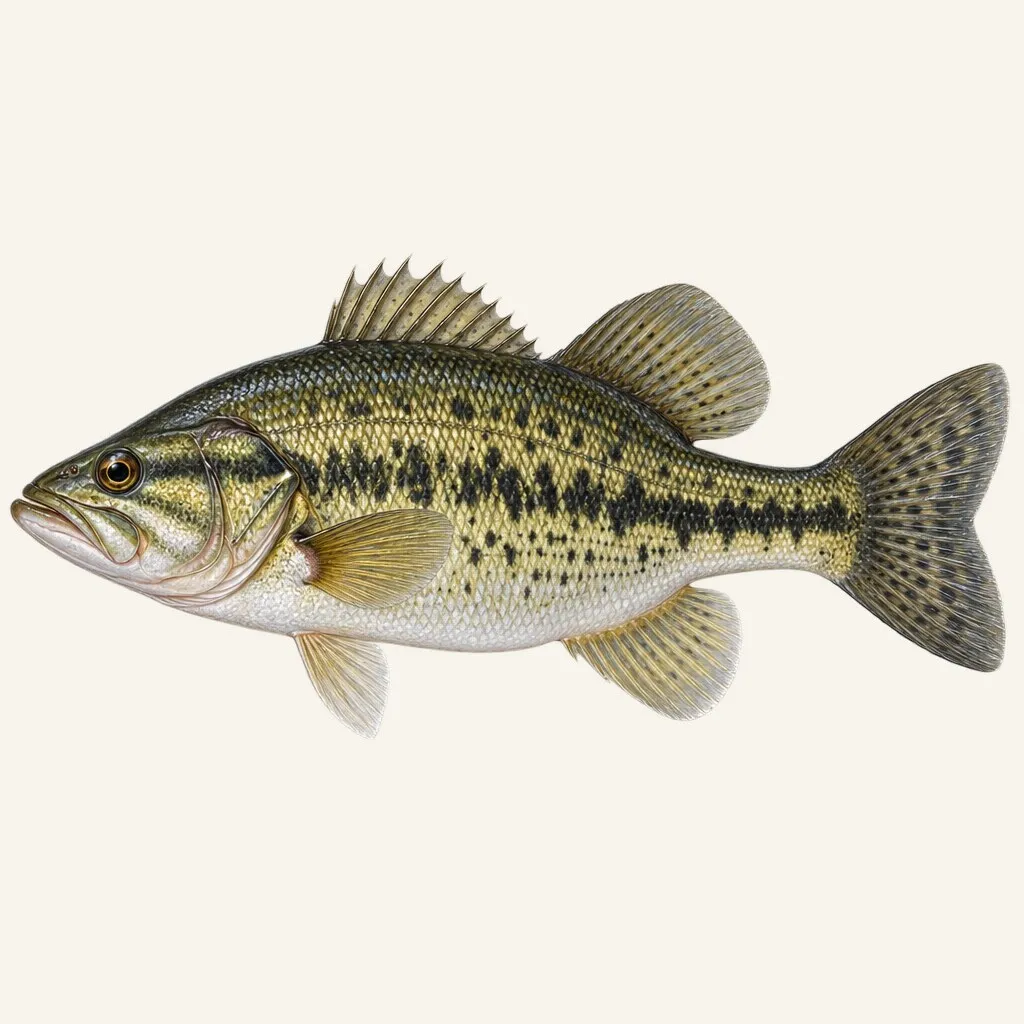
The spotted bass is a streamlined centrarchid with an olive-green back and pale flanks covered with rows of small dark spots, its mouth corner stopping under the middle of the eye, distinguishing it from the largemouth bass.
Calendar
Recorded in 2 countries
South Africa · United States
GBIF occurrence records — native and introduced populations combined.
Its range
Native water covers the Mississippi drainage from southern Ohio and West Virginia west to southeastern Kansas and down to the Gulf of Mexico, plus the Gulf Slope rivers from the Chattahoochee in Georgia across to the Guadalupe in Texas. That is a wide sweep of the American South, and it overlaps almost entirely with the ranges of the two better-known members of the genus.
Abroad, the record is thin and worth reading precisely. The species is established in southern Africa, but in several isolated bodies of water rather than across a connected system. Those are separate arrivals that took hold locally, not a spreading front, and the contrast with the two black bass that were exported by the million is the whole point.
Breeding
The literature does not describe the spawning of this species directly. It assumes the pattern of the smallmouth: a nest built and then guarded by the male in shallow water over sand, gravel or rock.
That assumption is worth flagging before reading any confident account of the subject. What is on record is an inference from a relative, not an observation of this fish, and the two are not the same claim.
The water it needs
Clear gravelly runs and flowing pools in creeks and in rivers of small to medium size. Also streams, lakes and reservoirs.
The list is short and it contains a contradiction that turns out to be the species' defining trait. Moving gravel and standing impoundment are the two ends of the genus, one belonging to the smallmouth and the other to the largemouth, and this fish occupies both. In practice that places it on the ground the other two leave half-empty: the middle reaches, the tailwaters, the transitional stretch below a gravel run and above a reservoir flat.
Areas
- Rocky rapids and riffles
- Stony reservoir banks
- Swift river channels
- Deep hard-bottom points
Techniques
- Soft plastics (dropshot, finesse)
- Texas rig jig
- Deep-diving crankbait
- Topwater surface lures
Baits
- Soft lures (shads, creature baits)
- Live crayfish
- Live baitfish
- Worms
What it eats
Juveniles feed on small crustaceans and midge larvae. Adults take insects, larger crustaceans, frogs, worms, grubs and small fish.
That adult list is the longest in the genus, and more to the point it has no head. The smallmouth is organised around crayfish and the largemouth around fish; this one has no dominant prey at all, which is exactly what a fish occupying intermediate habitat would be expected to look like from the inside.
How to catch it
The absence of a specialist diet is the practical information. A predator with no dominant prey has no lure that the biology hands you, and the range of presentations it will take is correspondingly wide — which sounds like freedom and is really an absence of guidance.
So the search runs on habitat rather than on forage. Gravel-floored pools with a current through them, in creeks and mid-sized rivers, are the core ground: downstream of where a smallmouth would hold in the run, upstream of where a largemouth would sit in the weed.
One number separates this fish sharply from its relatives. Maximum reported age is seven years, against 26 for the smallmouth, on two fish that grow to a comparable size. Common length is 30 cm. A population turning over that fast is built on very few year classes, grows quickly to get there, and rebuilds after a bad season faster than a long-lived species can.
Regulations
Check the local regulations in force (legal size limits, closed seasons, bag limits).
For guidance only. Legal sizes, quotas and open seasons vary by location and season: always check the local regulations in force before fishing.
Other names
Spotted bass is the standard name, with Kentucky bass in general use and spot or spotty in casual speech. In parts of the range Alabama bass is heard as well, a name that now belongs to a separate species split out of this one, which is reason enough to be careful with it.
The name comes from the flank. Below the lateral band sit rows of dark spots aligned along the scale rows, and at a distance they read as horizontal streaks rather than as spots — the mark that separates this fish from the unbroken band of the largemouth.
There is a second field check that costs nothing. This species carries a rough patch of teeth on the tongue and the largemouth does not, so a fingertip run across the tongue answers the question in the dark, in a boat, without measuring a jaw against an eye.
Sources: fishbase.se · api.gbif.org