Smallmouth bass
Micropterus dolomieu · Centrarchidae
- Freshwater
- Predators
- Hard
- Size
25–69 cm
- Weight
0.2–5.4 kg
- Lifespan
26 years
- Water temp.
9–30 °C
- Depth
1–7 m
Where to fish
- Lake
- River
Habitat icons: Flaticon
More combative than the largemouth - Prefers cooler, flowing waters
Calendar
Recorded in 6 countries
Canada · France · Japan · Mexico · South Africa · United States
GBIF occurrence records — native and introduced populations combined.
Its range
Native water is the St Lawrence and Great Lakes system, the Hudson Bay drainage by way of the Red River, and the Mississippi basin — southern Quebec across to North Dakota, then south to northern Alabama and eastern Oklahoma.
The southern edge is the informative one. The species sits between 33 and 50 degrees north and works a thermal band of 9 to 30 degrees, several degrees cooler at both ends than the one its larger-mouthed relative occupies. That single difference explains how the genus splits the continent: this is the northern black bass, comfortable in water that leaves the other one sluggish, and it thins out towards the Gulf where the other one is at its best.
Stocking carried it far past those limits. It has gone into many countries as a sport fish, and several of them have since recorded damage to their native fauna.
Identifying it
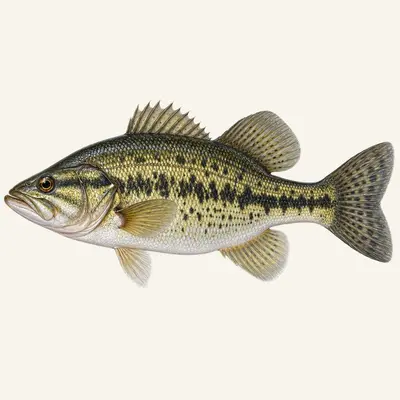
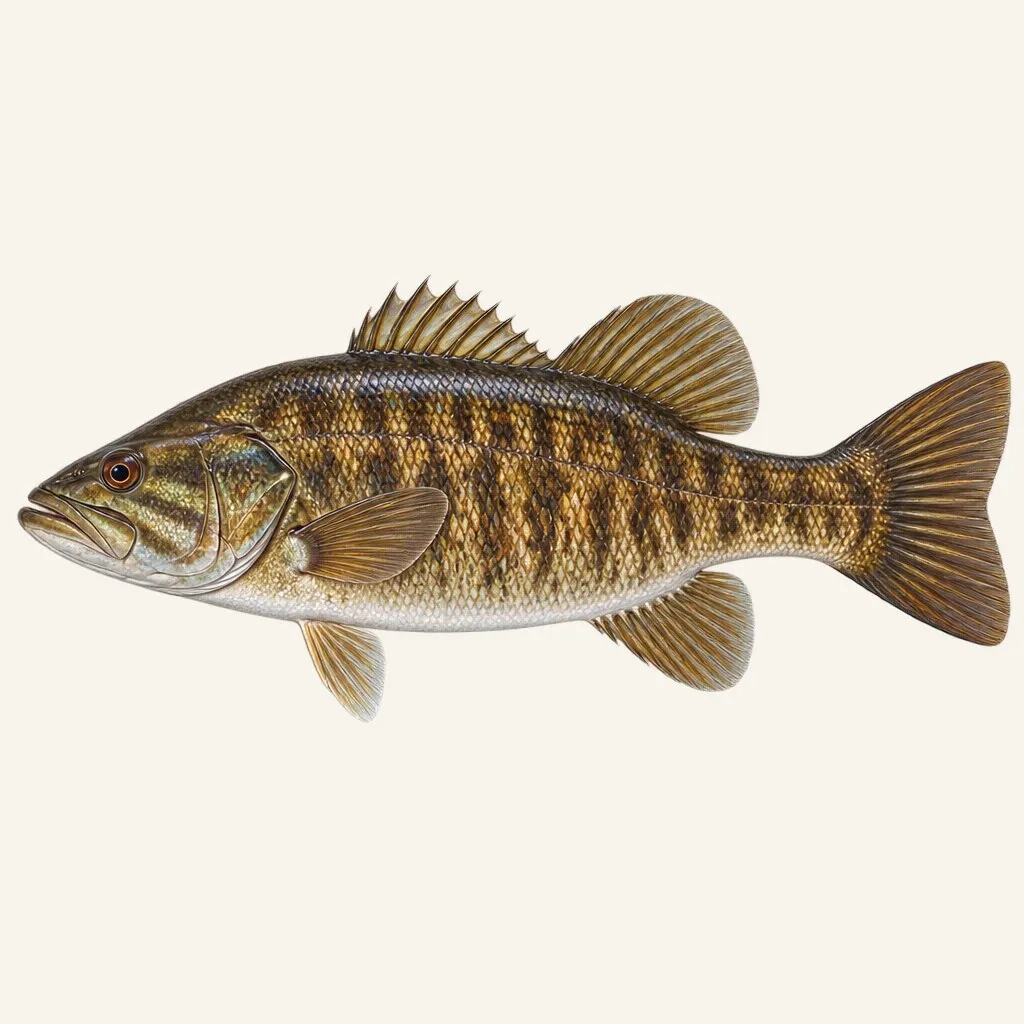
The markings run the wrong way for a black bass. Instead of one dark band drawn from the eye to the tail, this fish wears a row of dusky vertical bars over a ground that runs from olive to hammered bronze, and it is the bronze that most anglers register before anything else. Hence bronzeback, the nickname it carries almost everywhere it is fished.
The jaw settles a doubtful fish in one look. With the mouth shut, the rear of the upper jaw stops in front of the eye instead of ending behind it.
For anyone working from a key: nine to 11 dorsal spines, 13 to 15 soft rays behind them, 10 or 11 elements in the anal fin, 31 or 32 vertebrae. The body is fusiform and distinctly rounder in cross-section than a largemouth of the same length. That last point belongs less to identification than to what happens once the hook goes in.
Breeding
The male returns to the same ground year after year. He builds within roughly 140 m of the site he used in previous seasons, which makes the spawning areas of a given stretch stable between springs: a nest found one year is a reasonable prediction of where to look the next.
The nest is a cleared hollow on sand, gravel or stone, in the shallows of a lake or a river, usually under about a metre of water.
What happens on it is documented almost second by second. The pair circles, rubbing against each other and nipping, then settles onto the bottom. The release itself lasts five seconds. The two then swim a ring around the nest for 25 to 45 seconds before dropping back to repeat it, and the cycle runs on for some two hours.
At the end of it the female leaves and may spawn again on a different male's nest elsewhere in the water. The male stays, first over the eggs and then over the fry. Maturity comes at around 27 cm, sometimes at 22.
The water it needs
Stone, gravel and moving water. In lakes it holds over shallow rocky ground; in rivers it takes clear gravel-bottomed runs and the flowing pools between them. Recorded working depth is 1 to 7 m.
This is the cleanest division in the genus, and it is useful because it is so mechanical. Weed, silt and still water belong to the largemouth. Rock and current belong to this fish. A river holding both keeps them in different places rather than in the same places at different hours, so reading the bottom comes before choosing a lure.
Areas
- Rocky areas
- currents
- gravel
Techniques
- Lures
- Crayfish
Baits
- Jig
- Crank
- Tubes
- Drop shot
What it eats
Crayfish head the adult diet, ahead of fish and of insects taken in the water and off the surface alike. Juveniles begin on plankton and immature aquatic insects and move up as their mouths allow. Cannibalism occurs. Turtles and larger fish take this species in their turn.
The crayfish deserves more weight than a diet list usually gets. It is the dominant animal of the hard bottoms this bass lives on, and it crawls rather than swims.
How to catch it
Everything follows from crayfish on stone. A predator making its living on crustaceans over rock answers to something worked in contact with the bottom, dragged and paused rather than swum through open water; a lure that never touches down is fishing the wrong layer of the river.
Current supplies the other half of the plan. This fish uses the flow rather than avoiding it, so the lies that pay are the pockets behind boulders, the seams along the edge of a run and the heads of pools — not the sheltered margins.
The fight has a physical explanation rather than a mythological one. A rounder, more heavily muscled body than its relative, in water that is already moving, gives the animal something to push against, and much of a hooked fish's effort goes into using the current instead of resisting it.
One figure sets expectations: maximum reported age is 26 years. Growth is slow at the cold end of the range, so a genuinely large fish out of a northern river has been in it a long time.
In spring the site fidelity cuts both ways. Nests reappearing within 140 m of last year's are easy to find again, and a male lifted off one leaves eggs and fry with nothing above them.
Conservation
The pressure here runs mostly outward. Several countries report adverse ecological effects following introduction, and the species is listed as a potential pest — an odd label for a fish that is simultaneously a prized game species and rated an excellent one to eat.
The mechanism is particular to this bass rather than general to the genus. Cold tolerance opens rivers a largemouth could never hold, which in practice means rivers holding salmonids, and it enters them as an efficient predator working exactly the sizes that young trout and salmon occupy. A transfer that would fail in a warm reservoir succeeds in cold running water.
Inside the native range the weak point is the nest. Shallow water, a fixed location and a single guardian make a reproduction that a change of level, or repeated disturbance during the guarding period, can undo outright. The loss surfaces years later, as a year class that is not there.
Regulations
Check the local regulations in force (legal size limits, closed seasons, bag limits).
For guidance only. Legal sizes, quotas and open seasons vary by location and season: always check the local regulations in force before fishing.
Other names
Smallmouth bass is the standard name, shortened to smallie across most of North America and to bronzeback wherever colour is the point. Brown bass and brownie turn up regionally. Quebec French has achigan à petite bouche.
The name only functions where both species swim. Smallmouth means smaller than something, and in waters stocked with this fish alone it usually ends up called black bass, which is the group name and settles nothing.
The species epithet honours Déodat de Dolomieu, the French geologist the Dolomites are named for, who had no connection with the animal. It is a reminder that a scientific name is a label and not a description.
Sources: fishbase.se · api.gbif.org