Tench
Tinca tinca · Cyprinidae
- Freshwater
- Carp & coarse
- Medium
- Size
30–60 cm
- Weight
0.3–7.5 kg
- Water temp.
4–24 °C
Where to fish
- Pond
- Lake
- Canal
Habitat icons: Flaticon
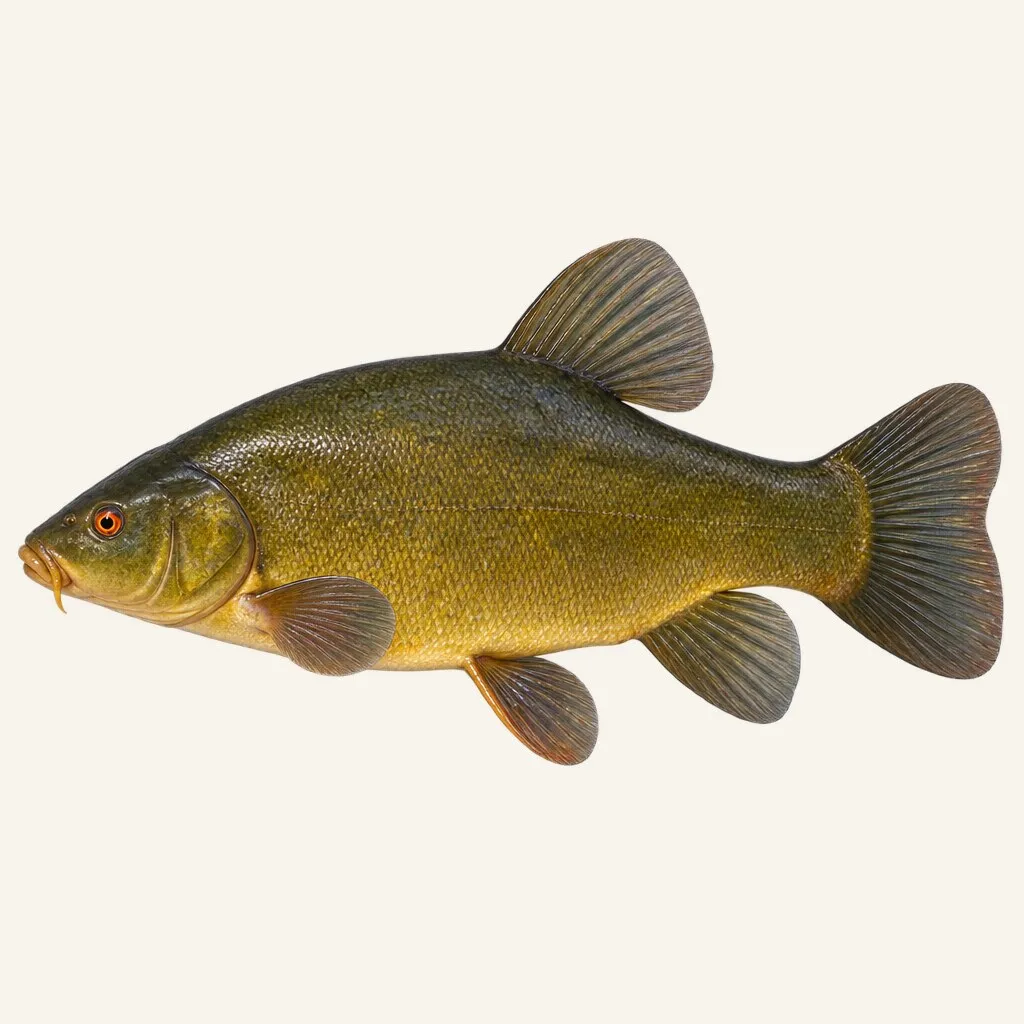
Stocky green-brown body with thick protective mucus - very hardy out of water
Calendar
Spawning: fish are vulnerable. Check local rules — closed seasons vary by country.
Recorded in 33 countries
Australia · Austria · Belarus · Belgium · Bosnia & Herzegovina · Canada · China · Croatia · Czechia · Denmark · Finland · France · Germany · Greece · Ireland · Italy · Lithuania · Luxembourg · Netherlands · New Zealand · Norway · Poland · Romania · Russia · Serbia · Slovenia · Spain · Sweden · Switzerland · Türkiye · Ukraine · United Kingdom · United States
GBIF occurrence records — native and introduced populations combined.
Its range
FishBase hedges the native range of this species, and it is right to. Tench are taken to be native across most of Europe and east through western Asia to the Yenisei drainage below 60°N, with genuine gaps in Ireland, in Scandinavia above 61°30'N, in the eastern Adriatic basin and in western and southern Greece. All four of those gaps now hold tench, put there by people.
The northern edge is a spawning limit, not a survival limit. The species lives down to 4 degrees without difficulty; what it cannot do is breed below 19. Draw a line where summers stop reaching that figure for long enough and most of the northern boundary draws itself.
The rest of the boundary has been rubbed out by centuries of stew ponds. Tench were kept and carried alongside carp through the medieval period, and that traffic makes the difference between a native population and a very old introduction close to unrecoverable across much of the continent.
Identifying it
A tench announces itself by feel before colour gets a say. The skin is thick and loaded with mucus, the scales are minute and sunk deep into it, and a fish held in a dry hand is gone before the hook is out. No other European cyprinid has that surface.
The colour is olive green over the back and flanks, running to dark green or nearly black in peat-stained water, with gold low on the belly. The eye is small and orange-red, and it keeps that colour whatever the light does to the rest of the fish.
The build is short and heavy: a thickset body, compressed from the sides, ending in a caudal peduncle that is unusually deep and unusually short. The fins are rounded, the tail barely notched. That combination of a stout wrist and a blunt tail belongs to nothing else in fresh water here.
One barbel sits at each corner of the mouth, short and fleshy. A single pair, not two, and that count separates a tench from a carp before any other character is consulted. The mouth is small, terminal and thick-lipped, and the snout is long relative to the width between the eyes.
The scale counts run high because the scales are so small: 96 to 115 along the lateral line. The dorsal carries 8 to 9½ branched rays, the anal 6 to 9½, and there are 39 to 41 vertebrae.
Breeding
Nothing happens until the water reaches 19 or 20 degrees. That threshold is among the highest of any European freshwater fish, and it is what pushes the season back to somewhere between May and September depending on latitude. A cool summer shortens it. A cold one can close it.
The spawning itself is spread out rather than concentrated. A female lays sticky green eggs on plants or straight onto the bottom every one to five days, and keeps doing so for about two months. Split that way, a cold spell or a falling level takes a slice of the year's production instead of all of it.
What follows is quick. The eggs are under a millimetre across, hatching takes three days at 20 degrees, and the larvae emerge at four to five millimetres and stay attached to the plants they were laid on until the yolk sac is spent. They begin feeding inside the same weed, and they do not leave it.
Males are mature at two or three years, females at three to seven. The males in a spawning group are routinely younger and smaller than the female they are following, and a water can hold a good many ripe males for every ripe female.
The water it needs
Warm, still, shallow and choked with weed, over mud. The description is unusually narrow for a fish this widespread: ponds, backwaters, silted canals, shallow lake margins, the sluggish ends of drains.
Tolerance of low oxygen is what makes it work. In late summer a shallow weedy pond running at 24 degrees strips itself of oxygen overnight and either kills or drives out most of what lives in it; the tench stays and feeds. It occupies the water other species vacate, which is why so many tench fisheries are places with a short species list.
Winter takes it out of circulation entirely. Tench bury themselves in the mud and sit out the cold, which means months in which the fish is not merely hard to catch but effectively absent from the water column.
The young never leave dense vegetation and the adults barely do. This is not a fish that ranges. A tench swim is a place, and it stays a place. The species also handles brackish water, though that has little bearing outside the Baltic margins.
Areas
- Muddy bottoms
- dense weed beds
- ponds
- backwaters
Techniques
- Feeder
- Float
- Bottom rigs
Baits
- Worms
- Maggots
- Bread
- Corn
What it eats
Tench work the bottom and the mud in it. Detritus, benthic animals and plant material make up the general diet, and adults concentrate heavily on molluscs — snails and small bivalves pulled out of the silt.
That is a diet with no dependence on open water at all. A predator needs prey fish and a plankton feeder needs a bloom; a tench needs sediment with things living in it, which every silted pond has. It accounts for both the tolerance of poor water and the complete indifference to whatever is happening a metre above the bed.
How to catch it
The fish is in the weed and the silt, usually within a rod length or two of the bank, and the whole difficulty lies in accepting that. Distance is worth nothing here. Gaps between lily pads, the inside edge of a reed bed, the soft trough where a marginal shelf drops away: those are the swims.
Feeding tench give themselves away better than almost anything else that swims. A patch of pinhead bubbles rising in a tight cluster over soft bottom means a fish is rooting through it, and the sign is specific enough to fish to. Silt lifting off a clean margin says the same thing.
The bite does not oblige. A tench mouths and sifts, and the float answers by trembling, dipping a few millimetres, lifting, settling, going again. Striking at the first of those movements is the standard way to lose a morning.
The season is short at both ends. A species that will not spawn below 19 degrees and spends the winter under the mud is realistically catchable from late spring to early autumn, and inside that window the hour either side of first light is worth more than the rest of the day put together.
Handling costs the fish something. The mucus coat is not decoration, and a tench wiped down on dry grass or a dry towel goes back damaged. Wet hands and a wet mat are the price of returning one in the condition it arrived.
Conservation
River engineering is what presses on this species, and the mechanism is exact. Tench need shallow, weedy, warm, still water connected to the main river: backwaters, flooded margins, old channels, the wet ground behind a bank. Dredging, straightening and level control take those away first, long before anything visible happens to the main channel. A regulated river loses its tench ahead of its other cyprinids, because it loses the only water they can breed in.
The same drainage works on still waters. A pond that silts and is dug out, a lake margin cleared of weed for access, a drain held at a constant level: each removes the vegetation the eggs are laid on and the larvae spend their first days attached to. Nothing about the adults changes, which is what makes the loss hard to notice.
Two further pressures compound it. The flesh is well regarded and the species is fished commercially as well as for sport, which adds a take on top of populations already fragmented. And tench are cultured widely — for the table, as an ornamental fish, and as forage stocked for bass — so the fish in a given water may have arrived there in a tank on a lorry rather than by any route of its own.
Regulations
Check the local regulations in force (legal size limits, closed seasons, bag limits).
For guidance only. Legal sizes, quotas and open seasons vary by location and season: always check the local regulations in force before fishing.
Other names
Tench is the whole of the English name, which is unusual among coarse fish: no second species to confuse it with, no regional alternative in general use. What English does carry is the old reputation. Tench were the physician of fishes in the early angling literature, their slime credited with healing other fish that rubbed against them, and "doctor fish" survives from that — though the nickname now more often means Garra rufa, which is no relation whatever.
The scientific name asks nothing of anyone. Tinca is simply the Latin for the fish, taken over unchanged. The golden tench sold for garden ponds is the same species in a selected colour form, and escapees turn up in open water looking like nothing that belongs there.
Sources: fishbase.se · api.gbif.org