Southern African pike
Hepsetus cuvieri · Hepsetidae
- Freshwater
- Predators
- Medium
- Size
37 cm
- Lifespan
5 years
Where to fish
- Estuary
- River
Habitat icons: Flaticon
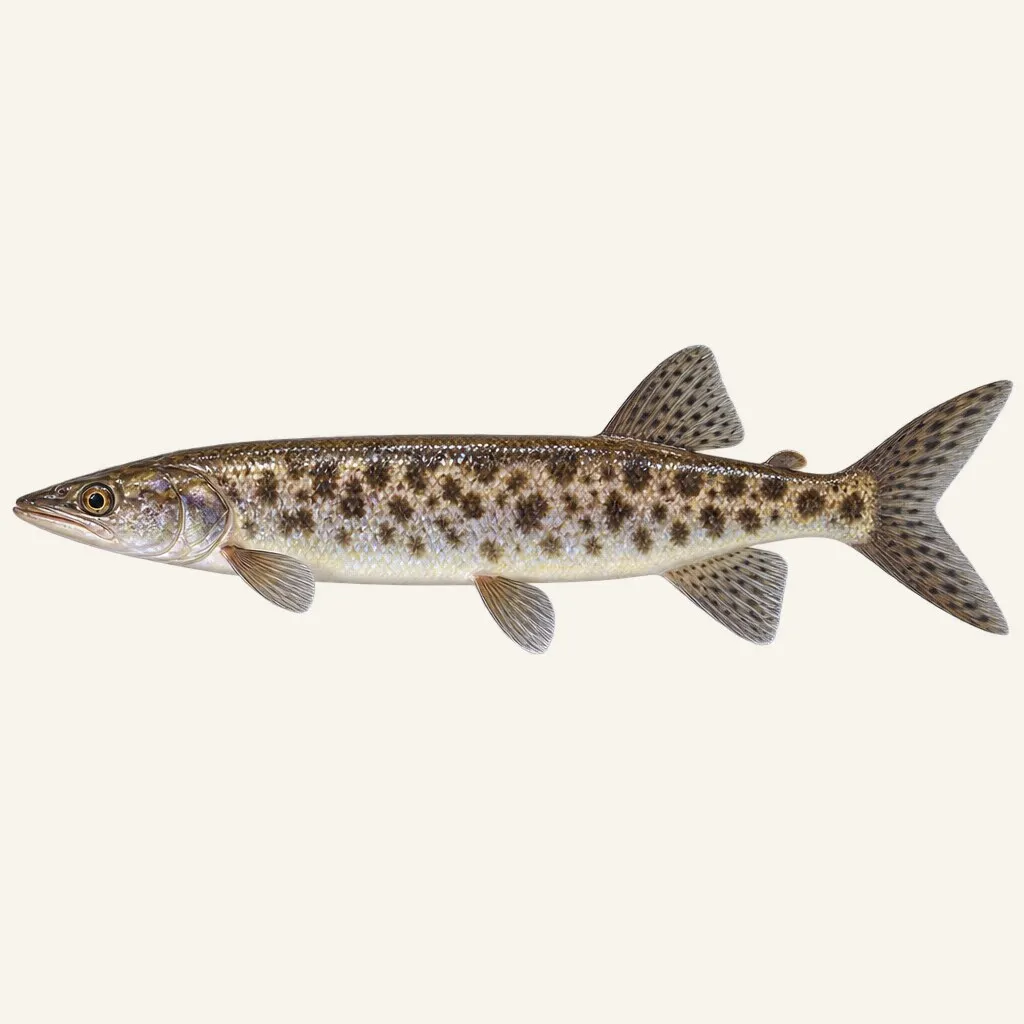
The West African pike is a slender predator of West African freshwaters, with a streamlined body, an elongated jaw lined with sharp teeth, and a silvery body with greenish reflections characteristic of the Hepsetidae family.
Calendar
Recorded in 3 countries
Angola · Botswana · Zambia
GBIF occurrence records — native and introduced populations combined.
Identifying it
Count the gill rakers on the first arch: eight to 13. That is the character the 2011 revalidation rested on, and it is the one that separates this fish from the West African species, which carries considerably more.
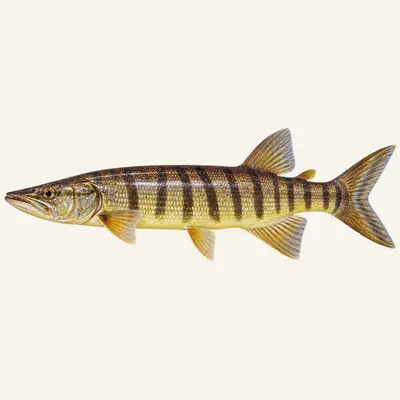
The flank does the same job without a needle. Its dark brown blotches run together into a clouded, marbled pattern; on the West African fish the same pigment organises itself into vertical stripes and bars. Mottled against barred, decided with the fish in hand.
The scale rows confirm. Ten and a half to 11.5 between the dorsal fin and the lateral line, and 6.5 to 7.5 between the adipose fin and the lateral line, both higher than in the other species. Nine soft rays in the dorsal, 12 in the anal, no spines, an elongate body.
One caution belongs with any of these counts. The ranges published for the comparison species do not match between papers — the diagnosis here cites 14 to 21 rakers for it, while that species' own redescription gives 17 to 23. The genus is still being sorted out, and a key written inside it has a short shelf life.
Breeding
The species spawns several times over a season, through the summer months, laying into a floating bubble nest. Spreading the effort rather than releasing it in one event spreads the risk: a flood, a drawdown or a destroyed nest then costs a fraction of the year instead of the whole of it.
That spreading compensates for a very short life. Four to five years at the outside, with maturity around 25 cm, which leaves an adult three or four summers of breeding after a growth phase that took most of what it had.
The margin is thin for a predator. There are no reserve age classes to fall back on: one failed season removes a large share of the renewal, and nothing else in the population makes it up.
The water it needs
Quiet, deep water: the channels and lagoons of large floodplains, not the fast lines of a river. That is unexpected for a fish shaped like this one, and it is the single most useful thing to know before choosing a beat.
Fry and juveniles keep to the well-vegetated margins instead. The separation between the two is also a separation of risk — the adults hold the open water where they hunt, the small fish hold the weed where they would otherwise be eaten.
Living in a floodplain lagoon means living on a calendar. Those waters exist because the river spills into them; they fill on the flood, close off afterwards and sometimes shrink away in the dry season. The fish is held to the same annual breathing as the water body it occupies.
Areas
- Vegetated river margins
- Floodplains
- Lagoons and backwaters
- Stagnant weedy zones
Techniques
- Live-bait fishing along margins
- Topwater surface lures
- Slow dead-bait fishing
- Light spinner along edges
Baits
- Small live fish
- Frogs
- Surface lures
- Earthworms
What it eats
Adults eat fish. Juveniles take small invertebrates and fish together, which means the dietary switch begins very early and never entirely replaces what came before.
A predatory mouth that still accepts invertebrates is a versatile one, and versatility suits the habitat. In a lagoon that is closing off, the available food changes character from one month to the next, and a strict hunter would not last there.
How to catch it
The lies are channels and lagoons, in the calm deep part, and not the current. This is flat-water prospecting, the opposite of what the animal's silhouette suggests.
The marginal weed sorts the sizes on its own. Working it produces young fish; moving off it into open water produces adults. The choice of lie settles the size class before the choice of lure comes into it at all.
Local catches are also made with drawnets, and that says something about the ground. A water body is only swept that way if it is open, unobstructed and of workable depth. Where a drawnet operates, a line will operate too.
Conservation
The dependence is on the flood regime, and it is a dependence on timing rather than on volume. The lagoons and channels used for spawning have to be filled at the right moment, and a floating nest needs a level that neither rises nor falls sharply while the eggs are in it. A dam that smooths the hydrograph of a floodplain kills no adult fish at all; it removes the conditions for a spawning season.
Four or five years of life turns that into an immediate problem. A population with no old age classes rebuilds quickly after a bad year but holds nothing in reserve to absorb one, and two poor summers in succession leave very little behind.
The third difficulty is documentary. This name was treated as a synonym for about 150 years, so there is no record series to compare against: catches, surveys and observations from that period were filed under the West African species, and the baseline for these populations starts in 2011.
Regulations
Check the local regulations in force (legal size limits, closed seasons, bag limits).
For guidance only. Legal sizes, quotas and open seasons vary by location and season: always check the local regulations in force before fishing.
Other names
The epithet honours Cuvier, but the history of the name is more instructive than its dedication. Described in 1861, the taxon was quickly confused with the African pike, then buried as a synonym for a century and a half, and revalidated in 2011 on gill-raker counts and coloration. The name existed long before anyone used it.
European languages simply attach the geography: Southern African pike, Südafrikanischer Hecht, lucio de África austral. That is worth holding on to, because secondary accounts routinely place this fish in West Africa — the shadow of the years it spent filed under a genuinely West African species. The systems that carry it are the Quanza, the Cunene, the Okavango, the upper Zambezi, the Kafue and the southern fringe of the Congo basin, which is the other half of the continent.
Sources: fishbase.se · api.gbif.org