Spotted gar
Lepisosteus oculatus · Lepisosteidae
- Freshwater
- Predators
- Medium
- Size
100–150 cm
- Weight
8.1–4.4 kg
- Lifespan
18 years
- Water temp.
12–20 °C
Where to fish
- Lake
- River
Habitat icons: Flaticon
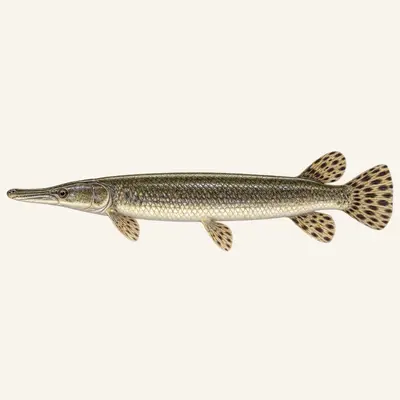
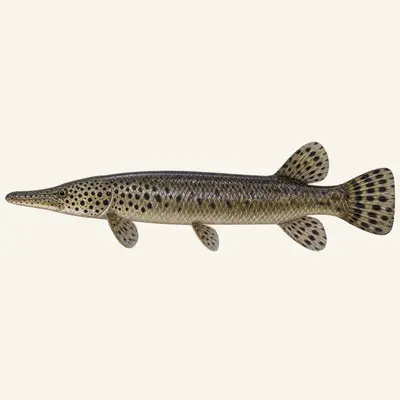
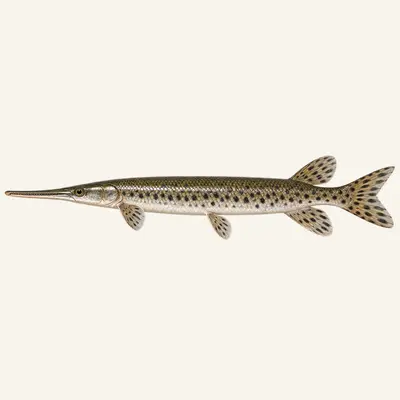
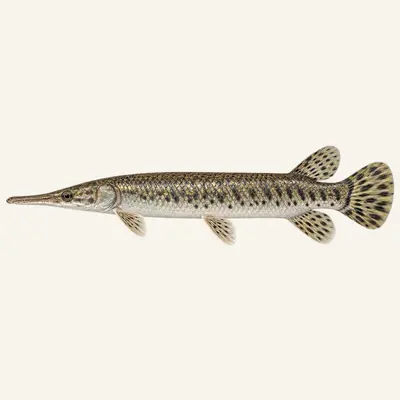
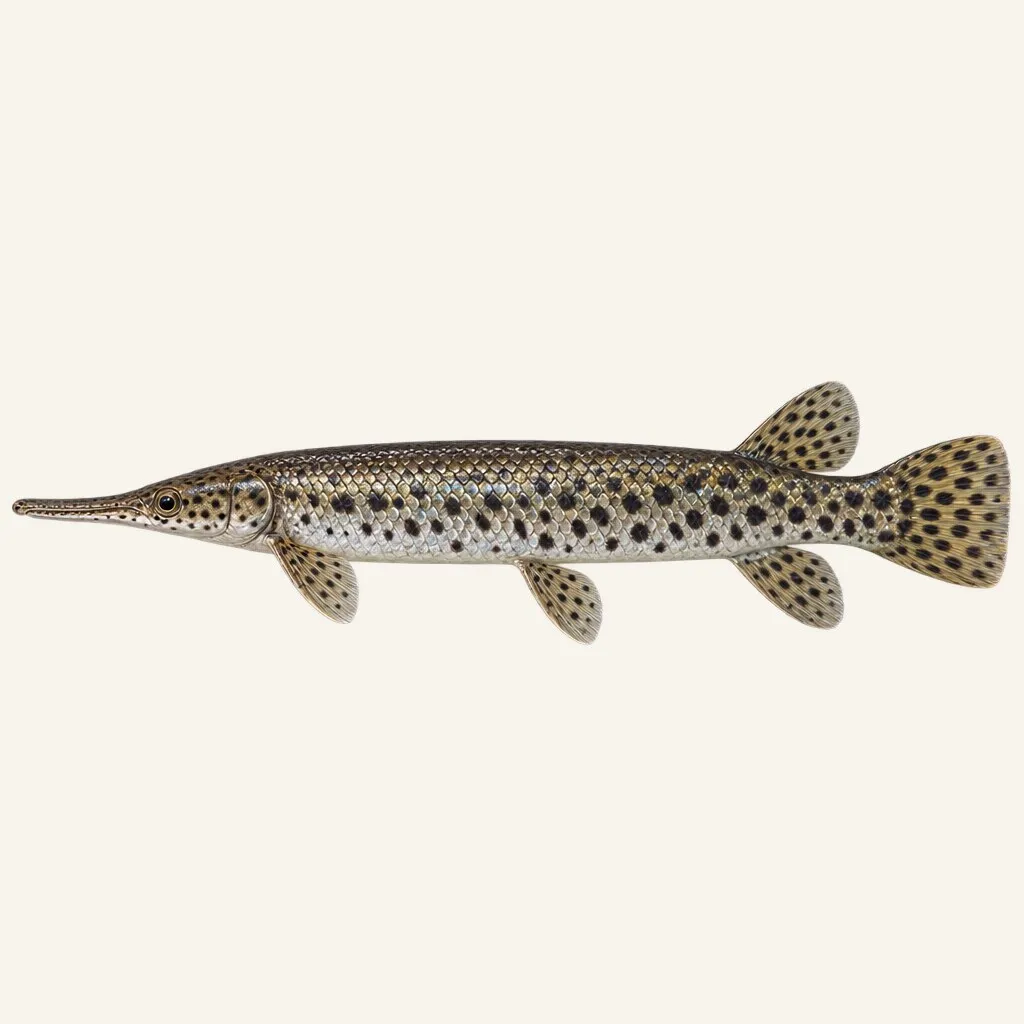
Gar recognizable by its numerous well-defined dark spots on the flanks and fins, with the elongated body and beak-like snout characteristic of gars.
Calendar
Recorded in 2 countries
GBIF occurrence records — native and introduced populations combined.
Its range
The range takes in the Lake Erie and southern Lake Michigan drainages, runs south through the Mississippi basin, and continues along the Gulf slope from the lower Apalachicola in Florida to the Nueces in Texas.
That is a markedly tighter allocation than the longnose gar holds, and it is weighted to the south-east. The northern edge is a pair of lake drainages rather than a broad front, which fits a fish with a working band of 12 to 20 degrees and no tolerance for the conditions further up the continent.
Identifying it
The spots are the identification, and the word to hold on to is profusion. Dark markings cover the body, the head and the fins together — not a scatter over the rear half and the median fins, which is what the longnose gar shows, but a dense stippling that runs forward onto the snout itself. Ground colour is dark overall, so the pattern reads as blotching on a dark fish rather than as decoration on a pale one.
The body is elongated on the plan common to the genus. The beak is short and broad, at the opposite end of the range from the longnose: laid side by side, the two species are separated in a second and by one measurement.
The water it needs
Quiet, clear pools and backwaters of lowland creeks, of rivers small to large, of oxbow lakes, swamps and sloughs; occasionally into brackish water.
One adjective in that list does all the work. Clear. Where the longnose gar accepts turbidity and thrives in coloured water, this species is described as occupying clear water, which confines it to the better-preserved parts of a range it otherwise shares. Two gars in the same oxbow are not using the same oxbow.
The vascularised swim bladder serves as an accessory lung when oxygen falls away, without the fish being obliged to use it — the standard arrangement in the genus, and here it buys access to warm, still, weed-choked water that has stayed transparent.
Areas
- Lake weed beds
- Vegetated river banks
- Shallow coves
- Clear calm waters
Techniques
- Surface lures
- Float fishing with live bait
- Fly fishing
- Minnow-type lures
Baits
- Small live fish
- Streamers
- Topwater lures
- Shrimp
What it eats
A voracious predator, taking fish of many kinds and crustaceans.
The short broad beak is a different instrument from the longnose gar's. It trades reach for closing force and for the strength of the jaw itself, which suits an ambush made in water where the fish can see its target and does not need to sweep blind. Clear water and a stout beak belong to the same strategy.
How to catch it
Clear, still water in backwaters, sloughs and abandoned channels is what identifies the species on the ground, and it sets this fishing against the longnose gar, which is looked for in the warmer and dirtier end of the same system.
Transparency has one direct consequence: the fish sees what is coming. Approach counts for as much as the rig, and sight fishing is genuinely possible here, which it rarely is elsewhere in the genus. Casting to a located fish beats covering water.
The dentition presents the same difficulty as in its relatives — fine teeth on a bony beak, a hook point with nowhere to seat, and a high proportion of fish lost at the strike. Ganoid scales cut a bare hand.
And the roe is toxic. The eggs of every gar are poisonous to people while the flesh is not, so a ripe female taken for the table must be handled with that in mind. It is the one fact about this genus that has consequences off the water.
First maturity is reported from 40 cm, which is earlier than in the longnose gar, against a maximum reported age of 18 years.
Conservation
The clear-water requirement is the vulnerability, and it fails quietly. A backwater that silts up or takes on a load of fine sediment stops suiting this gar well before it stops suiting its congeners, and nothing dramatic has to happen for that to occur — a change of land use upstream is enough.
The consequence is a range that thins from the inside. The species can remain present on a map, basin by basin, while the individual sloughs that actually hold it drop out one at a time. Maturity at 40 cm and a lifespan approaching two decades mean the adults outlast the conditions that produced them, so the record of occurrence lags the reality by years.
Regulations
Check the local regulations in force (legal size limits, closed seasons, bag limits).
For guidance only. Legal sizes, quotas and open seasons vary by location and season: always check the local regulations in force before fishing.
Other names
Spotted gar in English, after the character that identifies it. The epithet oculatus means eyed, in the same reference: the markings were read as eye-spots by the describer.
The North American gars are conveniently named — longnose, shortnose, spotted, Florida — each on a snout or a livery, and the names hold up in the field. The confusion worth flagging is the transatlantic one: in Britain garfish means a marine needlefish, an unrelated animal with a superficially similar beak. A British reader who meets an American gar for the first time is usually expecting the wrong fish.
Sources: fishbase.se · api.gbif.org · fishbase.se