Southern saratoga
Scleropages leichardti · Osteoglossidae
- Freshwater
- Predators
- Medium
- Size
55–100 cm
- Weight
1.0 kg
- Water temp.
24–40 °C
Where to fish
- Estuary
- Lake
- Pond
- River
Habitat icons: Flaticon
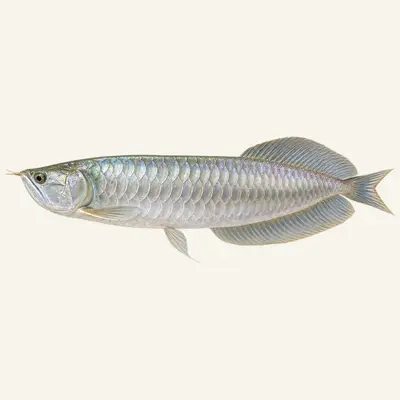
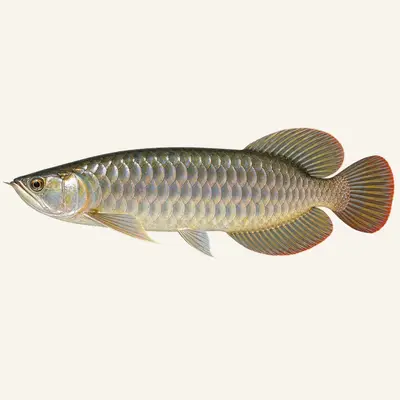
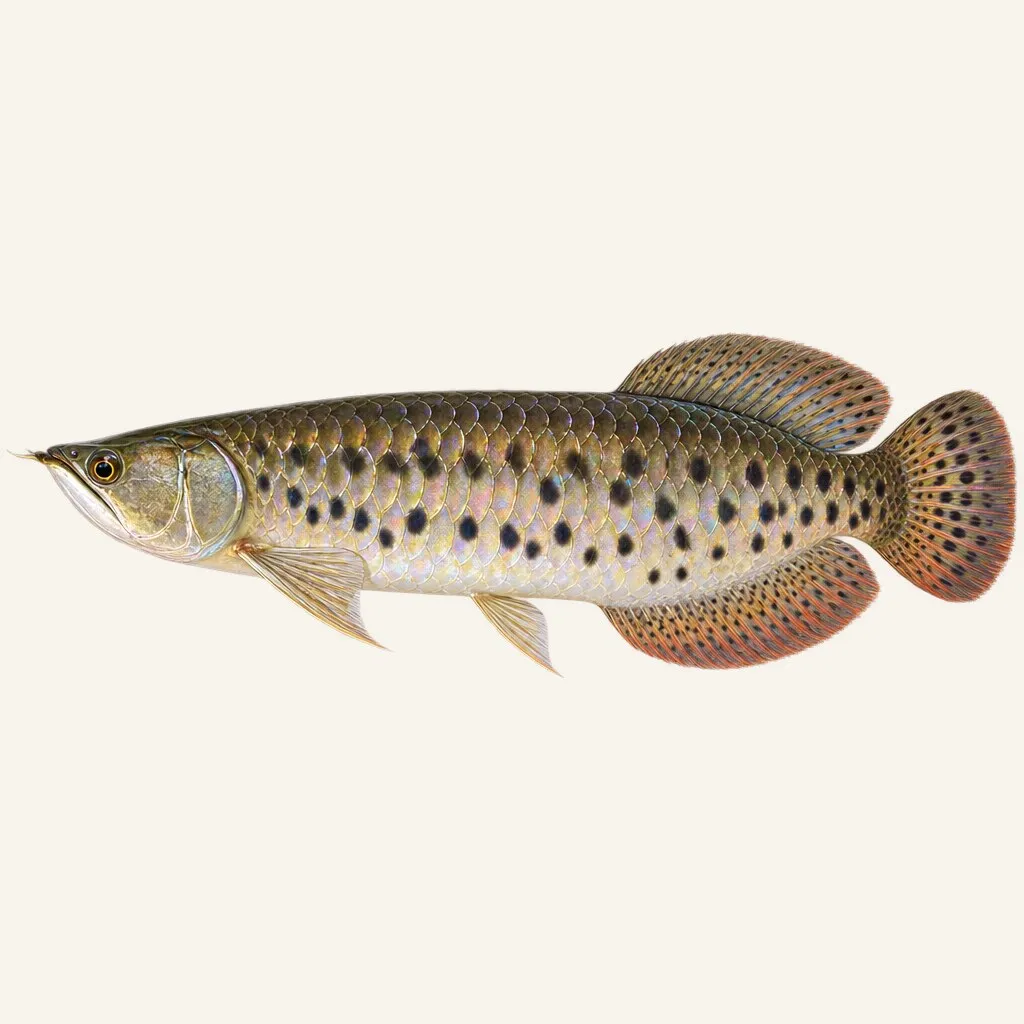
The spotted saratoga is an Australian osteoglossid with an elongated body covered in large silvery scales adorned with distinctive red or orange spots, and two short barbels under the lower jaw. An agile surface hunter, it inhabits rivers and lakes of Queensland.
Calendar
Recorded in 1 country
GBIF occurrence records — native and introduced populations combined.
Its range
The natural range is one river system: the Fitzroy, in central-eastern Queensland. Beyond it, the species occupies a few other systems in the south-east of the same state, and it occupies them because people put it there.
An endemic confined to a single catchment and translocated into neighbouring ones is in an odd position. The transfers reduce the chance of losing everything to one event on one river, and they simultaneously move fish between systems that had no exchange before. Both things are true of the same act.
Identifying it
The FishBase page for this species carries no morphology rubric at all, so the field marks on it come from the catalogue description printed above: large silvery scales spotted with red or orange, and two short barbels beneath the lower jaw.
There is a second mark, and it is temporary. A female holding unhatched eggs or larvae is told by a conspicuous white chin, which appears for the incubation and then goes. A character that reports a fish's reproductive state rather than its identity is rare, and this one can be read from the bank, since carrying females spend more of their time at the surface than other fish do.
Breeding
In daylight the female lets the whole brood out, and calls it back with one movement of her body.
The published account is worth following closely. Late in the incubation she begins circling and inspecting the shallow shore areas — prospecting the nursery before using it. Then she comes into the littoral shallows, releases the full brood, and swims slowly along parallel to the bank. The larvae hold station around her head, making brief excursions towards the water's edge, and she watches them the whole time. A sudden kinking movement of her body is followed by the rapid return of every one of them to her mouth.
Everything before that is a long approach. Pairing is direct, and for several days ahead of laying the pair stay in continuous close company, swimming near the surface. The courtship is listed: close following, intermittent angled swimming with the head down, and nudging and lifting of the female's vent by the male.
While she is carrying, her behaviour changes on every axis. She spends more time at the surface, shows no aggression towards other fish that are not carrying, and takes no interest in food — though two incubating females will occasionally spar briefly with each other.
The male's season is shaped differently. He can take part in at least two spawnings, and re-pairs with a new available female within weeks of the first. The investment is asymmetric in both directions: he supplies the courtship twice over, she supplies the mouth.
The water it needs
Still water and the slow-flowing sections of streams, with the fish usually near the surface or close to the shore among aquatic vegetation. That is a shoreline animal working a narrow band of the column.
It is territorial and aggressive towards other fishes, and particularly towards its own kind. The consequence appears on the fish themselves: adults taken from the wild frequently show scratches and wounds from fighting.
Breeding here happens ahead of the wet season at temperatures between 20 and 23 °C. The rubric of the northern species in the same genus gives close to 30 °C for the same event. The southern fish therefore breeds in the cooler water, which is what a range set that much further from the equator would lead you to expect.
Areas
- Eastern Australian billabongs
- Slow-moving rivers
- Shallow vegetated areas
- Calm lagoons and backwaters
Techniques
- Surface lures
- Streamer fly fishing
- Light poppers
- Live bait at surface
Baits
- Small live fish
- Frogs
- Surface insects
- Colored soft plastic lures
How to catch it
The aggression is the lever. A fish that attacks its own kind will attack whatever enters its space, and the marks it carries are the proof of the habit rather than an artefact of capture. A scarred fish in the net is telling you the stretch is held, and held at density.
Terrestrial insects in the diet justify something unusual for a fish of this length — a placed, static imitation, left where it fell. The common length here is 55 cm, and static surface work on an animal that size is not a technique most fisheries offer.
The pre-wet weeks need a separate calculation. A white-chinned female is the most conspicuous fish in the lagoon, at the surface and circling the shallows, and simultaneously the least likely to touch anything, because she is not feeding. The risk to her does not come from the bait.
The rubric calls the species a renowned angling fish, and that reputation is built on what the previous paragraphs describe: a surface feeder that holds a territory and defends it.
Conservation · Near Threatened (IUCN) — This species is in decline. Release your catch quickly and handle it with care — wet hands, as little time out of the water as possible.
Conservation
One river system is the whole of the natural range, and nothing else offsets that.
The reproduction concentrates the risk further. A brood carried in the mouth and recalled to it on a signal is not spread across a substrate where a proportion survives whatever happens to the parents — the female is the brood. Removing her in the season removes all of it, and the timing is unforgiving, since incubating females hold the shallow margins in daylight, which is the most accessible water in the system.
The introduced Queensland populations are not a replacement for the Fitzroy fish. They are copies with a shorter history, and an assessment that counts them together counts a founded population alongside the one it was founded from.
Regulations
Check the local regulations in force (legal size limits, closed seasons, bag limits).
For guidance only. Legal sizes, quotas and open seasons vary by location and season: always check the local regulations in force before fishing.
Other names
Southern saratoga is the catalogue's English entry. Spotted barramundi is the other Australian usage, and it misleads twice over: the true barramundi, Lates calcarifer, is an unrelated fish that shares the same northern rivers and is fished in the same water.
The identification problem has produced a legal curiosity. This species is protected in Indonesia, where it does not occur — most likely through a misidentification of Scleropages jardinii. A protection resting on a wrong determination does not protect the animal it names, and it does not protect the one it was aimed at either.
What separates the two is exactly what the catalogue descriptions separate them on: spots here, a half-crescent on every scale there.
The epithet commemorates the explorer Ludwig Leichhardt, though the spelling in the fish's name is not quite his.
Sources: fishbase.se · api.gbif.org