African pike
Hepsetus odoe · Hepsetidae
- Freshwater
- Predators
- Medium
- Size
44 cm
- Water temp.
26–28 °C
Where to fish
- Estuary
- Canal
- River
Habitat icons: Flaticon
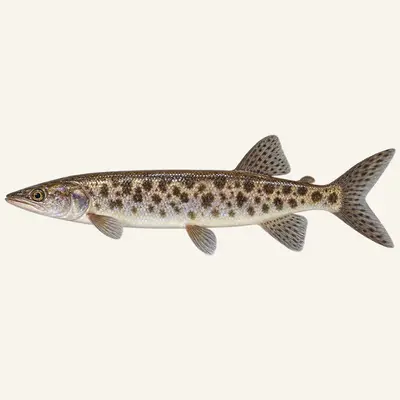
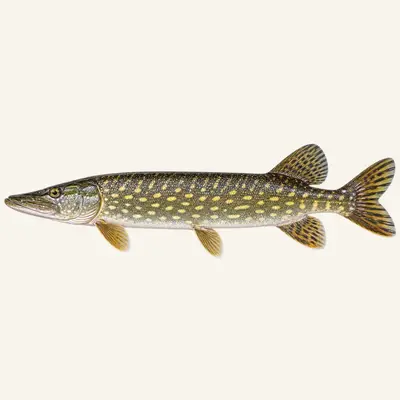
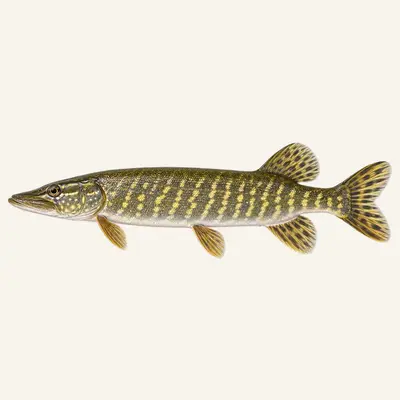
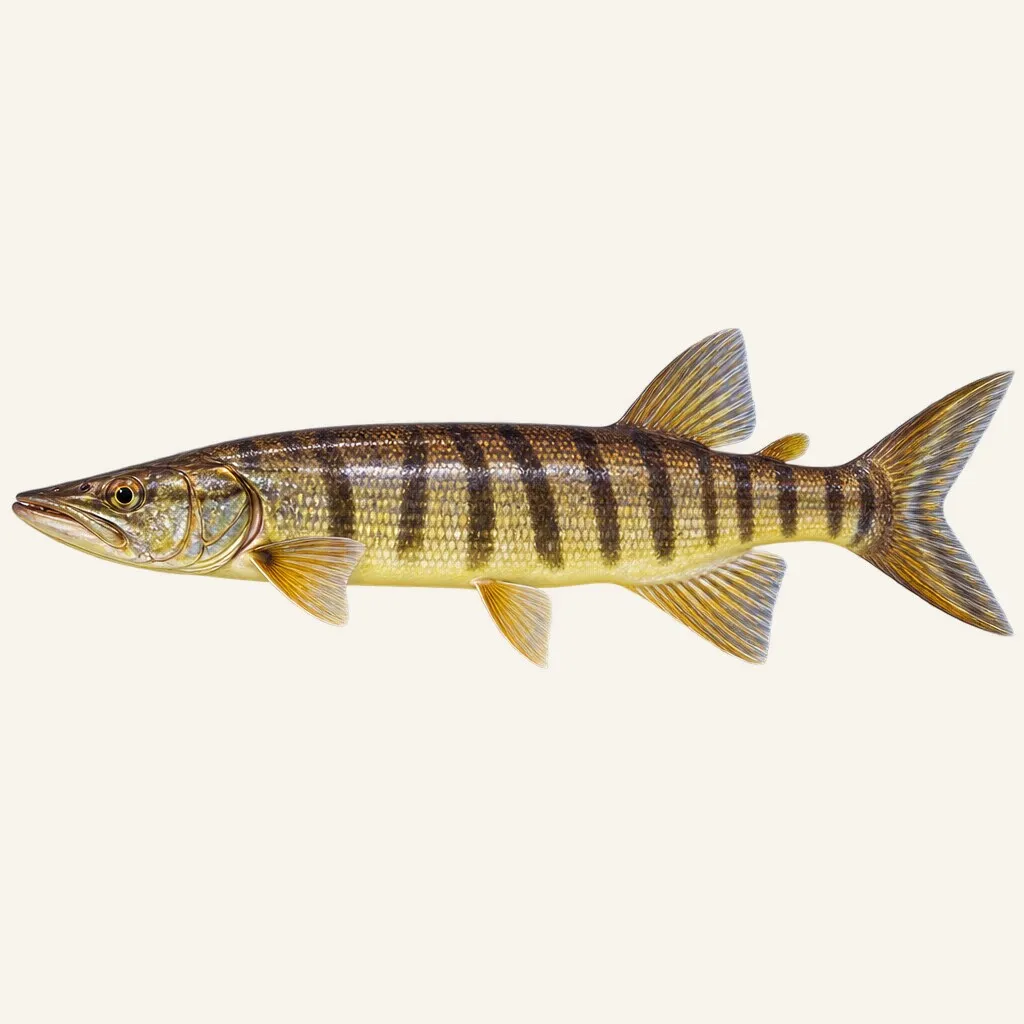
Small African predator with an elongated, streamlined body resembling a pike, featuring a prominent mouth with sharp teeth and a spotted greenish livery.
Calendar
Recorded in 19 countries
Angola · Benin · Botswana · Cameroon · Central African Republic · Congo - Brazzaville · Congo - Kinshasa · Côte d’Ivoire · Gabon · Gambia · Ghana · Guinea · Liberia · Namibia · Nigeria · Senegal · Sierra Leone · Togo · Zambia
GBIF occurrence records — native and introduced populations combined.
Identifying it
The published diagnosis offers no single character. It offers a combination of seven, and says so explicitly: it is the unique combination that identifies the species, not any one item in it.
The seven are lateral-line scales, low at 43 to 51; the distance from nostril to lower jaw, short at 36.6 to 42.1 per cent of head length; gill rakers, numerous at 17 to 23; scales between the dorsal fin and the lateral line, 7.5 to 9.5; scales between the adipose fin and the lateral line, 4.5 to 6.5; head width, broad at 32.8 to 42.3 per cent of head length; and internasal distance, high at 21.9 to 28.3 per cent. Three of those are cranial proportions taken with callipers.
The fin formula adds nine soft rays in the dorsal, 12 in the anal and no spines anywhere, over a column of 45 to 49 vertebrae.
One mark can be read without instruments, and it comes from the other side. The diagnosis of the southern species contrasts its own mottled flank against the vertical brown stripes and bars of this one — so the comparison is in the data rather than deduced from it, and striped against clouded is the only field character the genus provides.
Breeding
The nest is a raft of bubbles and it is free-floating: held together by mucus, held up by nothing, attached to no plant and no bank.
A structure like that sets its own conditions. It cannot survive wind fetch, current or chop, so it requires a surface that stays still — sheltered water, usually closed in by vegetation. Anglers meet bubble nests among the gouramis and bettas of Asia; this is a characiform, an order in which the overwhelming majority of species scatter their eggs and never return to them, building one instead.
Maturity comes early and small, at around 14 cm. A fish that spawns at that size spends most of its life breeding rather than growing, and a population accordingly contains very few immature individuals.
The water it needs
The most useful line of biology on this species is about an absence rather than a presence. It prefers the upper courses of rivers and small rivers, where the tigerfishes of the genus Hydrocynus are scarce or absent.
A predator whose local distribution is stated in terms of another predator is not searched for at random within a basin. The wide channel, patrolled by Hydrocynus, is not its ground. The tributaries and the head of the network are.
The rest of the envelope agrees with those waters: pH 6 to 7.5, moderate hardness, and a temperature range of 26 to 28 degrees — a window two degrees wide, which is unusually tight. That is forest water, warm, weakly mineralised and often shaded. The fish lives near the bottom and moves within fresh water without ever reaching the sea.
Areas
- Vegetated river margins
- Temporary floodplains
- Swamps and lagoons
- Weedy channels and ditches
Techniques
- Live-bait fishing along margins
- Animated surface lures
- Slow dead-bait in lily pads
- Light spinner along edges
Baits
- Small live fish
- Surface lures
- Earthworms
- Small frogs
How to catch it
Going up is the first decision. Since the species concedes the main channel to the tigerfish, a beat is chosen towards the headwaters and towards the small: narrow arms, tributaries, margins closed over by vegetation, rather than the open width of a river.
The nesting constraint then guides how the surface is read. Calm sheltered water able to hold a bubble raft is also water in which an ambush predator watches upwards, and a surface presentation earns its place there in a way it never would in current.
Scale follows. This is a small predator that is already spawning at 14 cm, so hooks and lures are sized on bank prey rather than on channel fish.
Two harvests take it locally: subsistence netting, and the ornamental trade, which collects live fish. They do not target the same sizes, and the second one takes the young.
Conservation
The species looks commoner and far more widespread than it is, and that impression is an artefact of its name. Reports from outside the band described here refer to other members of the genus — the published account states as much — so a great deal of what has been written about Hepsetus odoe counts populations that belong to different species.
The practical effect is that no long series exists. Landings, surveys and older assessments filed under this name cover a set of populations spread from one side of sub-Saharan Africa to the other; anything applying to the fish of the Sassandra-to-Shari band starts after the genus was revised in 2012. Monitoring of a species begins on the day its name stops meaning something else, and for this one that day is recent.
Against that blank background, two harvests fall on the smallest waters in the system. Headwater streams are where subsistence nets and ornamental collection both work, and they are the least buffered part of any drainage.
Regulations
Check the local regulations in force (legal size limits, closed seasons, bag limits).
For guidance only. Legal sizes, quotas and open seasons vary by location and season: always check the local regulations in force before fishing.
Other names
Every language in the catalogue calls this fish a pike — African pike, brochet africain, lucio africano, Afrikanischer Hecht — and every one of them is wrong in the same way. This is a characiform, in the order that holds the piranhas and the tetras, and its resemblance to Esox is an independent solution to the same trade rather than a relationship.
The more consequential problem is that the common name did not split when the species did. The 2012 revision cut a new species, Hepsetus akawo, out of the material that had been going under this name, and named it after a local word rather than a European one. Nothing changed in vernacular usage: African pike still covers the genus. So the English name identifies a group of species while the scientific name now identifies a band of West Africa, and only one of the two has been narrowed.
Sources: fishbase.se · api.gbif.org