Spotted pike-characin
Boulengerella maculata · Ctenoluciidae
- Freshwater
- Predators
- Medium
- Size
32 cm
- Water temp.
23–27 °C
Where to fish
- River
Habitat icons: Flaticon
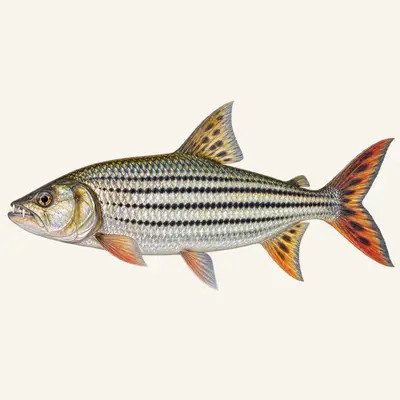
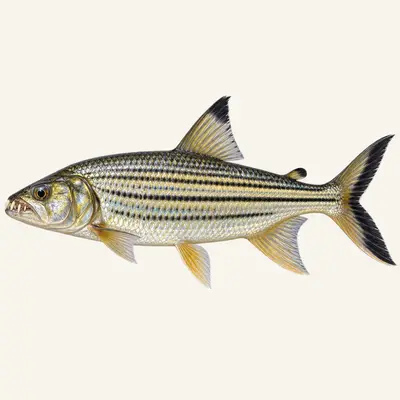
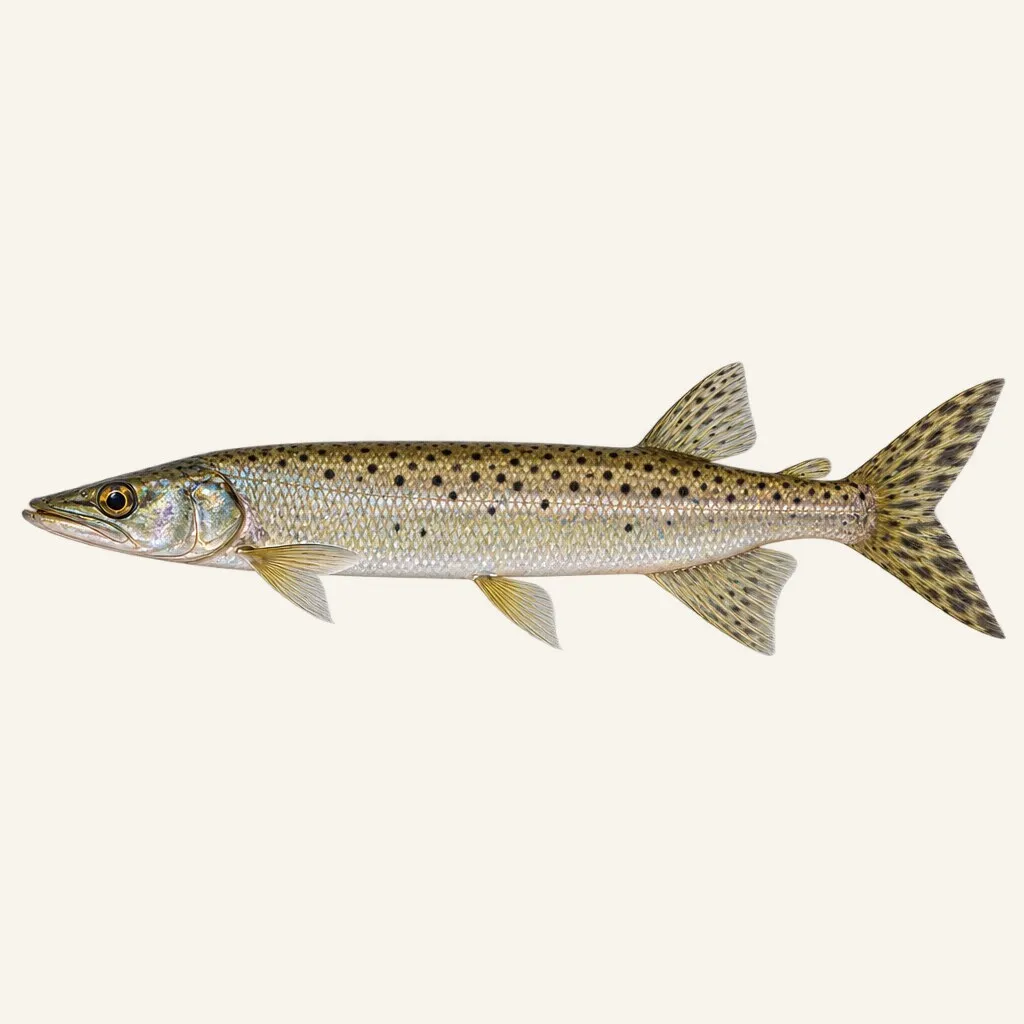
The spotted pike characin sports a slender silver body marked with dark spots, distinguishing it among South American freshwater predators of the Ctenoluciidae family. It hunts near the surface in fast-flowing rivers of the Amazon and Orinoco basins, darting at small fish with precision.
Calendar
Identifying it
The key is a position, not a colour. The base of the dorsal fin sits well behind the vertical drawn through the origin of the anal, and that single relation separates this species from all of its congeners but one — Boulengerella lateristriga.
Against that one, the 1995 revision of the family sets out its own contrasts, and states them itself rather than leaving them to be deduced. This fish has no narrow dark stripe along the side of the body. Its caudal fin is marbled. Its back and upper flanks carry a scattering of dark spots the size of the pupil. And the two differ in their scale counts.
The spot size is the useful part of that list, because it is calibrated against the fish's own eye. A ruler that arrives with the specimen is worth more in the field than one in a millimetre measurement.
The skeleton confirms the silhouette: 46 to 49 vertebrae. The unpaired fins carry no spines, with nine to 11 soft rays in the dorsal and 10 to 12 in the anal.
The water it needs
The fish is described as pelagic, which in fresh water means away from the bottom and away from the bank. It lives in the volume rather than against a structure, and that is the single most consequential line on its page.
The envelope reads oddly at first. Temperature is narrow — 23 to 27 °C — while the chemistry is permissive: pH from 6.0 to 7.5, hardness up to 18 degrees. The water may be acid or neutral, soft or moderately hard; what it has to be is warm, and what it has to do is stay warm.
The lies listed above, rapids, confluences and rocky shallows, are where those two facts meet. Open water is where the fish lives and a seam in the current is where open water becomes findable.
Areas
- Rapids and fast currents
- Aquatic vegetation edges
- River confluences
- Rocky shallow zones
Techniques
- Surface lures
- Small hard baits
- Streamer fly fishing
- Light spinners
Baits
- Small live fish
- Soft plastic lures
- Hard swimbaits
- Streamers
How to catch it
An open-water hunter has no ambush available to it. Nothing conceals the predator and nothing conceals the prey, so the meeting is settled in plain sight. The unpaired fin area is gathered towards the tail, which puts the thrust behind the mass and buys acceleration in a straight line rather than a turn.
Fishing organises itself on depth instead of on lies. There is no hole to sound and no snag to work along the edge of: there is a height in the column to find, and then to repeat.
The rest is missing, and it is better to say so than to fill it in. No rubric gives the diet. None describes the spawning. None supplies a length at first maturity. No prey, no season, no threshold — the three things a recommendation is normally built out of, absent together.
One indication does come from the uses. The species supports a commercial fishery while remaining a small fish, which implies catches in numbers, taken with collective gear rather than on a line. In tanks it appears only in public aquariums. It is eaten considerably more often than it is kept.
Regulations
Check the local regulations in force (legal size limits, closed seasons, bag limits).
For guidance only. Legal sizes, quotas and open seasons vary by location and season: always check the local regulations in force before fishing.
Other names
The genus honours George Albert Boulenger, the Belgian ichthyologist who worked in London and described more fishes than almost anyone of his generation.
Maculata names the spots, and the spots are among the characters the family revision uses to tell this species from its nearest relative. The scientific name and the identification key are pointing at the same thing here, which happens less often than the practice of naming would suggest.
The Brazilian entry, bicuda-pintada, attaches those spots to a word for a long, pointed snout — naming both halves of the animal where the scientific name settles for one.
Sources: fishbase.se · api.gbif.org