Tanganyika tilapia
Oreochromis tanganicae · Cichlidae
- Freshwater
- Other
- Medium
- Size
42 cm
- Water temp.
24–26 °C
Where to fish
- Lake
Habitat icons: Flaticon
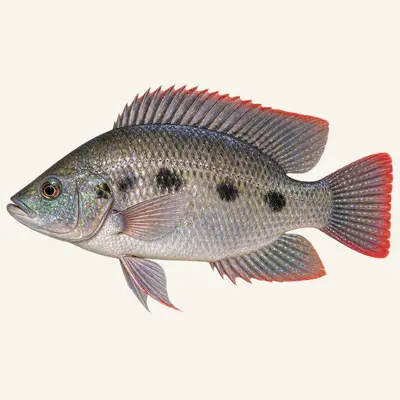
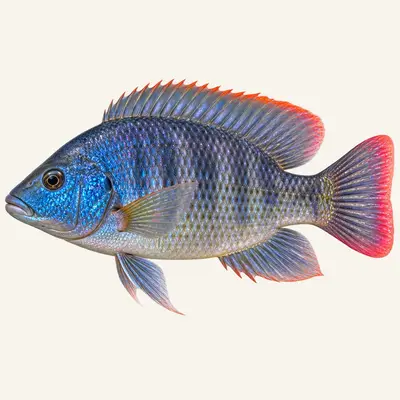
The Tanganyika tilapia is an African cichlid native to the deep, clear waters of Lake Tanganyika. Its elongated, compressed body displays a silvery to greyish colouration with bluish highlights, and it is among the species harvested by local artisanal fisheries.
Calendar
Recorded in 4 countries
Burundi · Congo - Kinshasa · Tanzania · Zambia
GBIF occurrence records — native and introduced populations combined.
Identifying it
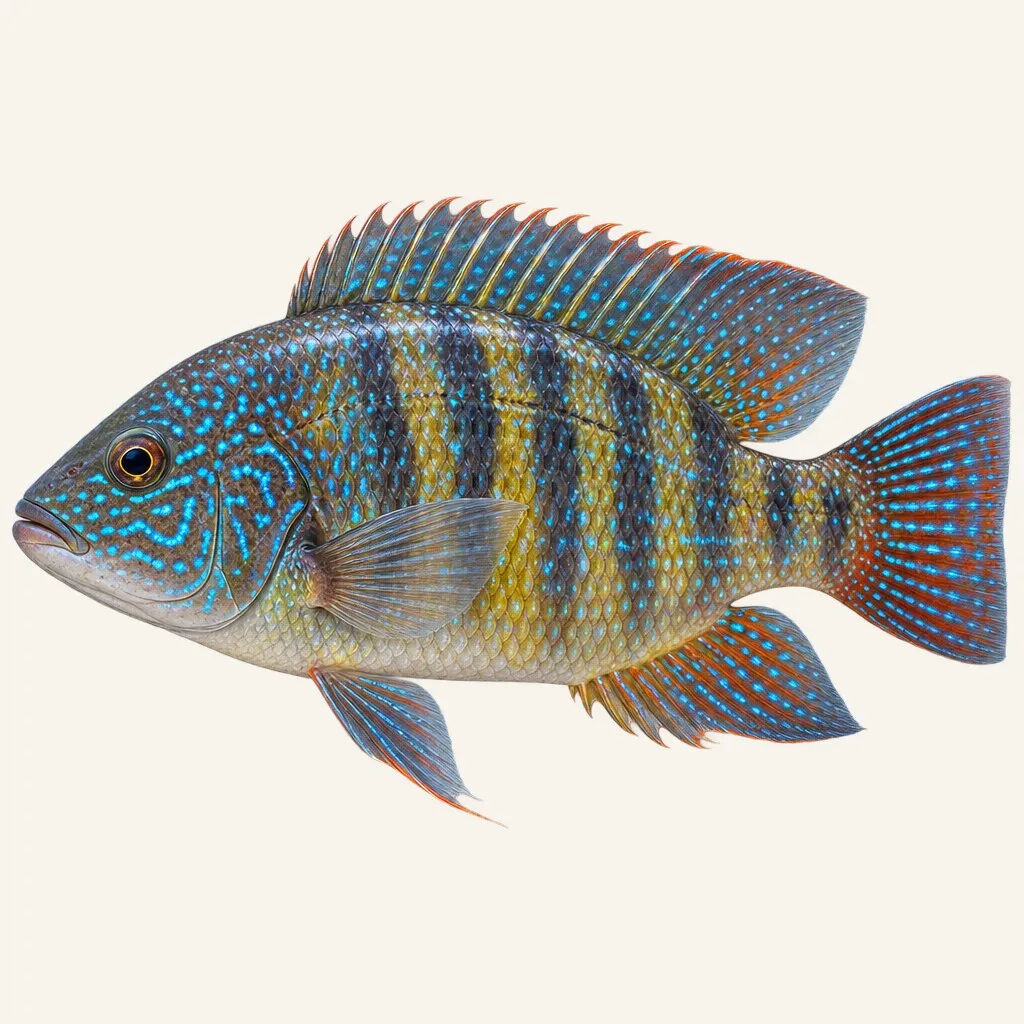
The territorial male carries a network of pale blue markings, bright and intricate, spread over the head, the flanks and the unpaired fins. The ground they sit on varies a great deal: grey, yellow, sometimes frank red. The underside of the head stays grey-white, the caudal often colours on a red ground, and the dorsal takes a broad margin of the same shade.
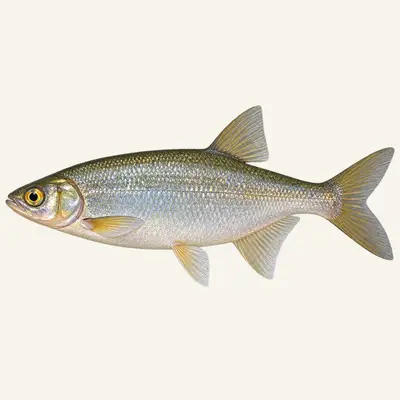
Females and males without a territory have none of that. They are uniformly silvery, scattered with small pearly spots on the flank, sometimes with vertical bars or, conversely, dark horizontal lines. The same individual can therefore present two unrelated appearances according to its social standing at the time.
The outline is short and deep, markedly compressed. The tooth bands in the jaws are wide, wider than in most cichlids of comparable size. Fifteen to 17 dorsal spines, 11 to 15 soft rays behind them, three anal spines, 30 or 31 vertebrae.
Breeding
Males settle in shallow water, on sheltered sand or mud, and dig a plain depression which they defend. Incubation then falls to the female, who keeps the clutch in her mouth.
That is all the literature holds securely on the subject. The detail of the cycle, the number of eggs and the length of brooding have not been established with the precision the farmed tilapias enjoy, which is a reminder that the species written about most are the ones somebody had a commercial reason to write about.
The water it needs
The fish lives in one lake and does not leave it. It occupies the coastal fringe of Tanganyika and the river mouths, without running far up the tributaries: this is a lake-shore species rather than a river one, and the range fits inside the outline of a single body of water.
One fact deserves flagging. It is the dominant tilapiine of Tanganyika even though the Nile tilapia is present there, the fish that ordinarily takes the place of local species wherever it is put. The endemic holds its lake against the most effective coloniser in the genus, which has no equivalent elsewhere in Africa.
Areas
- Rocky shores of Lake Tanganyika
- Sandy littoral zones
- Sheltered bays
- Shallow areas
Techniques
- Float fishing
- Pole fishing
- Light feeder
- Float rig
Baits
- Algae
- Bread
- Sweet corn
- Bloodworm
- Vegetable pellets
What it eats
It browses the surface film of sheltered water. Stomachs examined held large quantities of the diatoms Pinnularia and Navicula, mixed with grains of sand — the sand being the signature of a fish scraping a surface rather than filtering open water.
That resource is abundant and without a direct competitor in a lake this deep, where production concentrates on the first few metres and on the lit bottoms of the shore.
How to catch it
The species is large, fast-growing, and weighs heavily in the catches of the lake and its surroundings. Local fisheries meet it regularly, and it is on that record that its current interest for culture rests.
Two markers direct the search. Breeding males hold sheltered shallows, sandy or muddy, where their depressions show. The rest of the year the lake margin and the river mouths concentrate the species, while working up a tributary moves away from it.
The diet rules out lures. A grazer of surface film is taken on plant baits or fine offerings, presented near the bottom or in shallow water.
Conservation
A species confined to one lake has nowhere to fall back to. Anything that affects the littoral fringe of Tanganyika affects it entirely: there is no reserve population in a neighbouring basin.
Two recent movements concern it directly. It is now being promoted as a farmed fish, which means moving it out of its lake, and it is occasionally exported for the aquarium trade. Taking an endemic out of its only basin is exactly what produced, elsewhere on the continent, the establishments that states are now trying to contain.
Regulations
Check the local regulations in force (legal size limits, closed seasons, bag limits).
For guidance only. Legal sizes, quotas and open seasons vary by location and season: always check the local regulations in force before fishing.
Other names
Tanganyika tilapia in English, the epithet taken straight from the lake. Among the tilapias in this catalogue it is the only one named for a specific body of water, where the others point to a country, a river, a colour or a fin.
The naming has a practical consequence on the spot. A catch sold on that shore under a generic label may be this endemic or the introduced Nile tilapia, and the pale blue tracery of a territorial male — or, failing that, the barred tail of the other — is what tells the two apart.
Sources: fishbase.se · api.gbif.org