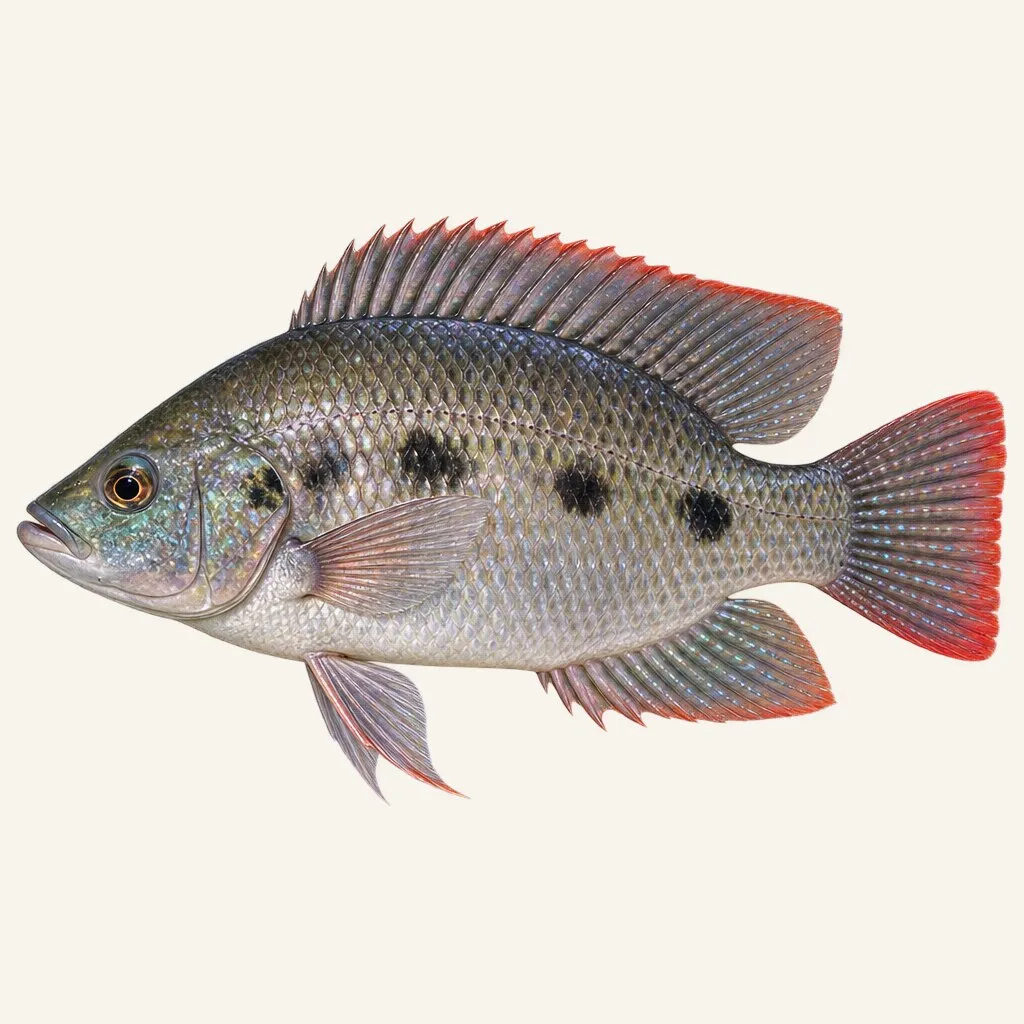
Three spotted tilapia
Oreochromis andersonii · Cichlidae
- Freshwater
- Other
- Medium
- Size
61 cm
- Weight
4.7 kg
- Lifespan
13 years
- Water temp.
18–33 °C
- Depth
0–10 m
Where to fish
- Estuary
Habitat icons: Flaticon
Three spotted tilapia - white fish, Southern Africa
Calendar
Recorded in 4 countries
Botswana · Mozambique · Namibia · Zambia
GBIF occurrence records — native and introduced populations combined.
Its range
Two halves make up this range and they are not the same age. The first is natural: the Ngami basin and the Okavango, the Cunene and the Mossamedes region in Angola, the upper Zambezi and the Kafue, with a record from the Angolan Kasai system.
The second dates from engineering. The middle Zambezi did not hold the species; lakes Kariba and Cabora Bassa, born of the dams, have been colonised since. A fish that looks for deep, quiet water with cover found exactly that in those impoundments, and two inland seas opened to it inside a human generation.
Deliberate transfers did the rest, one of them into Kasanka National Park in Zambia, on the upper Congo basin. Several countries have since reported ecological damage attributable to those establishments.
Identifying it
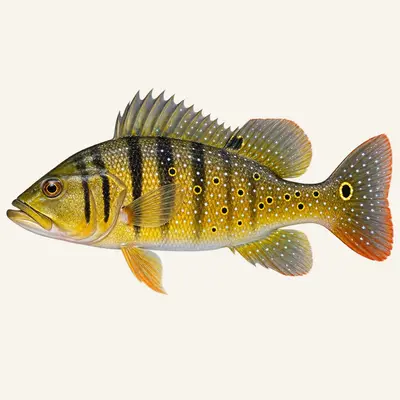
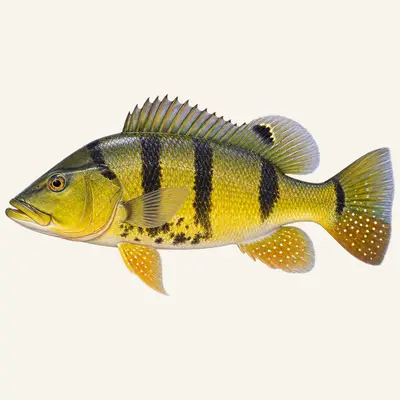
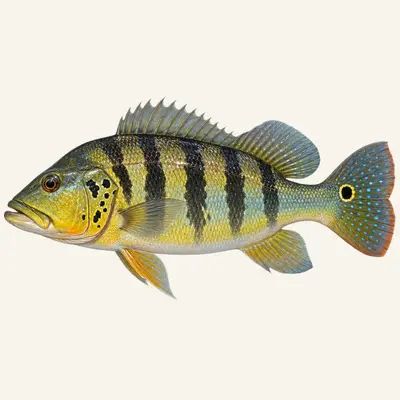
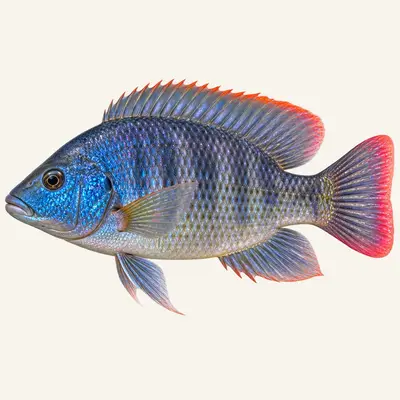
Three or four black blotches, broad and clean-edged, follow one another down the middle of the flank. They are constant in the female and in any fish out of breeding condition, and they gave the species its common name. The dorsal and caudal are edged in red, with no bar and no vertical series of dots on the tail.
A breeding male erases that pattern. Head, back and flanks take a dark iridescent purple-brown that covers the blotches, while the red borders broaden and brighten. His jaws enlarge too, but late: a male in breeding condition normally measures at least 30 cm.
The pectoral fin is the second mark, and the quickest on a fish in the hand. It is very long, 34 to 43 per cent of standard length, a proportion no neighbouring tilapia reaches. The body is deep, 40.5 to 50.5 per cent of the same measure.
The detail closes it: 31 to 35 lateral-line scales, usually 32 or 33; three full rows of scales on the cheek; 30 to 32 vertebrae; 28 to 31 dorsal rays in total; 15 to 18 dorsal spines and nine to 13 anal rays. The male's genital papilla is bluntly conical, with a narrow flange slightly notched at its middle.
Breeding
The nest is a saucer, neither a cone nor a plain pit. The male excavates it with mouth and fins on sand, up to 75 cm across and 30 deep, under one to three metres of water. He uproots the vegetation by mouth to clear the ground, and as many as 40 nests can sit alongside one another in the same sector.
It takes at least 21 °C for laying to start; below that, pond observation records nothing. The female puts her eggs into the hollow at the top, the male fertilises, and she takes the lot straight back into her mouth.
What follows separates this species from its close relatives: the male does not lose interest. He goes on defending the nest and the females present against any intruder while they carry out the incubation and then guard the larvae and fry. Parental care continues for some weeks after hatching.
The pace is slow by the standards of the genus. In the wild a female rarely raises more than one brood a season, where most tilapias run through several; in ponds, two a year have been obtained. That reproductive economy goes with a lifespan of 13 years and growth that carries further than in the others.
The water it needs
This is the most riverine of the large southern African tilapias: it is adapted to fairly fast-flowing rivers, which does not stop it preferring slow or standing water when it has the choice. Swamps and watercourses share its presence.
Distribution through the water column is settled by age. Adults hold open water and depth, generally between three and six metres and down to 10; juveniles stay inshore in the vegetation. Pools dug and used by hippopotamus make a favoured retreat.
Hardiness is real. The animal moves from fresh water into brackish water up to 20 parts per thousand, and lives between 18 and 33 °C. It travels in schools and feeds by day.
Areas
- Coastal estuaries
- Shallow brackish lagoons
- Sandy beaches
- Sheltered harbour areas
Techniques
- Bottom fishing
- Light surfcasting
- Float fishing in estuaries
- Bottom rig
Baits
- Shrimp
- Sea worm
- Mussel
- Small fish
- Squid
What it eats
It is a detritivore in the strict sense, taking the fine particulate matter deposited on the bed — algae, diatoms, organic debris — with the zooplankton mixed into it. The diet varies with what the place offers at a given moment, and that flexibility counts as much as the menu itself.
Large individuals depart from the pattern and take insects and other invertebrates as well. The shift comes with size, as mouth and power allow something beyond grazing.
How to catch it
This is the largest of the southern African tilapias, and it lives up to 13 years. The fishery record treats it as a sport species as well as a table one, which is not the case for all its relatives.
Depth governs the search. An adult is not found in the margins, where only juveniles will be met. The water to work is three to six metres, quiet, with cover nearby, and hippopotamus pools are among the most reliable places to find fish of any age.
The detritivore diet calls for modest baits and a rig laid on the bottom, with the qualification that the largest fish do take insects and invertebrates. That is where the difference lies between a pan of small ones and a fish worth the trip.
The breeding season redistributes everything. The saucer nests, wide and plainly visible on light sand in one to three metres, hold males over 30 cm — the only ones able to breed — and a fish taken off a nest is a spawner in post, in a species that often raises a single brood a year.
Conservation · Vulnerable (IUCN) — This species is threatened with extinction. Always release it (no-kill), handle it with the utmost care and check local rules — fishing for it may be prohibited.
Conservation
One brood a year in the wild, 13 years of life, and males that do not breed below 30 cm: turnover in this species is slower than in the tilapias it gets compared with, and it rests on the largest individuals in the population. A big male removed is not replaced the following season.
Dams have worked both ways. They opened Kariba and Cabora Bassa, and in the same movement they altered the regime of the rivers this fish had adapted to current in. An impoundment produces tilapias; it does not produce a river.
Where the species has been moved outside its range, several countries report negative ecological effects, which is what puts it among the potential pests.
Regulations
Check the local regulations in force (legal size limits, closed seasons, bag limits).
For guidance only. Legal sizes, quotas and open seasons vary by location and season: always check the local regulations in force before fishing.
Other names
Three-spotted tilapia is the English name, and the fourth spot is common enough to make that a poor count.
The bigger naming problem in southern Africa is that tilapias are generally called bream, a word that in Europe belongs to a cyprinid with nothing in common with a cichlid beyond a deep body. Kafue bream and three-spot bream both circulate for this species, so a catch reported as bream on that continent has to be re-identified from the start. The epithet honours Charles John Andersson, the traveller who worked the Ngami and Okavango country where the fish was first taken.
Sources: fishbase.se · api.gbif.org