Goldeye
Hiodon alosoides · Hiodontidae
- Freshwater
- Other
- Medium
- Size
31–52 cm
- Weight
0.3–1.7 kg
- Lifespan
14 years
Where to fish
- Lake
- River
Habitat icons: Flaticon
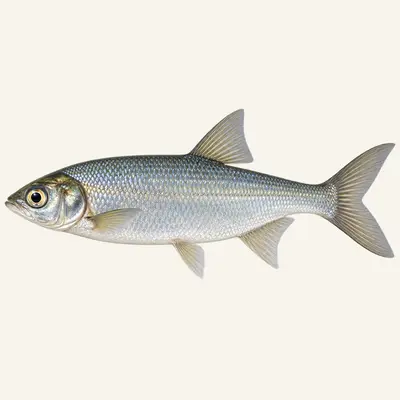
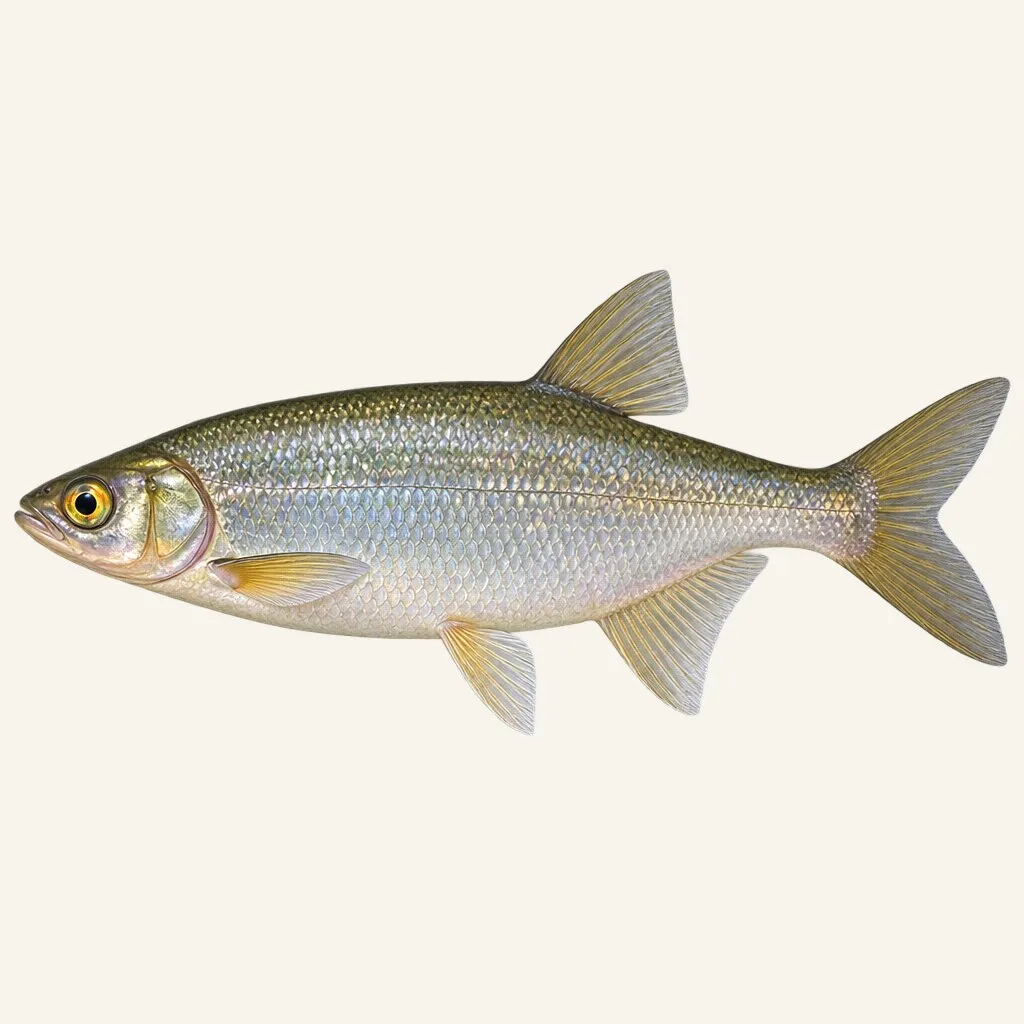
Fish of the Hiodontidae family with a laterally compressed silvery body, distinctive large golden eyes and a terminal mouth adapted for surface hunting.
Calendar
Recorded in 2 countries
GBIF occurrence records — native and introduced populations combined.
Its range
From the Mackenzie delta at Aklavik to Oklahoma: more than 30 degrees of latitude for one species, from the treeline to the southern plains. Eastwards it passes below the Great Lakes and runs down the Ohio and the Mississippi; westwards it descends from Alberta through eastern Montana and Wyoming.
A spread like that cannot be explained by climate, since the two ends have none in common. It is explained by the kind of water. This fish needs large silt-laden lowland rivers, and that habitat runs without interruption from the Gulf of Mexico to the Arctic along the same networks.
The range is therefore a tracing of the turbid-river system rather than of any temperature zone. Where the river turns clear and fast, the species stops.
Identifying it
The eye settles it. It is large out of proportion to the head and it is gold, and the colour is not pigment but a reflective layer set behind the retina that sends light back through it a second time — the same arrangement that makes a cat's eyes burn in headlights.
Everything else is a silver, laterally compressed body with a terminal mouth, set to work upward rather than down. A fish flattened from the sides, carrying an optical amplifier and a mouth aimed at the ceiling, is describing its own trade.
Breeding
Mature fish move upstream in spring, and the movement serves two purposes at once — spawning and feeding. The return downstream happens in autumn.
That double function changes how the season reads. A fish running upstream to eat as much as to breed stays catchable throughout its migration, whereas many migratory species shut down feeding on the way.
Longevity of 14 years allows several of those round trips in a life. It also means a reach that produces fish in spring is not necessarily a reach where they live the rest of the year.
The water it needs
It holds the deep pools and open channels of low, turbid rivers, together with small lakes and impoundments. This is an open-water fish with no attachment to weed or to sunken timber, which is unusual among river predators and which changes how a stretch is read.
Activity is mainly nocturnal, and there is nothing paradoxical in that for an animal equipped for gloom. It hunts at the hours when its prey sees less well than it does, and in a silted river those hours start early.
Areas
- Insect emergence areas
- Moderate currents of large rivers
- Open lake bays
- Downstream of rapids
Techniques
- Fly fishing
- Light surface lures
- Spinner fishing
- Small live bait under float
Baits
- Dry flies
- Small artificial insects
- Small spinners
- Maggots
What it eats
The prey list is the striking part of this species: surface and aquatic insects, crustaceans, molluscs, small fishes, frogs, and then shrews and mice.
A shrew in the stomach of a fish of about 30 cm says something precise. This is not a bottom feeder but an opportunist working the surface film, taking whatever crosses it or falls into it, alive or otherwise. The upward-facing mouth and the light-gathering eye both point at the same layer of water.
It is eaten in turn — by birds, by mammals and by other fishes. A position in the middle of the food chain explains why it occupies open water under cover of darkness rather than in daylight.
How to catch it
A surface diet decides everything downstream of it. A fish that takes insects, frogs and drowned rodents is fished in the film, on the fly or on small light imitations, which is a strange way to approach a silty river where the reflex is to fish deep.
The window is short and dependable. With activity concentrated at night, the two transitions of the day carry the best of it, with the added advantage that insect hatches fall there too.
Lies are read in volume rather than in structure. Deep pools, open channels, the tails of rapids, lake bays — what matters is water, and the absence of obstruction makes slow, methodical prospecting pointless.
Common length is around 31 cm. Tackle is chosen fine to match, which is in any case the condition for presenting the small imitations the diet calls for.
Conservation
Spawning depends on a spring ascent, and that is the exposure. Anything that stops adults moving upstream removes the spawning without removing the fish: the population below the obstacle stays visible, catchable and apparently healthy for years while producing nothing.
The awkward part is that impoundments also appear in the list of waters it occupies. The same structures give it habitat and take away its run, which is why the species can look secure in a reservoir and still be failing in the river that feeds it.
Regulations
Check the local regulations in force (legal size limits, closed seasons, bag limits).
For guidance only. Legal sizes, quotas and open seasons vary by location and season: always check the local regulations in force before fishing.
Other names
Goldeye in English, Goldauge in German, ojo de oro in Spanish, occhio d'oro in Italian, laquaiche aux yeux d'or in French: six languages, six names for the eye. Unanimity like that is rare and says plainly what anyone notices first.
Hiodon means teeth on the tongue, and that toothed tongue puts the fish in surprising company. The family belongs to the Osteoglossiformes, the bony-tongues, an order that otherwise holds the arapaima, the arowanas and the African elephantfishes. Two small silver fish of North America are all that this equatorial lineage has outside the tropics.
The commercial fishery has stayed modest and sells the flesh smoked, under the name of the Canadian city whose trade made it known: Winnipeg goldeye.
Sources: fishbase.se · api.gbif.org