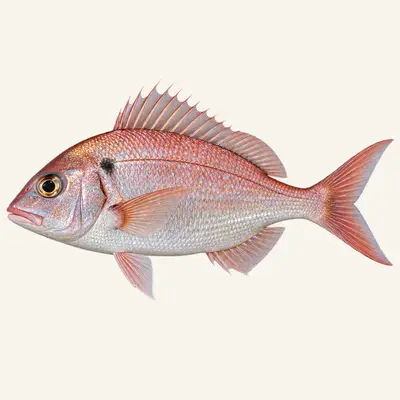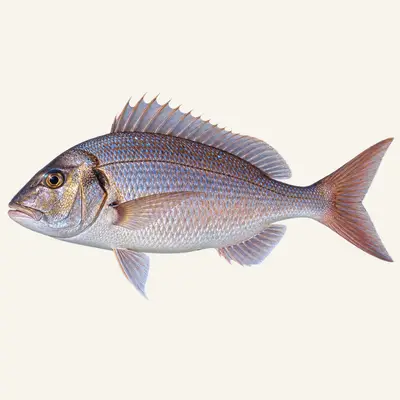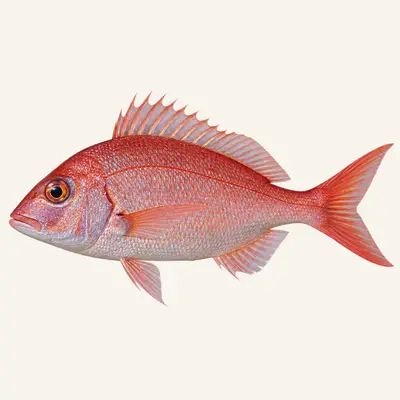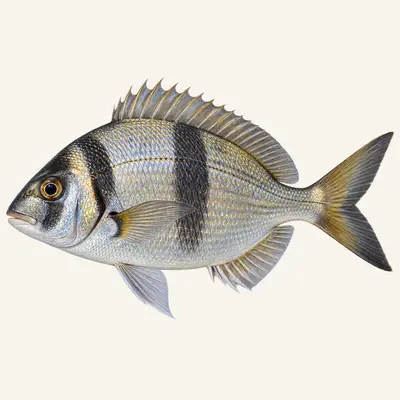
Black seabream
Spondyliosoma cantharus · Sparidae
- Saltwater
- Coastal
- Medium
- Size
30–60 cm
- Weight
0.4–1.2 kg
- Depth
5–300 m
Where to fish
- Estuary
- Rocky shore
Habitat icons: Flaticon
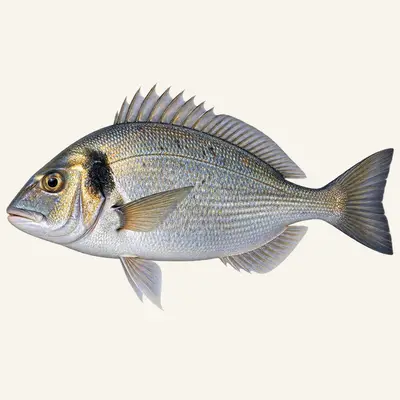
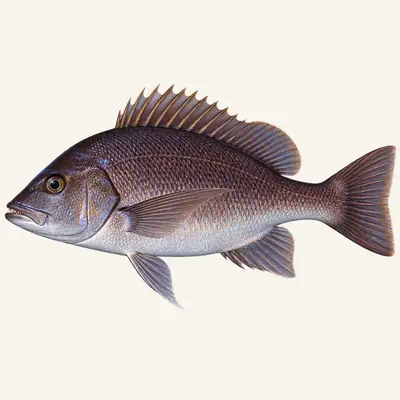
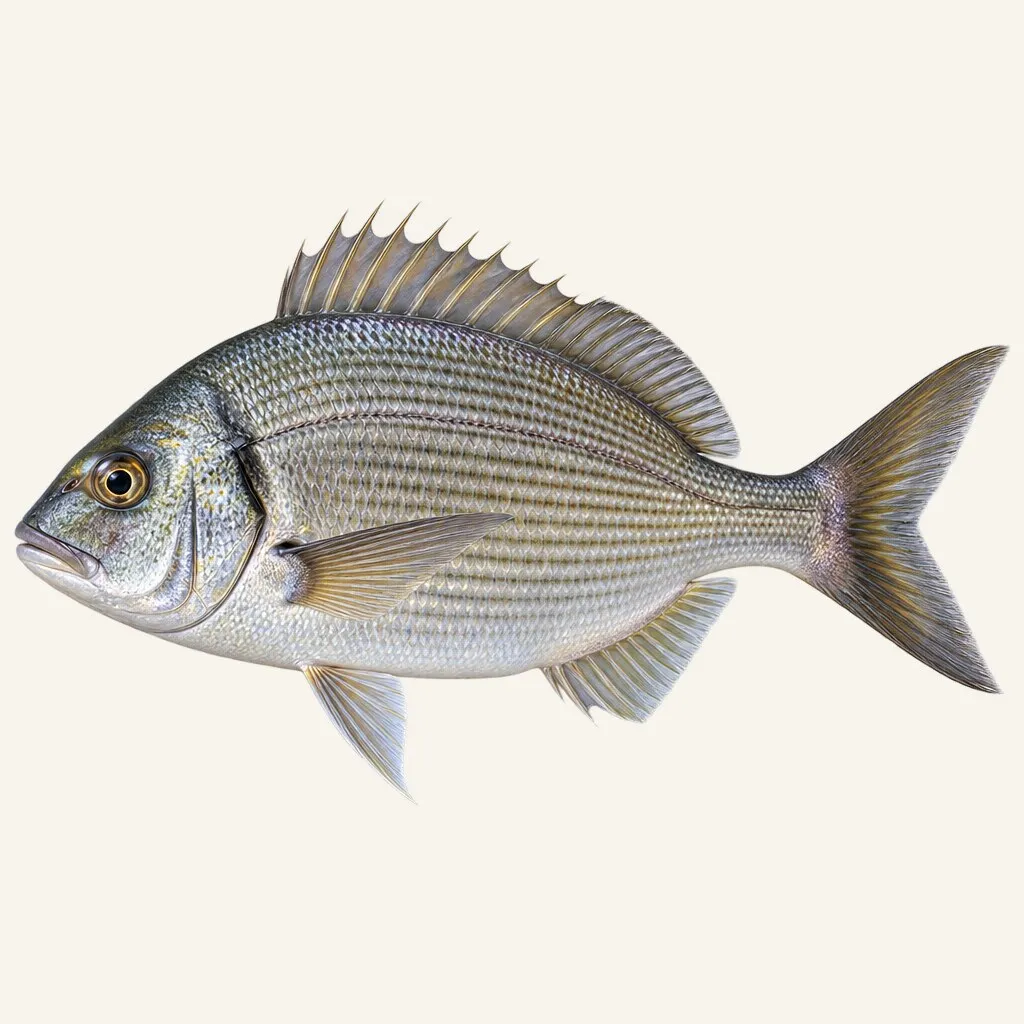
The black sea bream has an oval, compressed body with grey-blue silvery sheen and fine yellowish-orange longitudinal lines on the flanks. A pelagico-coastal sparid, it often gathers in schools in moderately deep waters of the eastern Atlantic and Mediterranean.
Calendar
Its range
Scandinavia to northern Namibia, taking in Gibraltar, the whole Mediterranean, the Black Sea, Madeira, the Canaries and Cape Verde. In degrees that is 63°N to 20°S: eighty-three degrees of latitude for a fish classed as subtropical.
Temperature does not explain a spread like that, and it is not what the range is made of. The recorded depth band is 5 to 300 metres, which is shelf, and every part of the list above is shelf — the continental margin of one ocean's eastern side, the island shelves hung off it, and two enclosed seas reached through a strait. There is no western Atlantic population. A fish whose eggs are stuck to a particular patch of sand does not colonise across three thousand miles of open water, and this range is the shape of that constraint.
The Black Sea sits at the end of the chain, past the Mediterranean, past two straits, at the cold and low-salinity limit of everything the species does elsewhere.
Identifying it
The published diagnosis records no dark spots. That sounds like nothing until you have spent an afternoon on a Mediterranean or Biscay mark deciding whether a spot sits on the gill cover, above the pectoral base or at the base of it — the question most sparid identifications here come down to. A silver-grey deep-bodied fish carrying no such mark anywhere has already answered it.
What it carries instead runs the wrong way. The markings are longitudinal, weak, and follow the length of the flank rather than crossing it.
The snout is as long as the eye is wide, or longer. That proportion is worth taking on a fish in the hand, because it survives everything: handling, ice, and the loss of colour that overtakes any sparid within a few hours of death.
Eleven dorsal spines, then 11 to 13 soft rays.
Breeding
The eggs are laid on a sandy bottom, and that single line from the reference account is the most consequential thing on this page.
Most of what an angler catches offshore spawns into open water. The eggs drift, nothing about their location can be known, and no decision taken on a boat can affect them. These eggs have an address. The published account gives one line — the species lays its eggs on a sandy bottom — and that line is enough to change the standing of a piece of ground. Eggs on the bottom are somewhere. They belong to a mark, and a mark can be fished or left alone.
Sex is the other half. This species matures female and turns male later. Sex reversal has been measured at around 24.3 cm total length — in a population off Algeria, which is one population and one figure, not a threshold that can be carried around the range. First maturity is given at about 19.7 cm.
Put the two together and the arithmetic is short. The fish holding the nest is a male, males are drawn from the older end of the population, and taking him removes both a spawner and the only thing standing over the eggs.
The water it needs
Seagrass beds, rocky ground and sand, down to about 300 metres. The fish is gregarious and forms large schools.
The three substrates are not alternatives, they are a division of labour. Rock and seagrass hold the crustaceans and the weed the fish feeds on. Clean sand takes the eggs. A mark that offers structure with open sand beside it is a mark that can serve both functions in the same season, and those are the places worth remembering.
The schooling matters more than the depth ceiling. Three hundred metres is the extreme; the fish that a shore or small-boat angler meets are in a fraction of that, in numbers, over ground they return to.
Areas
- Rocky coastal bottoms
- Marine seagrass beds
- Sandy areas near rocks
- Estuaries
Techniques
- Baited bottom fishing
- Float fishing
- Surf casting
- Handlining
Baits
- Sandworms
- Shrimp
- Mussels
- Crabs
- Sea urchins
What it eats
Omnivorous — seaweed on one side, small invertebrates on the other, crustaceans foremost among them.
Two things follow. Nothing in this diet ties the animal to a substrate, which is why the same species turns up over rock, over seagrass and over sand without any of the three being its habitat in particular. And the crustacean half is the working half: it is what the fish is described as taking preferentially, and it is what a bait should be.
How to catch it
Find the school. This is not a fish that is searched for one at a time, and a mark that produces one produces several, which changes how long it is worth staying on a spot before moving.
The accessible band is the shallow end of a 5 to 300 metre range. Ground that mixes structure with sand — reef edges, seagrass margins, the clean bottom around rock — covers both what the fish eats and where it breeds.
Baits follow the invertebrate half of the diet: crustacean first, then worm and shellfish. Weed is in the diet too, but it is the second item in the reference and it should be the second item on a hook.
Then the fact that ought to change a decision rather than a method. In spring the fish is on ground where it has laid, and a clutch on the sand is a clutch that can be dredged, anchored over or fished out from above. What the reference does not say is worth saying plainly: it describes no pit, no nest and no guarding parent, so nothing here justifies the picture of a male sitting over eggs. What is established is narrower and still enough — the eggs are on the bottom, in a season, in a place, and the fish taken above them were the ones that put them there.
Conservation
This is an important food fish, taken commercially through most of its range, and the pressure on it is ordinary. What is not ordinary is where some of that pressure lands.
Nest grounds are fixed. They are patches of clean sand near structure, they are used season after season, they are a small fraction of the bottom available, and once they are known they are known. Anything working that bottom in those weeks — gear, anchors, a run of boats on a productive mark — is concentrated on the one part of the cycle that has no dispersal to protect it. The rest of the year the same fish are spread through a school and across a shelf, and the same effort would remove far less.
The sexual arrangement adds a second cost to the same fish. Every male in the population is a former female that reached the switch, so a male is by definition an older animal, and the males are the ones sitting still in spring.
None of this is visible in a catch figure. A good spring on a known mark and a poor one look identical in a landing record, and the difference between them is a season of eggs.
Regulations
Check the local regulations in force (legal size limits, closed seasons, bag limits).
For guidance only. Legal sizes, quotas and open seasons vary by location and season: always check the local regulations in force before fishing.
Other names
Black seabream, for a fish that is grey. The name is old and it is not descriptive, which is why the French call it dorade grise, the Germans Streifenbrasse after the stripes, and the Italians tanuta after nothing in particular.
Shortened to "black bream" it becomes actively unreliable. In Australia that name belongs to Acanthopagrus butcheri, an estuarine sparid of a different genus with a different life; in the western Pacific "black sea bream" is normally Acanthopagrus schlegelii. Three fish, three oceans, one English name, and no part of it distinguishes them.
Cantharus is an ancient name carried into the binomial rather than a description of the animal, and Spondyliosoma refers to the body. Between them the scientific name says less about this fish than the German one does.
Sources: fishbase.se · api.gbif.org