Axillary seabream
Pagellus acarne · Sparidae
- Saltwater
- Coastal
- Medium
- Size
25–36 cm
- Weight
0.2 kg
- Depth
0–500 m
Where to fish
- Beach
Habitat icons: Flaticon
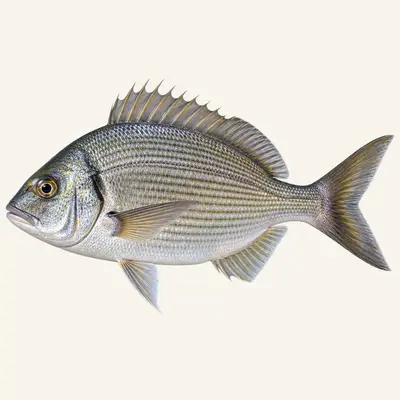
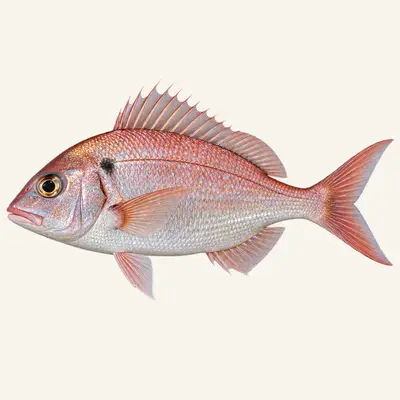
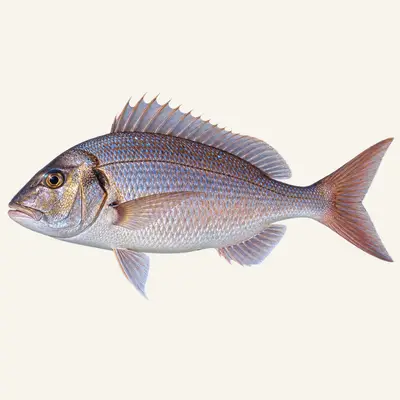
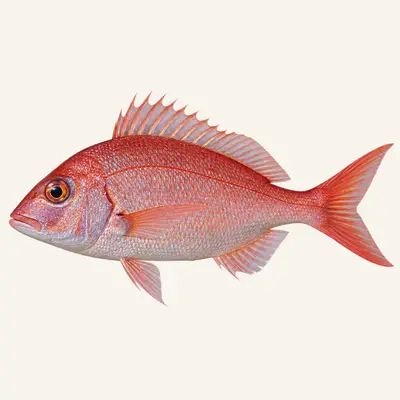
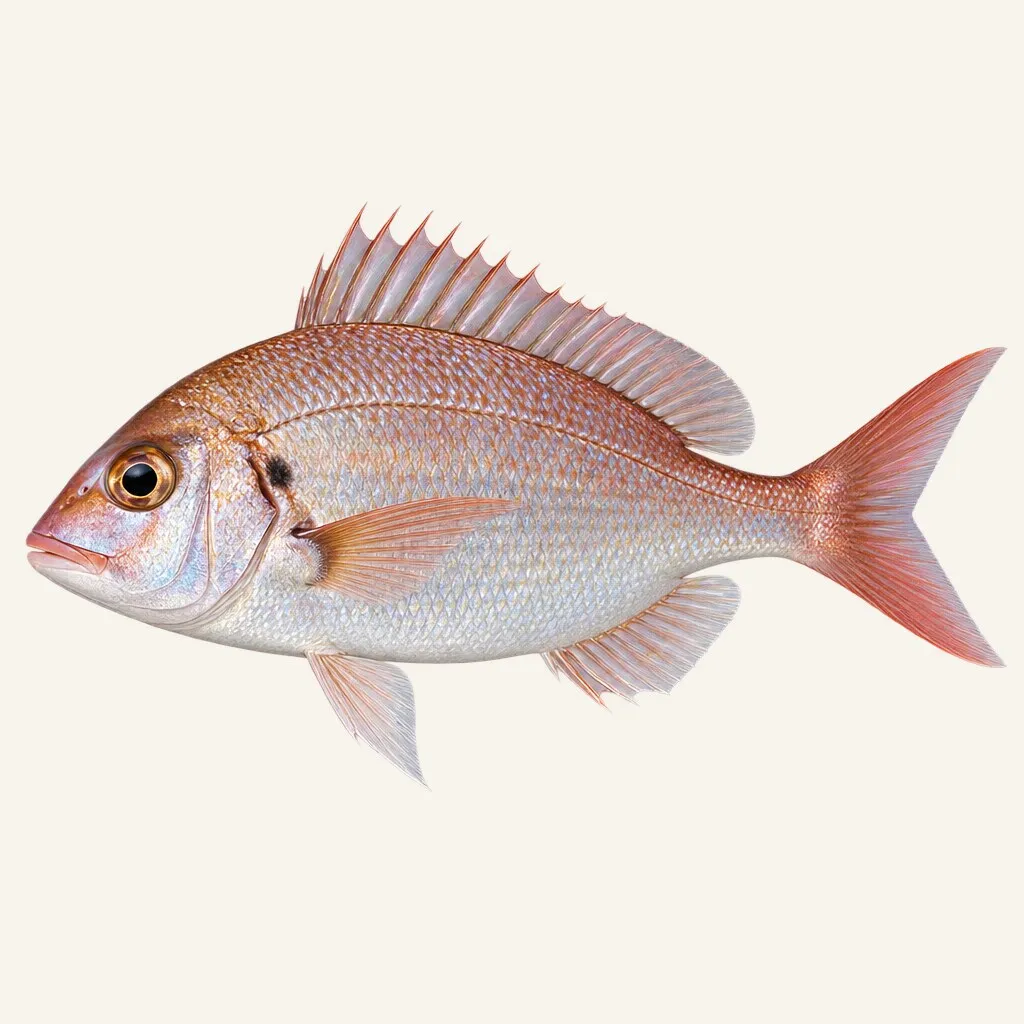
The axillary sea bream resembles the common pandora but is distinguished by a dark spot at the base of the pectoral fin and slightly more silvery hues overall. A sparid of eastern Atlantic and Mediterranean coastal bottoms, it lives in schools over sandy and detrital substrates.
Calendar
Its range
The Bay of Biscay to Senegal on the mainland, plus Madeira, the Canaries, Cape Verde and the Azores, plus the Mediterranean. The species is rare in the British Isles and has been recorded now and then off Denmark.
Those Danish records matter only as a marker of the envelope. The fish is classed as oceanodromous, so it does move within the sea rather than sitting on one patch for life, and the northern occurrences are the tail of a subtropical distribution rather than an outpost of it.
Identifying it
A black spot sits at the base of the pectoral fin. Not above it, not behind it: at the base, where the fin meets the body. The blackspot seabream carries its mark a little higher, above the same base, and that difference of a centimetre is the entire diagnosis between the two.
The rest of the animal offers no help. The body is tall, silver and unstriped, which describes half the family. Dorsal counts run 12 or 13 spines with 10 to 12 soft rays, the anal three spines with nine or 10 — figures that overlap those of its congeners closely enough to be useless in the hand.
So the identification comes down to lifting the pectoral fin and looking underneath it. That is the whole method, and it is why the English name of the fish points at the armpit.
Breeding
Male first, female afterwards. Most individuals mature as males and change sex later, which makes this a protandrous species and puts the eggs at the top of the size range.
The published thresholds do not agree, and the disagreement is informative rather than embarrassing. One set of work puts the change at roughly 24 to 30 cm; another at 17 to 29 cm total length. Both are given for the eastern Atlantic and the Mediterranean, and the age given is two to seven years.
Two ranges that wide do not describe one population. They describe several, switching at different sizes in different water, which means a rule of thumb calibrated on one coast will misread fish on another. The safe statement is the direction of travel, not the number.
First maturity, as a male, arrives at about 15 cm.
The water it needs
Seagrass and sand, specifically. The species will take other bottoms but those two are named as its ground, and they carry the animals it eats.
The depth figures need separating. The full recorded range starts at the surface and reaches 500 m; the band where the fish is actually common is 40 to 100. Anything quoted from the extremes describes an occurrence, not a habitat.
The young stay nearer the shore than the adults. That separation is real but modest: both stages remain on the continental shelf, unlike the blackspot seabream, which sends its adults over the edge and down the slope. Here the whole life cycle is a shelf life cycle, which is why one fishery meets every size class of the species.
Areas
- Sandy coastal bottoms
- Detrital areas
- Edges of seagrass beds
- Bay bottoms
Techniques
- Baited bottom fishing
- Handlining
- Drift fishing
- Float fishing
Baits
- Shrimp
- Sandworms
- Squid
- Mussels
- Crabs
What it eats
Worms, molluscs and small crustaceans, in that order of preference.
What is absent from that list is fish. The common pandora, working comparable ground, takes small fish regularly; this one is described without them. It is a more strictly sedimentary forager, which fits the seagrass and sand it lives over: both hold worms and small crustaceans in quantity and neither offers much in the way of ambush cover.
How to catch it
The search is narrow and it is defined by two numbers and one bottom type: 40 to 100 m over seagrass or sand, with smaller fish closer in.
The diet then closes off half the tackle box. A fish that prefers worms, molluscs and small crustaceans is fished with sediment baits presented on or near the bottom, and small lures — which do produce common pandora — have much less to recommend them here.
The size structure is the part worth thinking about before filling a box. This is a fish of regular calibre rather than one that produces occasional giants, and the common length is about 25 cm. Protandry then puts the females above the switch, somewhere between 17 and 30 cm depending on which population is being fished. In other words the female half of the stock occupies the upper part of a narrow size range, and any fishery that grades on size — which is to say most of them — takes the breeding females preferentially without anyone deciding to.
Conservation
The mechanism above is the one that matters, and it is a consequence of arithmetic rather than of any particular fishing method. In a species whose sex change falls inside the size range being landed, selectivity on size is selectivity on sex, and the fishery does not have to know it.
Two things soften it. First maturity at 15 cm is early enough that a large share of what is caught has already bred as a male. And the uncertainty in the switch thresholds cuts both ways: in populations that change at the lower end of the published range, more of the landed fish have completed the transition and spawned as females as well.
What is missing is a way to tell which population is which without sampling it. The fishery is old, continuous and spread from Biscay to Senegal, and it works on stocks whose sex-change size is known only as a pair of disagreeing intervals.
Regulations
Check the local regulations in force (legal size limits, closed seasons, bag limits).
For guidance only. Legal sizes, quotas and open seasons vary by location and season: always check the local regulations in force before fishing.
Other names
Axillary seabream in English, and the name is a piece of identification rather than a label: axillary means of the armpit, and the armpit is exactly where the black spot sits. Very few fish names are that directly useful.
Spanish says aligote, Italian pagello bastardo, French pageot acarné or pageot blanc. The specific epithet acarne comes down from older usage rather than describing anything about the animal.
The English difficulty is the same one that afflicts the whole family. Sea bream on a market slab covers dozens of species from several genera and a wide spread of sizes and situations, and no part of the trade name distinguishes a shelf fish of 25 cm from a deep-slope fish twice that length.
Sources: fishbase.se · api.gbif.org