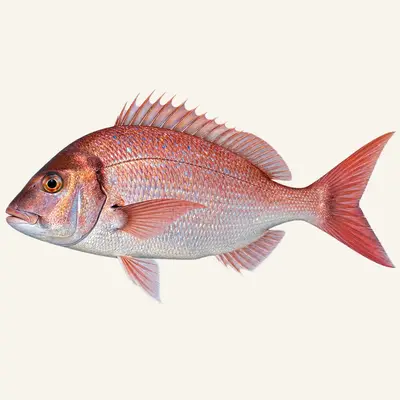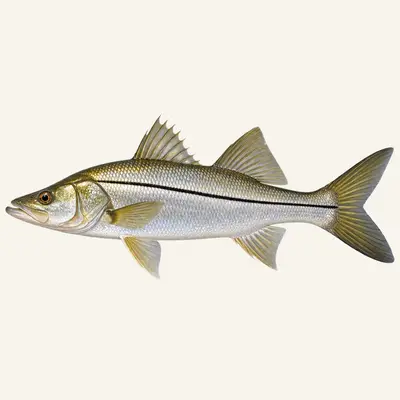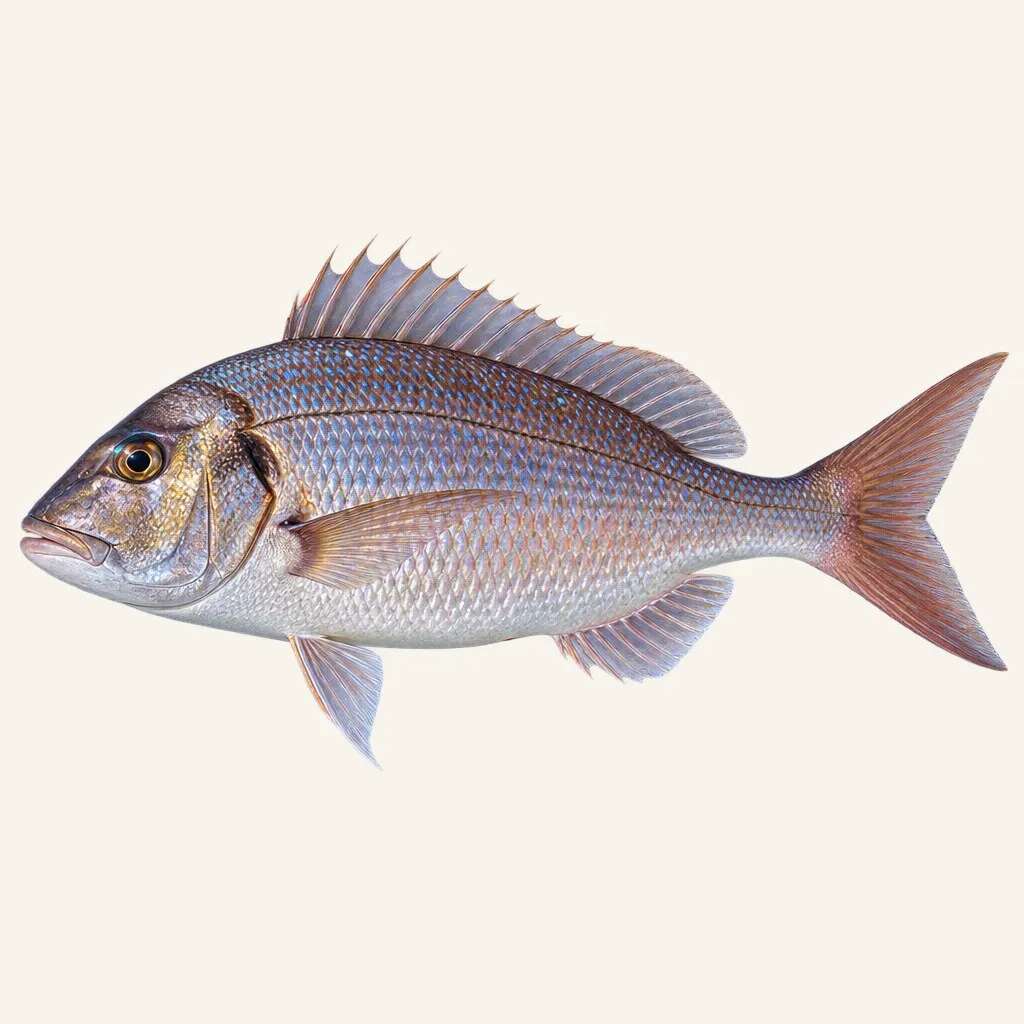
Common dentex
Dentex dentex · Sparidae
- Saltwater
- Coastal
- Medium
- Size
50–100 cm
- Weight
1.5–14 kg
- Depth
0–200 m
Where to fish
- Rocky shore
Habitat icons: Flaticon
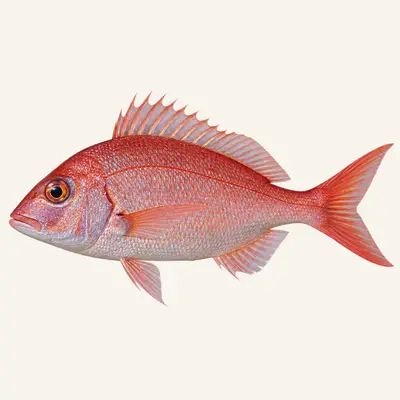
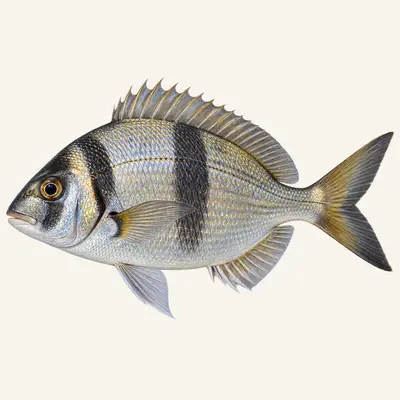
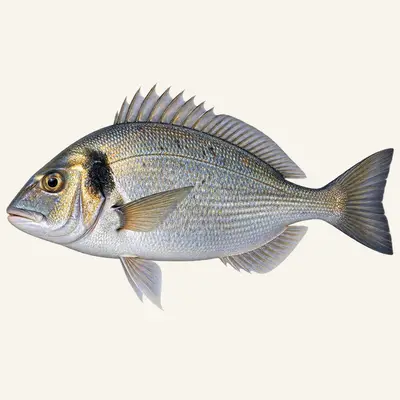
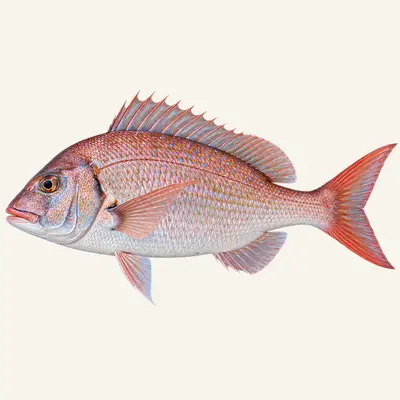
The common dentex is a powerful sparid with an elongated silvery blue-grey body, marked with bluish spots on the flanks of juveniles. Its wide mouth bears prominent canine teeth that give it its name and allow it to seize live prey such as fish and cephalopods.
Calendar
Its range
From the British Isles south to Cape Blanc in Mauritania, exceptionally on to Senegal, with the Canaries and Madeira. In the Mediterranean it is described as common south of the fortieth parallel — Spain, North Africa.
That last clause is the useful one, and it is the kind of detail a range map cannot show. Presence and abundance are different variables, and this species is present across a span of forty-four degrees of latitude while being common across a fraction of it. The northern part of the list is where it occurs. The southern basin is where it lives.
Identifying it
The reference description of this fish is four lines long, and three of them are counts: 11 dorsal spines with 11 or 12 soft rays, three anal spines with seven to nine, an oval compressed body of ordinary sparid proportions. Nothing about colour, nothing about markings.
The fourth line is the fish. Each jaw carries four to six anterior teeth that are very strongly developed — canines, at the front, in both jaws, and large enough that the animal is named for them twice over, once by its genus and once by its species.
That is a positive character and it should be used as one. A deep-bodied silver fish of these coasts with obvious canines standing at the front of the mouth is identified by them; the counts confirm it afterwards. What the canines are not is a substitute for looking, because more than one species in the genus carries them.
Breeding
The sexes are separate here. This is a gonochoric species — and then the account immediately qualifies itself: some individuals are hermaphroditic, particularly at young stages. Both halves of that statement should be kept. It is neither the clean protandry of the gilt-head bream nor a clean separation.
The practical effect is a negative one, and it is worth stating because so much of this family works the other way. Around most of the Mediterranean, the length of a sparid in the hand carries an implication about its sex, because so many of them change from one to the other at a known size. Here it carries none. A large common dentex is a large common dentex.
In the Mediterranean the fish breeds between March and May, close inshore. Embryonic development takes about three days at 17 °C. First maturity is given at around 34.6 cm.
The water it needs
Hard bottom — rock, rubble, broken ground — down to 200 metres. In practice it is usually shallower than 50, with a working band of 15 to 50.
The social structure inverts with age, and the inversion is the single most useful line in the file. Young fish are gregarious. Adults are solitary.
Everything about how the species is fished follows from that. A shoaling fish is found once and caught repeatedly; a solitary one holds a position on a piece of structure, and the mark holds it rather than them. When the adult is taken, nothing behind it in a shoal moves up to replace it. The mark is empty until another fish finds the ground.
Areas
- Deep rocky drop-offs
- Mediterranean coralligenous habitats
- Offshore wrecks
- Underwater faults
Techniques
- Live bait fishing
- Vertical jigging
- Deep trolling
- Bottom soft lures
Baits
- Live sardine
- Live mackerel
- Whole squid
- Shrimp
- Octopus
What it eats
Fish, molluscs and cephalopods.
Cephalopods are the item that explains the jaw. Squid and octopus are soft-bodied, fast, and equipped to grip back; nothing about them requires crushing and everything about them requires holding. Set that beside the fish component and the anterior canines stop being a curiosity and become the obvious equipment for the diet on record.
Nothing on that list has a shell to open. The molar batteries carried by the shell-feeders of the family would do no work at all on it.
How to catch it
This is the sparid that is fished like a predator, and the tackle reflects it: live bait, strip bait, squid, and lures worked near the bottom, where the rest of its relatives on the same coast are fished with shellfish and crustacean on a static rig.
Ground is hard bottom between 15 and 50 metres. Because the adult is solitary and site-attached, the method is to cover structure rather than to wait for a shoal to arrive — successive marks, each searched properly, rather than one mark worked long.
The juveniles are a separate fishery and the record says so directly: young fish are taken in traps. Gregarious animals enter traps; a solitary adult holding a rock face does not, which is a second consequence of the same behavioural split.
One record deserves to be read carefully rather than repeated. A spearfisherman reports a fish of about 1.60 m and 42 kg taken on an overnight bottom-line off Corfu, and the reference carries the report together with the note that the identification cannot be verified. That is the right way to hold it. It is an account, it is in the literature, and it has not been confirmed — three separate statements, and the third does not cancel the first two.
Conservation · Vulnerable (IUCN) — This species is threatened with extinction. Always release it (no-kill), handle it with the utmost care and check local rules — fishing for it may be prohibited.
Conservation
The traits stack the wrong way, and none of them is remarkable on its own.
A predator of hard bottom, solitary as an adult, faithful to a mark that can be found again, sought after on the market, and reachable by spearfishing in the shallow half of its range. Each of those is ordinary. Together they describe an animal whose individual removal is permanent at the scale of a particular piece of ground, and whose location is knowable to anyone who has fished that ground before.
First maturity at around 34.6 cm leaves genuine headroom above it, and that headroom is the margin the species has. It only exists while fish are allowed to occupy it.
Culture has succeeded on an experimental scale, and the reference notes that low market supply makes commercial production attractive. That is pressure removed from wild fish rather than added to them, with the escape question that follows farmed marine fish everywhere.
Regulations
Check the local regulations in force (legal size limits, closed seasons, bag limits).
For guidance only. Legal sizes, quotas and open seasons vary by location and season: always check the local regulations in force before fishing.
Other names
Common dentex, and the noun is a straight lift: dentex is the Latin word, applied to the fish in antiquity for the reason the animal makes obvious. English never built a native name for it, because English-speaking coasts are the thin northern edge of a range whose centre is the southern Mediterranean.
The word travels. Spanish dentón, Italian dentice, Portuguese dentão, German Zahnbrasse — tooth-bream. Every one of them names the dentition, which is rare enough among fish names to be worth noticing, and it makes the vernaculars unusually easy to move between.
The trap is elsewhere in the water. Dentex also serves as a species epithet outside this family: Pseudocaranx dentex is a jack, a fast open-water carangid with nothing structural in common with this fish beyond the reason for the name. A search on the bare word returns both, and the qualifier "common" does not help, since it distinguishes this species from its congeners rather than from a jack.
Sources: fishbase.se · api.gbif.org