Blackspot seabream
Pagellus bogaraveo · Sparidae
- Saltwater
- Coastal
- Medium
- Size
30–70 cm
- Weight
0.3–4.0 kg
- Lifespan
15 years
- Depth
150–700 m
Where to fish
- Rocky shore
Habitat icons: Flaticon
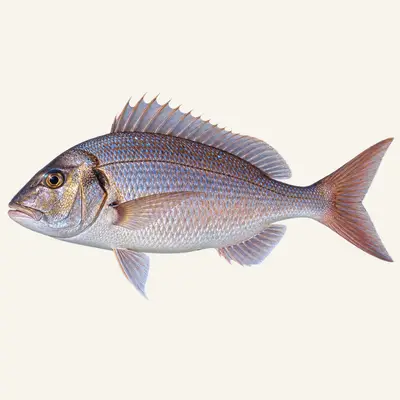
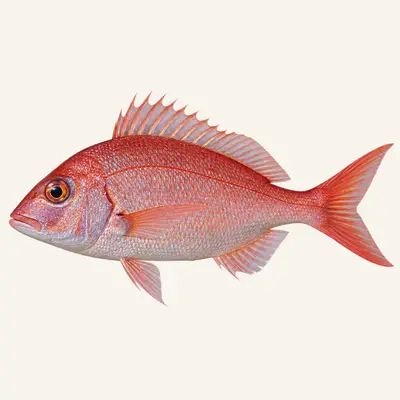
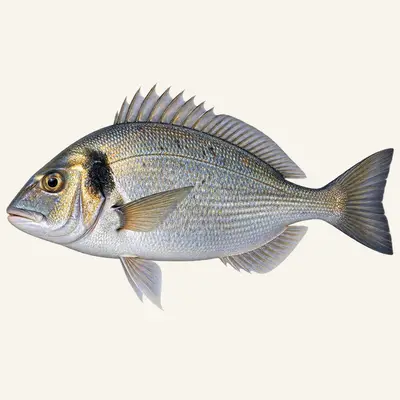
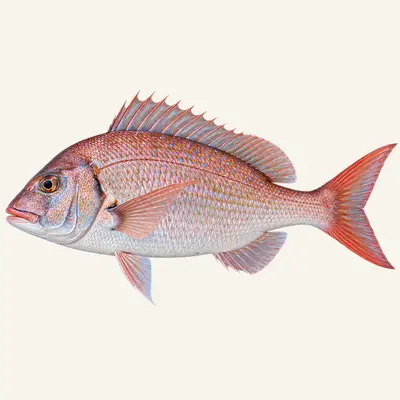
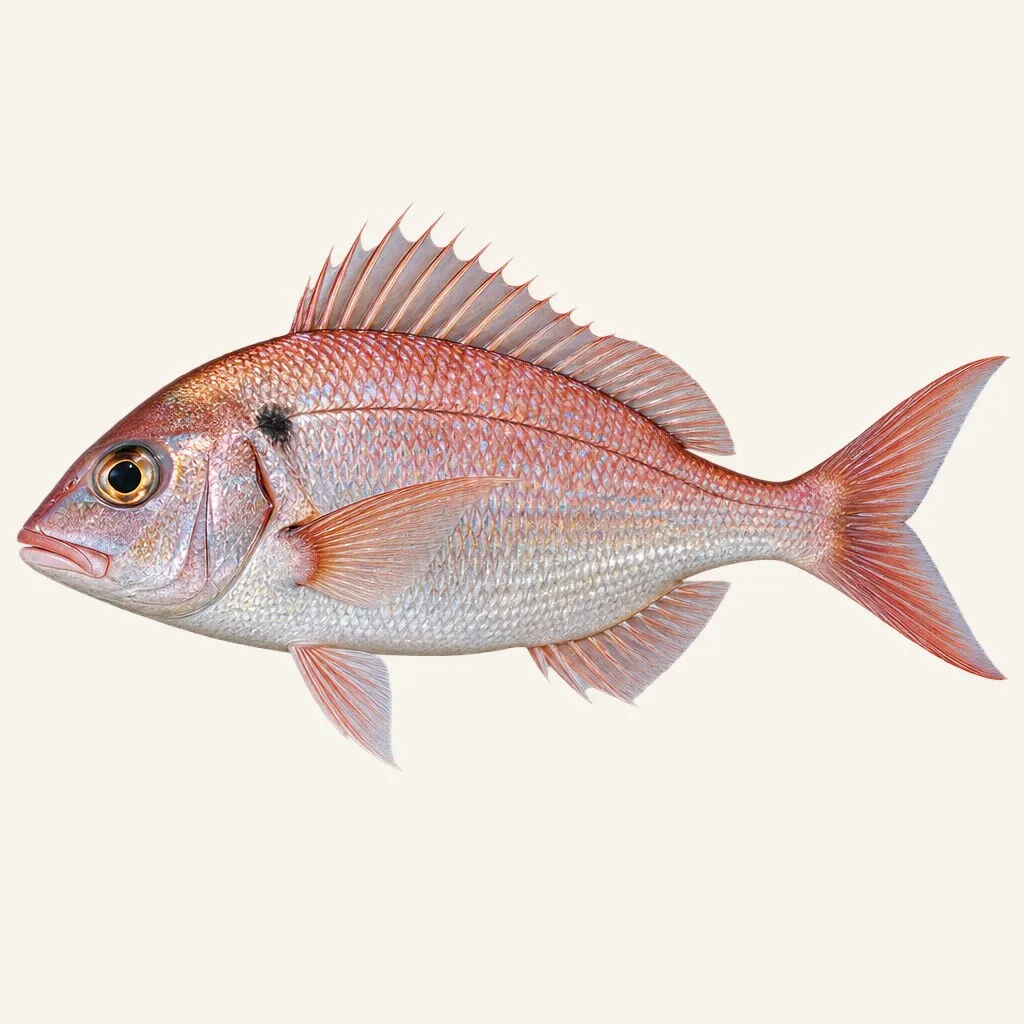
The blackspot seabream is a sparid with an oval silvery-pink body, recognizable by the large black spot at the base of its pectoral fin and its large eye. It inhabits rocky and sandy bottoms in the Mediterranean and East Atlantic, often at depths between 100 and 500 metres.
Calendar
Recorded in 11 countries
Albania · Algeria · Croatia · France · Greece · Israel · Italy · Netherlands · Portugal · Spain · United Kingdom
GBIF occurrence records — native and introduced populations combined.
Its range
Norway and the Strait of Gibraltar south to Cape Blanc in Mauritania, with Madeira and the Canaries, and the western Mediterranean.
The eastern limit is the part to remember. The species becomes rare beyond the Sicilian Strait, so the eastern basin is effectively outside its range. A pandora-shaped sparid with a pectoral spot taken in the Levant or the Aegean is far more likely to be something else, and the identification should be treated as open until the snout and the spot position have both been checked.
Unlike its congeners this is classed as a temperate rather than a subtropical fish, which explains why the range reaches Norway and stops before the warm end of the Mediterranean.
Identifying it
The snout is shorter than the eye is wide. That single proportion gives the fish a blunt, front-heavy head, and it is the fastest way to tell it apart from the common pandora, whose snout runs to twice the eye diameter or more. Nothing about handling, freshness or size changes it.
A black spot marks the body just above the base of the pectoral fin. It is constant and it should be the first thing looked for, but it needs to be located precisely rather than merely noticed: the axillary seabream carries a comparable spot at the base of that fin instead of above it.
The anal fin carries three spines and 11 or 12 rays — a higher ray count than in either congener, and one of the few times in this genus that a count is worth taking. The dorsal has 12 or 13 spines and 11 to 13 soft rays.
Breeding
Male at first sexual maturity, female afterwards, with the change placed between two and seven years of age and at 20 to 30 cm. Simultaneous hermaphroditism has also been suggested for the species — functional tissue of both sexes at once — and the literature has not settled the matter. Reporting both is more useful than choosing.
First maturity is given at about 31.5 cm. Set beside a sex change that is supposed to happen between 20 and 30 cm, that figure is hard to reconcile, and the reconciliation is not available in the sources. What the two numbers agree on is the direction: this species matures late where its congeners mature early, and by a wide margin.
Spawning runs from January to June depending on latitude, and it is the one time of year the adults leave the slope. They move shorewards to the edge of the continental shelf to do it. Eggs measure 1.19 mm and larvae 3.7 mm at hatching.
The water it needs
Depth is the whole biography. The recorded band runs from 150 to 700 m, with the usual domain between 150 and 300 — reaching 400 in the Mediterranean and 700 in the Atlantic. This is a fish of the continental slope, not of the shore.
Age sorts itself by depth. The young live in coastal water; the adults hold the slope, and specifically the muddy ground on it. The two stages are separated by hundreds of metres of water for most of the year, and they only converge on the shelf edge during the spawning months.
Longevity reaches 15 years, which is long for the genus and is the other half of the late-maturity picture: a slow fish in cold, deep, dark water.
Areas
- Deep rocky bottoms
- Continental slopes
- Deep detrital areas
- Edges of seamounts
Techniques
- Deep bottom fishing
- Handlining
- Drift fishing
- Vertical fishing
Baits
- Squid
- Shrimp
- Sandworms
- Mussels
- Small fish
What it eats
Crustaceans, molluscs, worms and small fish. The diet is described as omnivorous but the listed items are all animals, and on slope mud at 300 m that is the only option available — there is no algal film and no seagrass down there to graze.
That distinguishes it in practice from the shelf members of the genus, which take some plant material along with the sediment fauna. Depth does not just move the fish, it changes what the fish can be.
How to catch it
This is a boat fishery on the continental slope, worked between 150 and 300 m over mud. It has nothing in common with the shore and small-boat fishing that the other sparids on this catalogue imply, and it needs deep tackle, weight and an echo sounder rather than a reading of visible structure.
The one window when the fish comes within easier reach is the spawning migration from January to June, when adults rise towards the shelf edge. That is also the period when taking them costs the most, since the whole point of the movement is reproduction.
Two facts should be held together before deciding what to keep. First maturity is given at about 31.5 cm. The common length of the species is about 30. The ordinary fish, in other words, sits on or just under the threshold at which the reference figure says it begins to breed — which is a different situation from a species where the average capture is comfortably a repeat spawner.
The flesh is marketed fresh and frozen and is cooked whole, pan-fried, grilled or baked, which sustains a steady commercial demand for exactly the size class that is at issue.
Conservation · Near Threatened (IUCN) — This species is in decline. Release your catch quickly and handle it with care — wet hands, as little time out of the water as possible.
Conservation
Four traits stack, and none of them is unusual on its own.
Maturity around 31.5 cm, later than in any congener. A lifespan of 15 years. Adults confined to slope ground that deep-water gear reaches and shallow-water gear never touches. And a spawning migration that concentrates those adults, on a known calendar, at the shelf edge.
The consequence of the last one is worth stating plainly: catch rates during the migration bear no relation to abundance. Fish that were spread thinly across hundreds of metres of depth are briefly in one place, and a good season on the shelf edge can be recorded from a stock that is not doing well at all.
The depth stratification adds a monitoring problem on top of the biological one. Inshore gear works the juveniles; slope gear works the spawners; and neither fishery sees what the other is removing from the same stock. A recruitment failure caused inshore takes years to appear in the slope catches, by which time the year classes that would have explained it are gone.
Regulations
Check the local regulations in force (legal size limits, closed seasons, bag limits).
For guidance only. Legal sizes, quotas and open seasons vary by location and season: always check the local regulations in force before fishing.
Other names
Blackspot seabream in English, after the mark above the pectoral. The name is accurate and it is also shared in spirit with the axillary seabream, whose spot sits a fraction lower, so the two English names distinguish the species less sharply than they appear to.
Spanish besugo and French dorade rose. Italian goes for the eye instead, with occhialone, and that is the better description: a fish whose snout is shorter than its eye is a fish built to see at 300 m.
The commercial name to distrust is beryx, which is applied to this species on some labels. The beryxes are unrelated deep-water fish of another family, with a different body and a different fishery, and the two should not be filed together whatever the slab says.
Sources: fishbase.se · api.gbif.org