Striped bass
Morone saxatilis · Moronidae
- Saltwater
- Coastal
- Medium
- Size
120–200 cm
- Weight
21–57 kg
- Lifespan
30 years
- Water temp.
8–25 °C
Where to fish
- Estuary
- Beach
- Rocky shore
Habitat icons: Flaticon
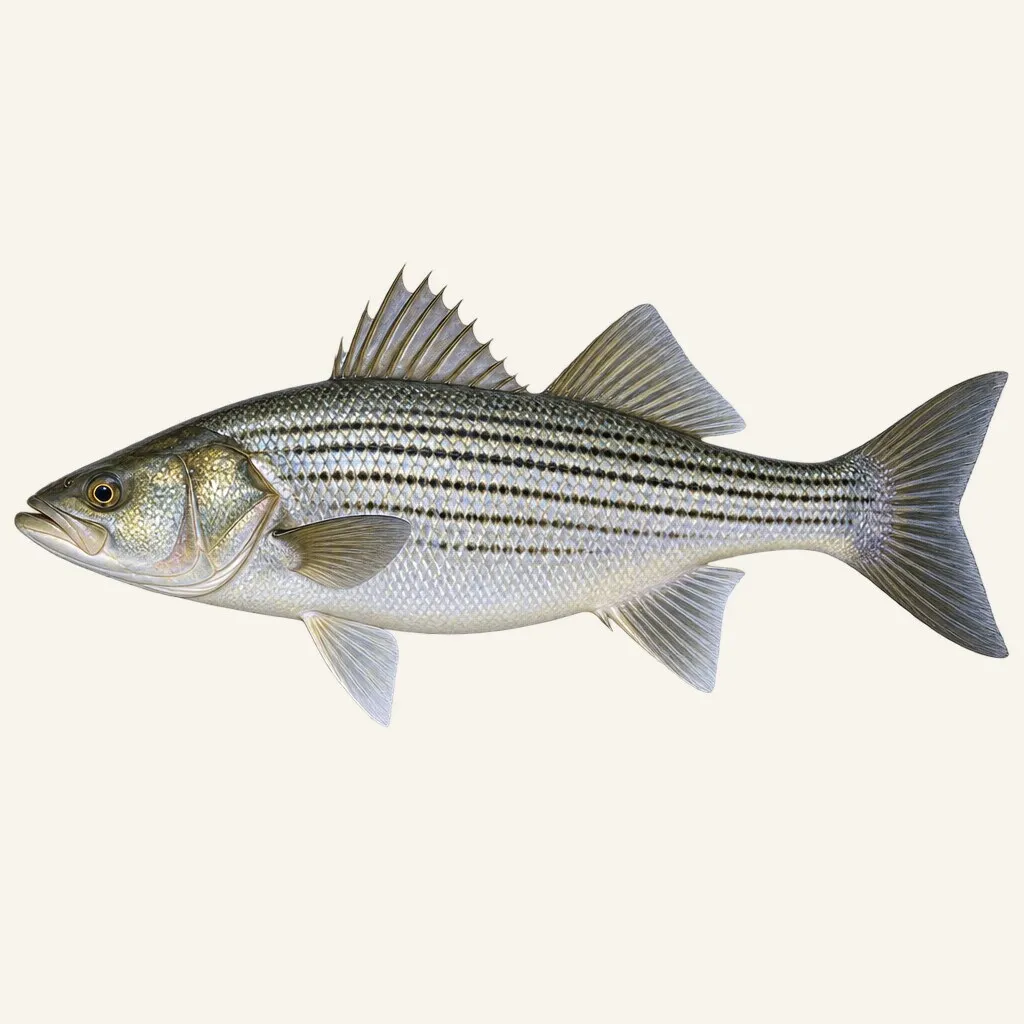
The striped bass is a large coastal perciform recognizable by its silvery sides marked with 7 to 8 dark horizontal stripes; it can exceed 1.2 m and 30 kg. An aggressive predator, it hunts at the surface and at depth in estuaries and along rocky shores of the North American Atlantic coast.
Calendar
Recorded in 3 countries
GBIF occurrence records — native and introduced populations combined.
Its range
The range follows the North American Atlantic seaboard from the St Lawrence in Quebec down to Lake Pontchartrain in Louisiana, with a southern outlier in the Florida peninsula in the St Johns and Suwannee drainages. Temperature closes it at both ends: the species is logged between eight degrees and 25, and it does not persist much outside that.
What a map cannot show is how much of the present distribution is maintained rather than natural. The species is farmed commercially, and closed populations have been established in reservoirs a long way from any estuary. A record from inland water is therefore as likely to come from a hatchery programme as from a fish that swam there, and the two mean entirely different things when reading the history of a fishery.
Identifying it
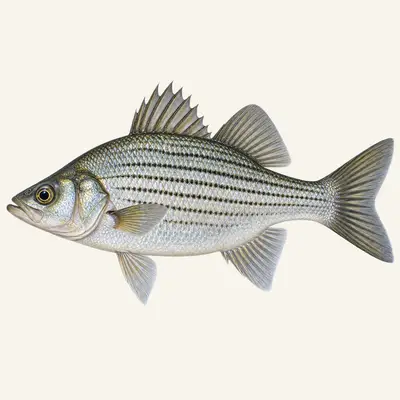
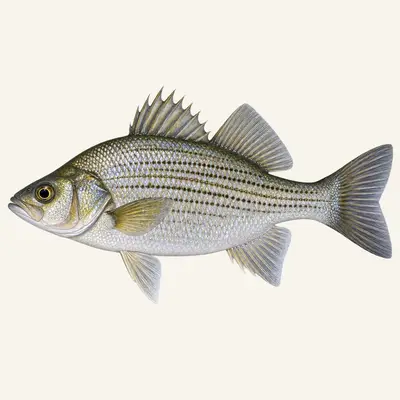
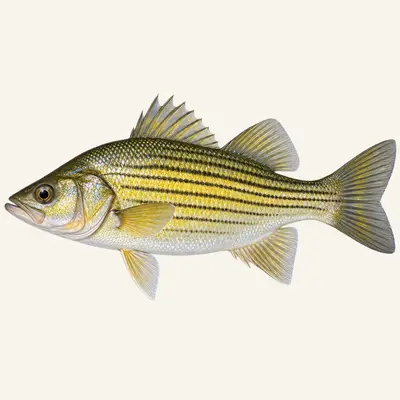
The stripes are unbroken. Seven or eight dark lines run back from behind the gill cover to the base of the tail without a break or a step in them, and that one character settles the fish against every other temperate bass on the coast: on a white bass and a yellow bass the lower lines are interrupted and offset. Anyone who has looked at the flank of a small striper and a small white bass side by side never needs to be told twice.
Note also that the lines run lengthwise. A perch of any kind carries dark bars across the body from top to bottom, so a striped flank and a barred flank are two different families before they are two different fish.
The body is fusiform and genuinely long — no dorsal hump, none of the lateral flattening that gives the smaller members of the genus their compact outline. The two dorsal fins are well separated, the first carrying nine to 11 spines, the second 10 to 13 soft rays; the anal fin has three spines and seven to 13 rays.
A fish taken in a river and a fish taken off a beach are the same animal, and nothing in the markings separates them. Freshwater fish darken somewhat, but the geometry of the stripes does not shift.
Breeding
Spawning happens in fresh or brackish water, and the fish stops eating shortly before it. That single line reorganises the calendar: a striper committed to its run is not hunting, and the productive part of the spring sits before the fish enter the river rather than during the time they are most concentrated and most visible in it.
A female spawns more than once in a season, but she does not necessarily spawn every year. This is the most consequential fact on the page. A stock full of mature females does not therefore produce a year class every spring — depending on conditions and on the condition of the fish, part of the breeding population sits the season out. Recruitment is irregular by nature, which means a blank year is not by itself evidence of a problem, and a strong year is not by itself evidence that anything has been fixed.
Some populations are landlocked and complete the whole cycle without ever reaching the sea. They are the proof that the coastal migration is a journey rather than a physiological requirement: what the fish needs is fresh or brackish water to spawn in, not a return from salt.
The water it needs
A fish of coastal water and bays, living near the bottom but hunting through the whole of the water column, recorded well past 30 m and running up into rivers in spring.
The real peculiarity is salinity. Sea, estuary, fresh river: this species crosses the whole gradient inside a single year without any obvious transition, which no fish that a bank angler is used to does. The practical version of that is unsentimental. A mark that fishes superbly in April can be barren in August, not because the fish have become cautious but because they are somewhere else — further up the estuary, or further out.
Areas
- Estuaries and coastal bays
- Atlantic surf beaches
- Tidal rivers
- Rocky coastal zones
Techniques
- Soft lures
- Topwater plugs
- Live bait fishing
- Surfcasting
- Jigging
Baits
- Bunker (menhaden)
- Sea worm
- Shrimp
- Squid
- Small live fish
What it eats
Voracious and undiscriminating, and the diet turns over completely as the fish grows. Larvae filter zooplankton; juveniles work on small shrimps and other crustaceans, marine worms and insects; adults attack more or less anything of the right size that swims.
The recorded prey list is the measure of that appetite: alewives, herring, smelt, eels, flounders, mummichogs, rock gunnels, sand lance, silver hake and silversides among the fishes, and squid, crabs, sea worms and amphipods among the invertebrates, with crustaceans dominating the second half.
Not one of those items is essential. That is exactly what makes the species hard to pin down — a striper does not lock on to a resource, it locks on to whichever resource is present, and a fishery built around one bait works only as long as that bait is there.
How to catch it
Find the forage, not the fish. It follows directly from a diet that broad: stripers hold where food is being concentrated, and a school of clupeids, a body of sand lance or a tidal seam that gathers shrimp is worth more than any amount of bottom reading. Which lure gets tied on matters far less than whether it is in the right water.
The season is read off the spawning calendar. The feeding shutdown before spawning cuts a hole in a period when the fish are otherwise gathered and easy to locate, and the days after feeding resumes are among the best of the whole year.
Moving between environments obliges the angler to move too. Estuary fishing in spring and open-coast fishing in summer are not the same exercise, not at the same depths and not with the same tackle, and anyone loyal to one kind of mark will meet the species for only part of its year.
Then there is age. Thirty years is the maximum reported. A very big striper is not merely a big catch: it is an animal that has been through three decades of everything the coast could do to it, and in all probability a female carrying the reproductive weight of a whole stretch of coastline.
Conservation
This is the case that every coastal fisheries manager cites, and it is worth knowing for what it demonstrates rather than for what it says about the species today.
The Atlantic coast stock collapsed through the late 1970s and into the early 1980s. Maryland closed its fishery outright in 1985, other states followed with closures and severe restrictions, and the coastwide stock was declared recovered by the Atlantic States Marine Fisheries Commission in the middle of the 1990s. A decade of restraint for one recovery.
That decade was not an arbitrary length of time; it came out of the biology set out above. A fish that lives 30 years, whose females do not spawn every season, rebuilds slowly. Several year classes are needed to reconstitute a proper age structure, and each of them takes years to become capable of breeding. A one-season or two-season closure would have produced nothing measurable — which is precisely the mistake the precedent now prevents elsewhere.
The other half of the lesson is less comfortable. What was rebuilt can come apart, and the same slowness works in the other direction: the decline of a long-lived stock is visible late, by which point several cohorts are already missing. Regulations on this species change frequently and differ by state and by water; the management authority for the coast being fished is the only source for them.
Regulations
Check the local regulations in force (legal size limits, closed seasons, bag limits).
For guidance only. Legal sizes, quotas and open seasons vary by location and season: always check the local regulations in force before fishing.
Other names
Striped bass is the full name, striper the universal shortening. Around Chesapeake Bay the fish is a rockfish and has been for centuries, in ordinary speech and in the state's own regulatory language, which matches the species epithet — saxatilis means living among rocks.
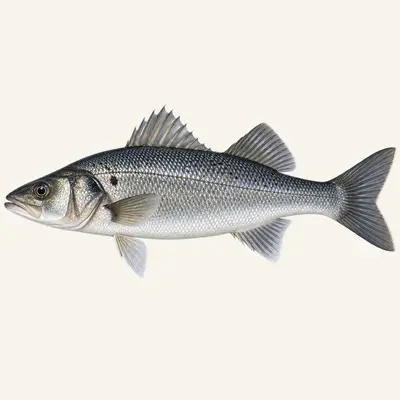
The family question is worth getting right, because the word bass is doing three jobs at once. This fish and the European sea bass are both Moronidae, genuinely close relatives, which is why they look and behave so much alike and why a European angler recognises the shape immediately. The black basses — largemouth, smallmouth and the rest — are Centrarchidae, sunfish, and are not related to either. So of the fish called bass on the two sides of the Atlantic, some are cousins and some are strangers, and the name itself gives no indication which is which.
One more source of confusion is deliberate. The cross between this species and the white bass is stocked in fresh water across much of the United States and sold under a shelf of names — hybrid striped bass, wiper, sunshine bass — so a striper reported from an inland lake may be a hybrid, a stocked landlocked pure fish, or neither.
Sources: fishbase.se · api.gbif.org