White bass
Morone chrysops · Moronidae
- Freshwater
- Predators
- Medium
- Size
32–45 cm
- Weight
0.5–3.1 kg
- Lifespan
9 years
- Water temp.
12–32 °C
- Depth
0–13 m
Where to fish
- Estuary
- Lake
- River
Habitat icons: Flaticon
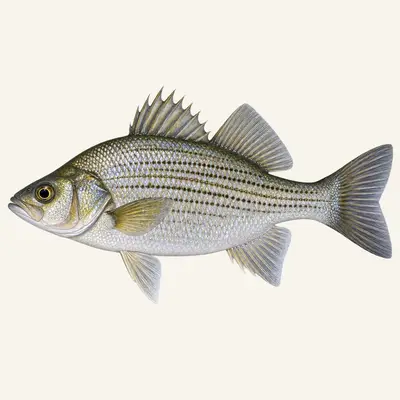
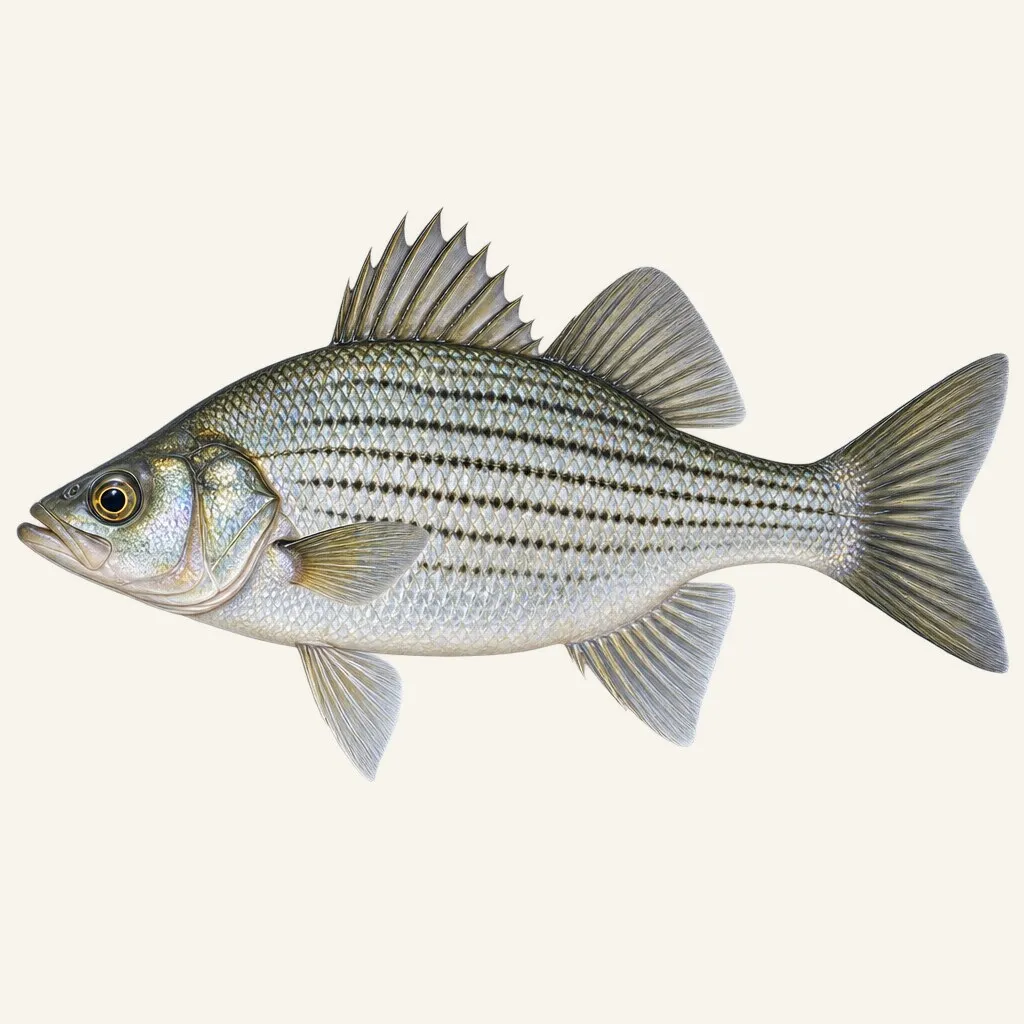
The white bass is a medium-sized fish with a silvery, elongated body and characteristic longitudinal stripes along its flanks. It belongs to the Moronidae family and is distinguished by its slightly protruding mouth.
Calendar
Recorded in 2 countries
GBIF occurrence records — native and introduced populations combined.
Its range
Three great interior systems carry the species: the St Lawrence with the Great Lakes, the Hudson Bay basin by way of the Red River, and the Mississippi, from Quebec and South Dakota down to Louisiana. From the lower Mississippi the range then runs west to the Rio Grande in Texas and New Mexico.
That shape is the signature of a fish that changes basin along continuous fresh water rather than by way of the sea. Its movements are potamodromous — they happen inside the drainage network — so the range grows where rivers connect and stops where they do not, which is why it fills the central drainages so completely and reaches the southwest along one line of rivers instead of spreading across it.
Identifying it
Of the four temperate basses in North America, this is the one that never sees salt water. It is a strict freshwater fish, with none of the salinity tolerance and none of the coastal leg the others have, and that alone often decides an identification: a striped silver bass taken from an inland reservoir, well away from tidal influence, is far more likely to be this species than a stray of another.
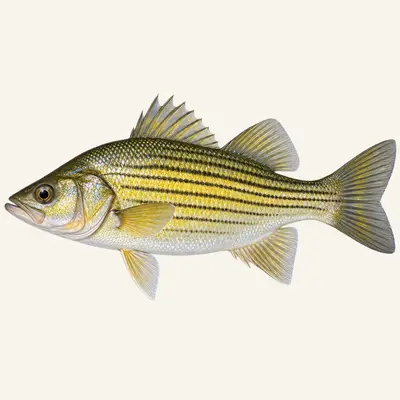
On the fish itself, the lines are the character but not a clean one. They run lengthwise along a silver flank and they are less even and less sharply drawn than the continuous set carried by the striped bass, particularly low down on the body. The ground colour has none of the brassy tone that gives the yellow bass its name. The mouth projects very slightly.
Size helps as much as anything. Forty-five centimetres is the greatest length published and around 32 the ordinary adult, so this species never reaches the bulk that makes a large striper recognisable from across a boat.
Breeding
Spawning takes place near the surface, which is a genuinely unusual arrangement for a freshwater perch-like fish. No nest is dug, no substrate is needed and no parent stays: the eggs are shed into open water in the upper layers and sink afterwards.
Maturity comes at about 28 cm, a little below the length of an average adult, so almost every fish caught in this species is a breeding one. The oldest reported age is nine years.
A short life has a visible consequence on the water. A population running on fewer than 10 year classes rests on a handful of successful springs, and a good or a failed spawning shows up in the catches two or three seasons later. The abundance of white bass therefore swings a long way from one period to the next, and neither the peaks nor the troughs need any explanation beyond that.
The water it needs
Lakes, ponds and river pools of any size will do, provided there is depth: the species is recorded from the surface to about 13 m, between 12 and 32 degrees.
It lives in shoals and it covers ground. This is an open-water fish rather than a margin or a bottom fish, and the shoals rise towards the surface when they are feeding. Its position in the column consequently changes through the day far more than that of a percid, which stays low, and a depth that produced fish at midday may be empty at dusk.
Areas
- Large lakes and reservoirs
- Moderately flowing rivers
- Tributary mouths
- Rocky shallows
Techniques
- Cast-and-retrieve with light lures
- Surface fishing with poppers
- Vertical jigging with light jig
- Slow trolling
Baits
- Small soft lures
- Light spinning spoons
- Bloodworms
- Small live baitfish
What it eats
The switch to fish is total in the adult. Juveniles take small invertebrates — cladocerans, copepods, midge larvae — and the diet then moves onto shad, silversides and the occasional young sunfish.
That reliance on one or two shoaling, open-water prey species is the central fact of the animal's biology. Where shad are abundant, white bass grow quickly and the shoals are large; where they are scarce, the species never amounts to much. Locating a shoal of white bass is therefore a matter of first locating the shoal it is living off.
How to catch it
Watch for the kill rather than for the fish. A shoaling predator driving clupeids up against the surface announces itself twice over — broken water, and birds working above it — and that signal beats any amount of structure reading. The whole thing moves fast: a surface feeding spell lasts a few minutes, so a long cast into it counts for more than a careful approach to it.
Between those episodes the fishing is open-water fishing. The fish are neither on the bottom nor along the bank, and the only method that finds them is to search the column from top to bottom instead of committing to a chosen depth.
The annual movement then supplies the one predictable appointment of the season. When the shoals run up into the tributaries and pile up below whatever obstruction stops them, an enormous number of fish occupy a very short length of river. It is the single occasion in the year when the exact place is known in advance, and it is fished accordingly.
Conservation
Two things about this species make it swing rather than decline, and it is worth telling those apart before reading anything into a poor season.
The first is the forage. A predator locked onto shad rises and falls with them, and a shad population is itself capable of collapsing in a hard winter or a bad year. The second is longevity: nine years leaves no reserve of old fish to carry a stock through two failed springs in a row. Together they produce a fishery that alternates between glut and scarcity as a matter of course.
Where genuine pressure applies, it applies at the run. A potamodromous fish depends on a connected drainage, and a dam or a weir does two things at once — it removes the upstream part of the movement, and it stacks every fish that would have made that movement into one short reach where they are at their most catchable and their most concentrated. The management question at those sites is not the size of the stock but the timing of the pressure on it, and the rules that follow from it vary by state and by water.
Regulations
Check the local regulations in force (legal size limits, closed seasons, bag limits).
For guidance only. Legal sizes, quotas and open seasons vary by location and season: always check the local regulations in force before fishing.
Other names
White bass is the accepted name; sand bass is standard in Texas and silver bass across parts of the north. Anglers in the South shorten the description of the flank to stripe or streak, which is where the trouble starts, since a reservoir holding both this species and a stocked striped bass will produce catch reports in which neither name means anything definite.
The species epithet is precise about something unexpected. Chrysops means golden eye, and it describes the eye rather than the body — a fish named for the one part of it nobody mentions.
Its near neighbour in the genus compounds the confusion by name alone: white bass and white perch are two different fish in the same family, and the second one is not a perch either.
Sources: fishbase.se · api.gbif.org