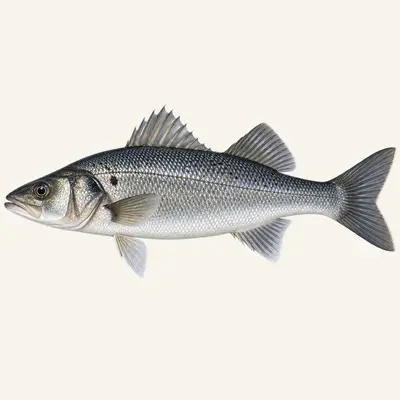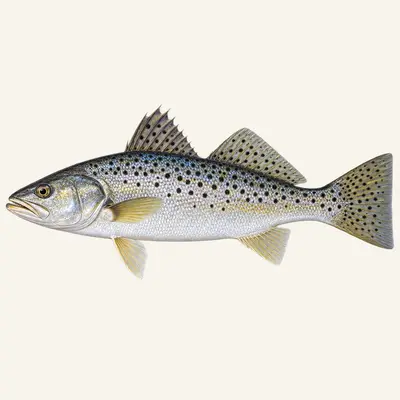
Spotted seabass
Dicentrarchus punctatus · Moronidae
- Saltwater
- Coastal
- Medium
- Size
30–70 cm
- Weight
0.2 kg
Where to fish
- Estuary
- Reef
- Rocky shore
Habitat icons: Flaticon
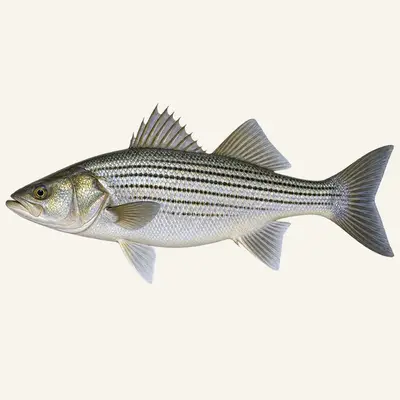
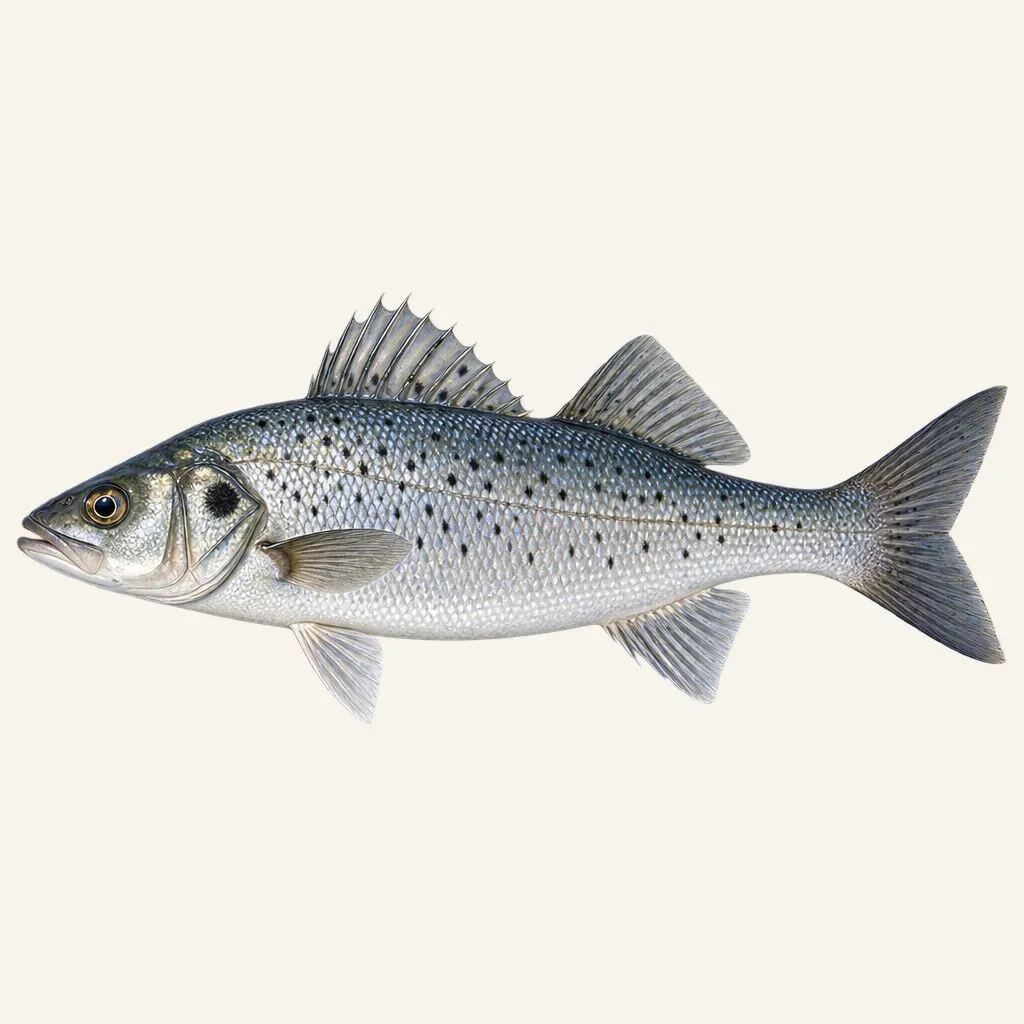
The spotted seabass is a coastal marine perch-like fish of the Moronidae family, found in the Mediterranean, eastern Atlantic, and African coasts. Its elongated silvery body is marked with distinctive small black spots on the flanks, easily distinguishing it from the common sea bass. It inhabits rocky areas, estuaries, and coastal lagoons.
Calendar
Its range
The species runs from the English Channel, where it is occasional, southward along the European and Moroccan coasts to Senegal and the Canaries, with the southern Mediterranean and the Gulf of Suez.
The shape of that is the point. This is a fish of north-west Africa and the warm southern rim, and the northern European records are the thin end of it rather than the middle. Its relative occupies the reverse arrangement, with its bulk in the north and strays to the south. Where the two ranges lie on top of each other — Portugal, Spain, Morocco, the southern Mediterranean — is where the identification actually has to be made, and it is also where the two are landed together.
Identifying it
The decisive character is in the roof of the mouth. The patch of vomerine teeth on the palate is shaped like an anchor, its rear teeth running back as far as the midline of the palate. The published diagnosis of the European sea bass describes its own patch as a crescentic band, confined to the front. Two descriptions, two shapes, one finger to check it with — and unlike colour, the palate does not change with age or with the water the fish came out of.
The scales on the interorbital space, between the eyes, are ctenoid: rough to a fingernail drawn across them. The same space on the European sea bass is recorded as cycloid, and smooth.
The spotting that names the species is real but treacherous. Small dark markings are scattered over the back and the sides, and the record notes them on adults as well as on juveniles; there is also a very distinct black spot on the gill cover. On a small fish that is all the identification anyone needs. On a large one the markings can be faint enough to argue about, and that is exactly when the palate is worth the extra ten seconds.
The rest is a bass: two separate dorsal fins, nine or ten spines then twelve to fourteen soft rays, three anal spines and ten to twelve rays, a moderately forked tail on a fairly deep caudal peduncle, small scales, two flat spines on the gill cover and a row of large forward-pointing spines along the lower edge of the preopercle. Those last will open a hand that grips the head carelessly.
The water it needs
Coastal marine and brackish water over any bottom it finds: sand, muddy sand, rock. Two extensions of that are worth more than the substrate list.
It goes up rivers, occasionally, into water that is fresh. And it lives in hypersaline conditions, the record citing the Sine Saloum in Senegal by name — evaporating tidal creeks where the water is saltier than the sea outside them.
Between those two limits lies just about every salinity a fish can be exposed to, and few coastal predators cover the whole span. The practical consequence is that ordinary reasoning about where a bass ought to be does not constrain this one: a lagoon too salty to hold much, or a river mouth running fresh after rain, are both places it can be.
The record also classes the species as pelagic-neritic — a fish of the water column over the shelf — where the European sea bass is set down as demersal. Whatever the two entries mean in detail, this is not an animal to be looked for exclusively on the bottom.
Areas
- Rocky coastal areas
- Seagrass beds
- Sandy estuaries
- Reef edges
Techniques
- Soft lures
- Hard plugs
- Live bait fishing
- Surfcasting
- Retrieve fishing
Baits
- Shrimp
- Sand eel
- Live bait (small mullet)
- Anchovy
- Cuttlefish
What it eats
Shrimps and molluscs lead the diet, with fish taken as well.
That order matters more than it looks. The published account of this species records no shift towards a fish diet with age, unlike the account of its relative, which follows juveniles onto invertebrates and adults onto fish. What is written down for this fish is a crustacean and shellfish feeder that also eats fish, at whatever size it has reached.
Read it as a bait instruction. Shrimp, prawn, worm and small crab are working baits for an adult, and they are not a compromise on the way to something better.
How to catch it
Rock, sand and the mouths of lagoons, worked with small crustacean baits and with lures kept modest.
Scale is the thing to get right, and it comes out of two figures. Maturity is recorded at about 22 cm and common length is 30. This is a small bass, and gear built for a large one is simply wrong: hooks too big for a mouth that takes shrimp, lures profiled for a fish twice the size, drag settings that have no purpose. The fish will not be found by fishing heavier.
Because the species is classed as a fish of the water column, presentations that stay in the middle of it earn their place — a light soft plastic on a small head, drifted rather than dragged, or a bait fished under a float over rough ground.
Salinity opens ground that would otherwise be dismissed. The upper reaches of a hypersaline creek and the fresh end of a river mouth are both worth prospecting, and in the southern part of the range they are frequently the productive water rather than the marginal water.
Conservation
The problem specific to this species is that it is caught in the same nets and off the same rocks as a fish it resembles, and the two do not respond the same way to pressure.
Maturity here comes at around 22 cm. In the Atlantic, the European sea bass is recorded as maturing at an average of 36 and after four to eight years of life. That is a very large difference in the thing that matters most: how much of a population has already spawned before it becomes catchable. An early-maturing fish carries removal far better, because most of the individuals taken have already contributed.
Two consequences follow, and they point in opposite directions. A management measure calibrated for the slow-maturing species will constrain this one for no biological reason. A measure calibrated for this one will fail to protect the other. Where the two are landed together and reported together — which is most of the Iberian and Moroccan coast — the mixture makes both errors possible at once, and the only correction is at the point of identification, on the boat or on the rocks.
The species is fished commercially on a small scale across its range and rules for it are set nationally; the maritime fisheries authority for the country concerned is where they come from.
Regulations
Check the local regulations in force (legal size limits, closed seasons, bag limits).
For guidance only. Legal sizes, quotas and open seasons vary by location and season: always check the local regulations in force before fishing.
Other names
Spotted seabass is the usual English name, and spotted bass is a form to avoid: in North America that is a black bass of fresh water, Micropterus punctulatus, and the two words have been thoroughly taken.
Iberian usage has baila in both Spanish and European Portuguese — Brazil says robalo-pintado — a proper name of its own rather than a modified version of the word for the other species, which is unusual and useful. French has bar tacheté or bar moucheté, Italian spigola punteggiata.
Punctatus means spotted. Dicentrarchus means two-spined, after the pair of flat spines on the gill cover, and the genus holds only this species and the European sea bass — which is why a bass caught in the eastern Atlantic reduces to a single question, and why it is worth being able to answer it.
Sources: fishbase.se · api.gbif.org