White perch
Morone americana · Moronidae
- Saltwater
- Coastal
- Medium
- Size
14–58 cm
- Weight
0.0–2.7 kg
- Lifespan
16 years
- Water temp.
10–33 °C
- Depth
0–10 m
Where to fish
- Estuary
Habitat icons: Flaticon
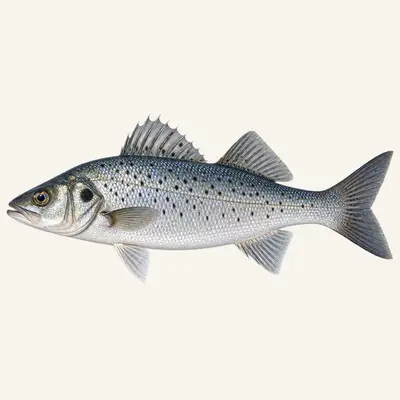
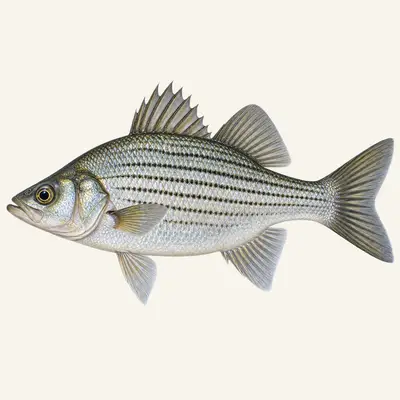
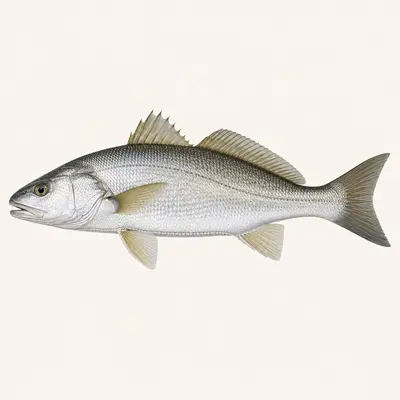
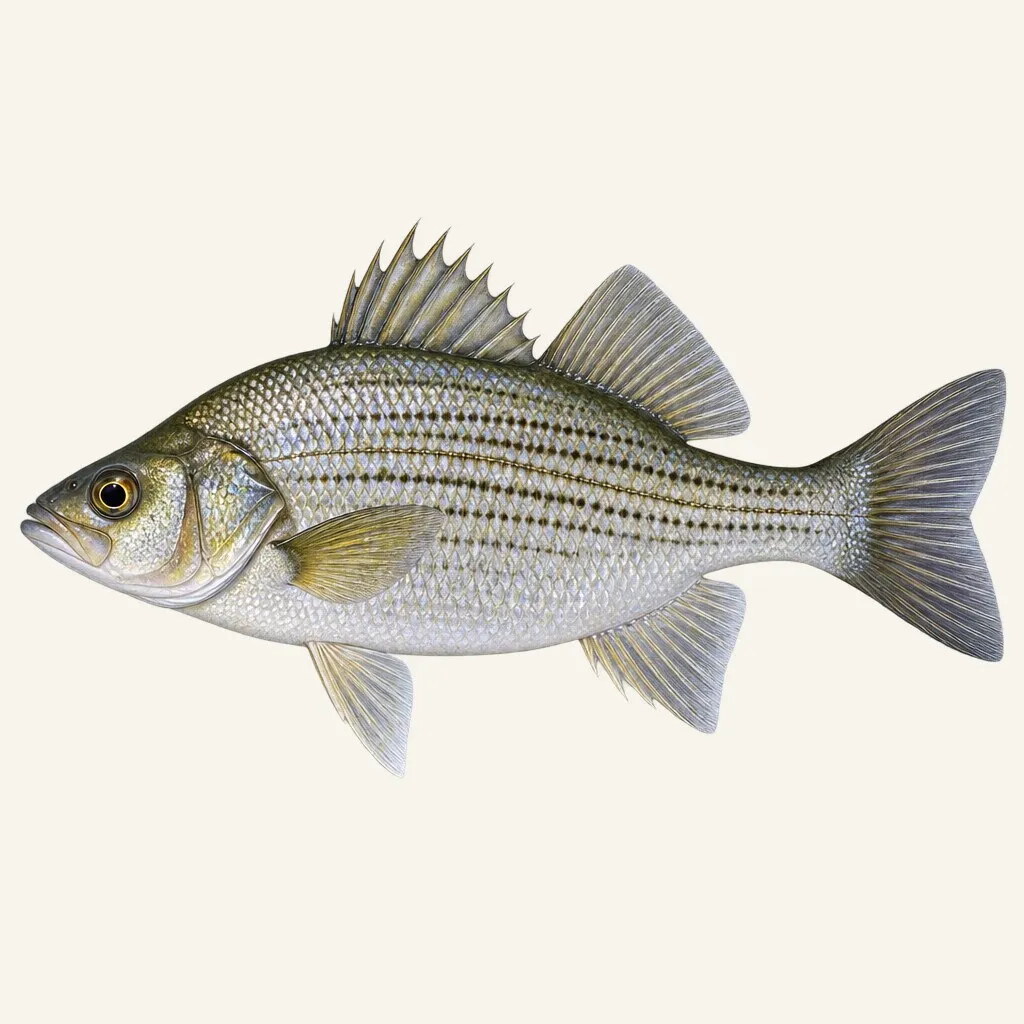
The white perch is a small coastal perciform of the Moronidae family, with a compressed, silvery body and greenish tints on the back; it rarely exceeds 40 cm. It inhabits estuaries, shallow bays, and coastal waters along the eastern seaboard of North America.
Calendar
Recorded in 2 countries
GBIF occurrence records — native and introduced populations combined.
Its range
The natural range is the Atlantic Slope, from the St Lawrence drainage in Quebec south to the Savannah River in Georgia. The thermal window is 10 to 33 degrees, wide at the warm end, which puts the species further south than the largest members of its genus manage.
Everything else came by lorry. It was moved into the Great Lakes — all of them except Superior — then into the Ohio, Missouri and Mississippi systems of the midwest, and on as far west as Colorado. The Superior exception is not a gap in the paperwork: it is the coldest of the five lakes, and the bottom of the species' temperature range runs through it.
The transfers did more than relocate a fish. An animal that had evolved to shuttle between river and sea was shut into fresh water across half a continent, where it now lives as a strictly inland species, and that landlocked version is the only one most American anglers will ever meet. The map above merges the two histories without distinguishing them.
Identifying it
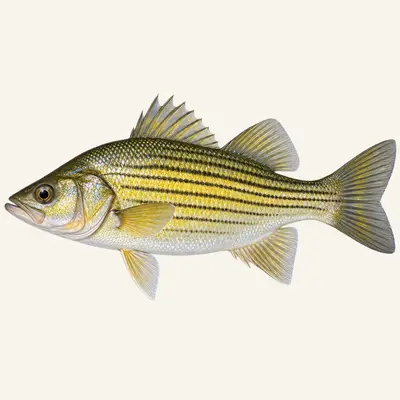
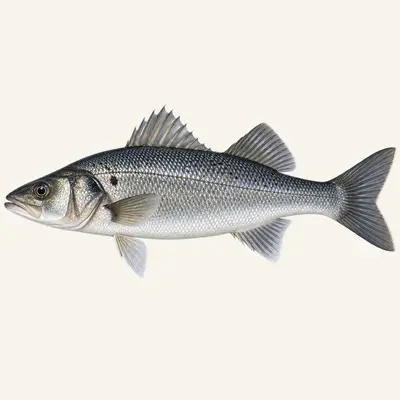
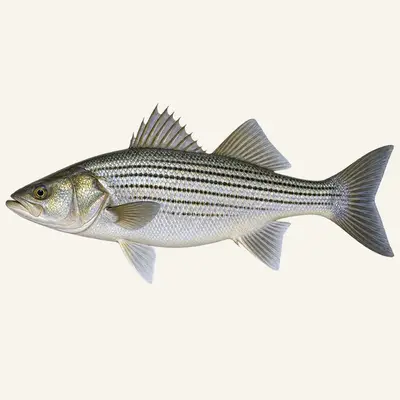
The absence of markings is the mark. This is the one temperate bass on the eastern seaboard with no clean lines along its flank: a compressed silver body, greenish over the back, plain sides, sometimes with faint dusky shading that never resolves into the hard stripes of the striped, white and yellow basses. Confusion runs the other way instead — a small white perch gets mistaken for a young striper by people who have not yet looked at where the lines are supposed to be.
The fin spines deserve a word. They are sharp and they will open a hand gripped in the wrong place, but they carry nothing: the species has neither an anterolateral glandular groove nor a venom gland, and the wound is a straightforward puncture. The distinction earns its keep in water that also holds catfish, whose spines do inject.
Breeding
The breeding of this fish has never been described in its own right. The reference literature assumes it follows the pattern of the striped bass — a move into fresh or brackish water, repeated spawning within a season — and no observation of the species itself is offered in support. Anyone building a spring strategy on that assumption should know it is an assumption.
What is established concerns where the cycle runs rather than how it works. The white perch completes it indifferently in fresh, brackish or coastal water, and the populations that sit hundreds of kilometres from any estuary breed perfectly well without ever going near the sea.
The water it needs
Slack water and a soft bed. Pools and other quiet sections of medium to large rivers, usually over mud, in the top 10 m and generally a great deal less than that: the species avoids current and does not hold in a fast seam.
Salt tolerance is the other half of it. Fresh water, brackish water and coastal bays are all in range without any evident threshold between them, which hands the fish an entire estuary — from the head of tide down to full salt — as a single continuous habitat.
Areas
- Atlantic estuaries
- Shallow brackish bays
- Tidal streams
- Sheltered harbour areas
Techniques
- Light bottom fishing
- Light lures
- Marine drop-shot
- Slow trolling
Baits
- Sea worm
- Shrimp
- Small soft lures
- Diced squid
- Mussel
How to catch it
A fish of numbers rather than of size. A shoal of white perch gives take after take on small baits worked close to the bottom in still water, and the difficulty is never catching one; it is finding a big one.
The size figures explain why, and they are the most useful thing on this page. An ordinary fish is about 13.5 cm, and the greatest reported age is 16 years. The length the species is capable of and the length it usually reaches are not reconcilable through growth alone, and the gap is not a measurement error: where the species is abundant it competes with itself and stops growing, so a dense population consists of a very large number of hand-sized fish, many of them not young at all. A small white perch is therefore not necessarily a juvenile with its growth ahead of it — it may already be as long as it is ever going to be, at 10 years old.
The marks are read off that preference for slack, soft ground: pools out of the current, broad mud flats, sheltered margins, harbour corners. A rig drifting in the flow passes over the fish rather than through them.
Its indifference to salinity widens the ground rather than complicating it. One approach and one set of baits will work from the fresh reaches to the bay, which is unusual, and it means a single tide can be fished across two or three kinds of water without changing anything.
Conservation
Nothing presses on the species. What is worth recording is what a century of stocking turned it into, because the transformation is unusually complete.
A migratory fish able to use sea, estuary and river was converted, in the space of a few decades, into a resident of reservoirs and inland lakes over an enormous area. The behaviour did not vanish with the opportunity — these are still fish that will spread through a connected system as far as temperature allows — and once in a lake they are not retrievable.
The density problem is the second consequence, and it is the same one in a different form. Populations that stunt tie up the productive capacity of a water in fish too small to interest anybody, and unlike a sunfish in a pond a white perch in a large lake is beyond any practical thinning.
The one place the process stopped is instructive. Lake Superior stayed out of it because it is too cold, which is a reminder that the limits on a transplanted species are physical rather than administrative, and that they are the only reliable ones.
Regulations
Check the local regulations in force (legal size limits, closed seasons, bag limits).
For guidance only. Legal sizes, quotas and open seasons vary by location and season: always check the local regulations in force before fishing.
Other names
White perch is the name and it is wrong twice over. The fish is a Moronidae, a temperate bass, and shares no family with the true perches at all — the yellow perch swimming beside it in the same rivers is a Percidae, and that one is the perch. Nothing about the two is related except the word.
The name is also taken. Across much of the American South, white perch means the white crappie, a centrarchid of another genus entirely, so a catch report from Tennessee and a catch report from Maine can use the same two words for two unrelated fish. Bait-shop usage muddies it further, since perch on its own in the South often means a sunfish of any kind.
Quebec settled on baret, which at least borrows nothing from anything else.
Sources: fishbase.se · api.gbif.org