Alligator gar
Atractosteus spatula · Lepisosteidae
- Freshwater
- Predators
- Medium
- Size
200–260 cm
- Weight
50–137 kg
- Lifespan
95 years
Where to fish
- Estuary
- River
Habitat icons: Flaticon
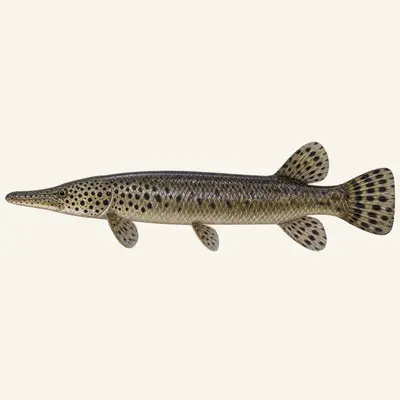
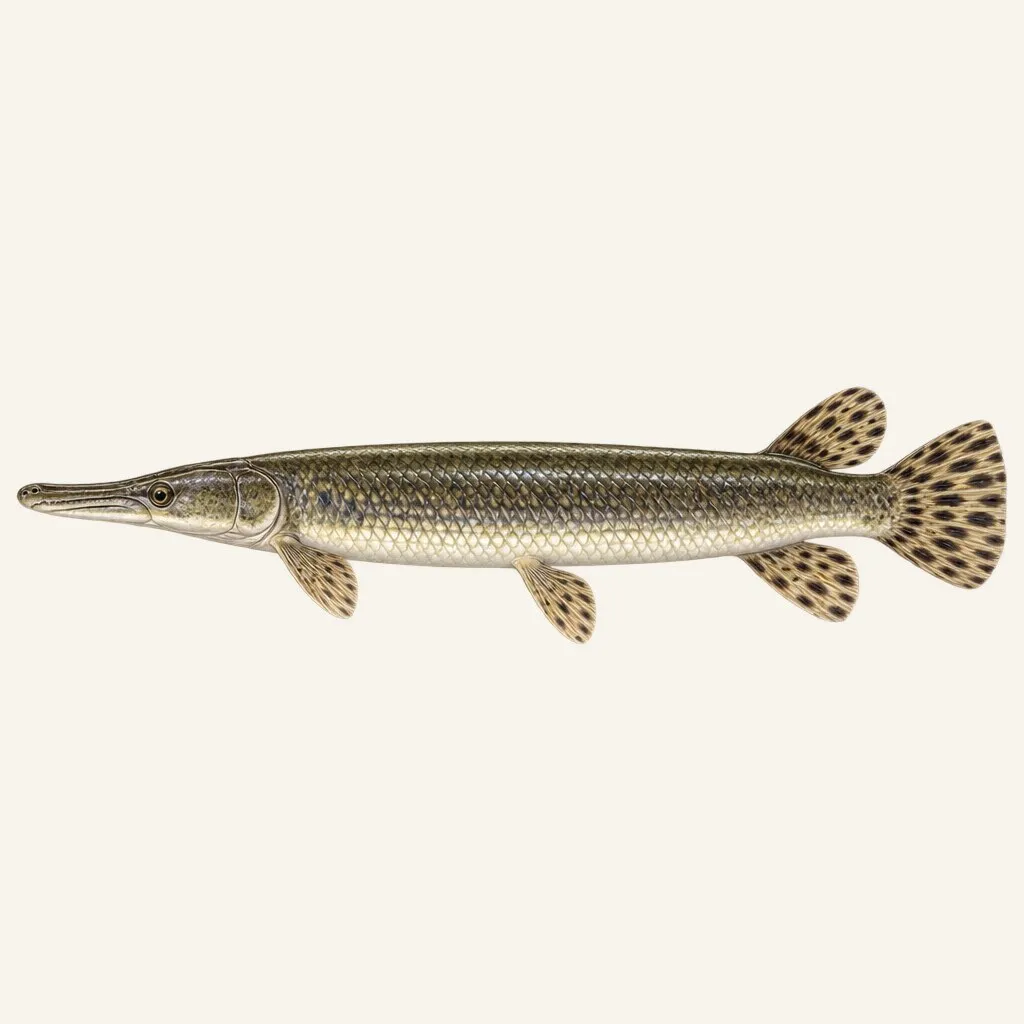
The alligator gar is the largest of all gars, inhabiting the warm waters of the southern United States, recognizable by its broad, flattened spatula-shaped snout, its two rows of teeth, and its brown-olive coloring with spotted flanks.
Calendar
Recorded in 2 countries
GBIF occurrence records — native and introduced populations combined.
Its range
The Mississippi basin from south-western Ohio and southern Illinois down to the Gulf of Mexico, then the Gulf coastal plain from the Econfina River in Florida west to Veracruz.
Half of that is Mexican. The species runs the full breadth of the Gulf plain and reaches the tropics on its southern flank, and the English-language literature — which handles it as a fish of the American South — is describing the northern portion of a range it shares with another country.
The northern edge is set by the season rather than by the river. There is nothing about the upper Mississippi this fish could not use in July, and the fact that it stops where it does says the winter is what excludes it.
Identifying it
A pale stripe runs the length of the back. The diagnosis leads with it after size and snout, and it is not something the smaller gars are described with: dark olivaceous brown above, white to yellowish below, and a light line down the dorsal surface between the two.
Dark brown blotches cover all the fins. The description says all of them, without exception, where the accounts of the smaller species single out particular fins instead.
The snout is short and broad. On this animal it is not a beak at all but a wedge, carrying two rows of teeth, and the difference from the narrow-snouted gars is one of kind rather than of degree. This is Atractosteus, a separate genus, and the head is where the separation shows.
The water it needs
Bayous, swamps, lakes, and the slack pools and backwaters of large rivers. What that list has in common is the absence of current.
It enters brackish and marine water rarely — but it does enter it, which is not an ordinary tolerance in a large freshwater predator, and it opens the coastal bays and the lower deltas.
The two tolerances stack at the same end of the river. Warm, still, poorly renewed water is also, at the bottom of a Gulf coastal system, the water closest to salt, and this species can supplement its breathing at the surface once the oxygen there fails, without being obliged to. Nothing in that combination stops it at the point where most of the basin's fish have to turn back.
Areas
- Large slow rivers
- Coastal bays
- Brackish waters
- Flooded marshes
Techniques
- Live baitfish near surface
- Deadbait retrieve
- Bottom fishing with large bait
- Large swimbaits
Baits
- Large live fish
- Whole mullet
- Dead carp
- XXL soft plastic lures
What it eats
Blue crabs, turtles, waterfowl and other birds, small mammals.
Fish are not on that list. It would be wrong to conclude the animal does not eat them — a diet rubric records what was found, not an inventory of what is taken — but the four items that were recorded do have something in common, and it is not a coincidence. A crab must be crushed. A turtle must be held. A bird and a small mammal are taken at the surface or off the edge, and both resist.
The wedge of a snout with its double row of teeth suits all four. It gives up the reach and the sweeping speed that a narrow beak buys and takes closing force and grip in exchange. A gar built this way is not scything through a shoal. It is seizing one animal at a time and not letting go.
How to catch it
The prey list is the fishing instruction. Crabs, turtles and birds are all taken at the margin or at the top of the water column, which puts the productive ground in the shallow, cluttered, weed-lined edge of a bayou rather than down a hole. A bait fished high in the column beats one on the bed, and the water worth working is often too thin to put a boat into.
Common length here is 200 cm, and that changes how tackle gets chosen. It is not being sized for an exceptional fish but for an ordinary one, and the dentition sets the trace: a leader this animal cannot part is a condition of the fishing and not a refinement of it.
The hooking problem the smaller gars present exists here in a milder form. A bony jaw offers a point almost nowhere to enter, though a mouth this broad makes the geometry less hopeless than a narrow beak does.
Two things attach to a landed fish. The enamelled plates are sharp enough to cut, so this is not an animal to grip by laying a palm along its side. And the eggs are not food: the roe of a gar is toxic to people while the flesh is eaten and sold, a property established for the family and not confined to any one species in it. A ripe female kept for the table is cleaned with the ovaries thrown away.
Conservation
The maximum reported age is 95 years, and that one number changes how the population should be read.
An animal living that long leaves cohorts spread across a century of different conditions. A stretch of river can hold plenty of large gar and be producing none, and the count will not say so for decades, because the fish doing the counting were spawned before whatever went wrong. Abundance and recruitment are separate readings here, and only the second describes the water as it is now.
The practical version of that is what a captured fish represents. An individual of this age was in the river before the person holding it was born, and there is no mechanism by which it can be replaced inside a human career. Putting one back means supporting the whole length of the animal and giving it as long as it needs before letting go — minutes rather than seconds at this mass.
The commercial draw is described as minor, and the species is otherwise taken as a sport fish, so most of the pressure arrives one animal at a time. That is exactly the situation in which handling practice decides the outcome instead of merely looking as though it does.
Regulations
Check the local regulations in force (legal size limits, closed seasons, bag limits).
For guidance only. Legal sizes, quotas and open seasons vary by location and season: always check the local regulations in force before fishing.
Other names
Alligator gar puts a reptile in front of a word that already meant a spear, and it is the only name in the family naming another animal. Every language in the catalogue does the same thing, and the German adds a pike on top of the crocodilian.
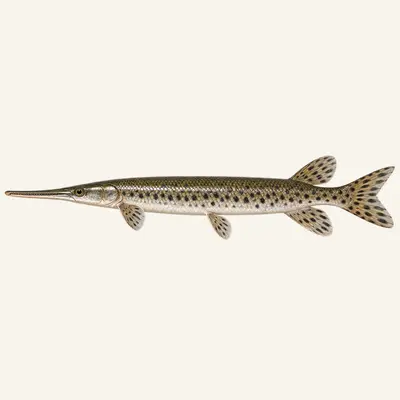
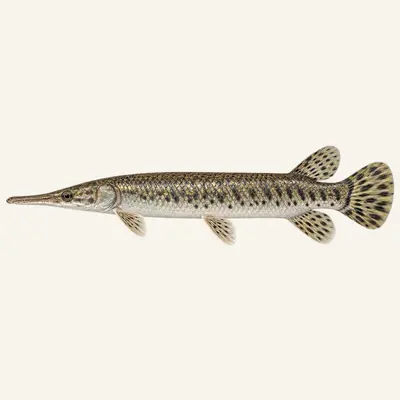
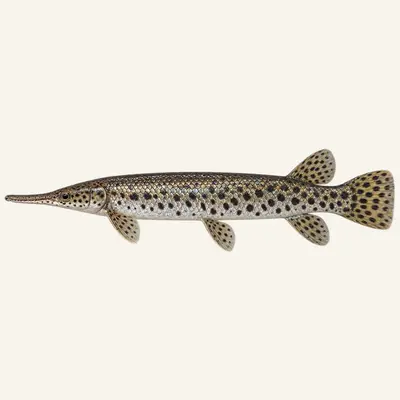
The word gar, in English, covers two genera without marking the boundary. Longnose, shortnose and spotted gars are Lepisosteus; this one is Atractosteus, and no English name in circulation says so. A list of the gars therefore reads as one set of close relatives when it is two.
The epithet spatula names the snout, and it is the only part of the whole nomenclature that describes the fish rather than comparing it to something else.
Sources: fishbase.se · api.gbif.org · fishbase.se