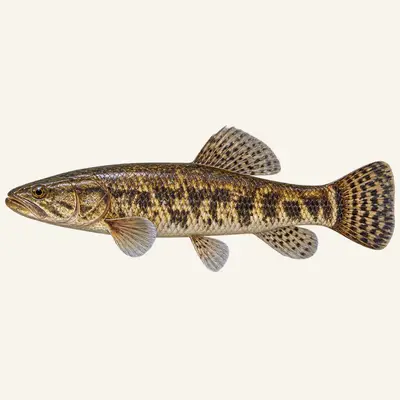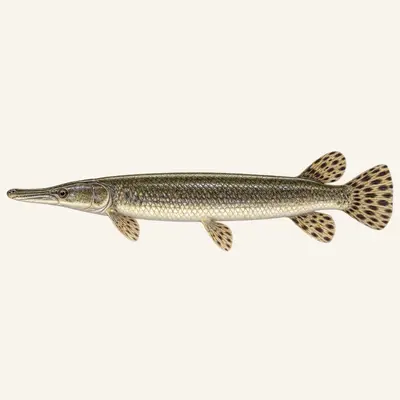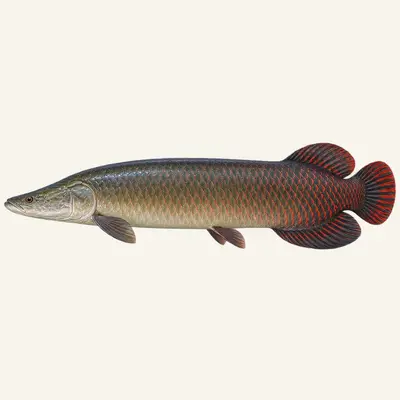
Aimara wolf fish
Hoplias aimara · Erythrinidae
- Freshwater
- Predators
- Medium
- Dangerous
- Size
100 cm
- Weight
40 kg
Where to fish
- River
Habitat icons: Flaticon
Lives in the counter-current zones of main rivers and creeks. Feeds mainly on fish but also on other animals that fall into the water, such as small terrestrial invertebrates
Calendar
Its range
Every river on the list runs off an old crystalline shield. The Trombetas, the Jari, the Tapajós, the Xingu and the Tocantins drain the Brazilian shield from the south; the Araguari and the Amapá, the coastal rivers of Guyana, Suriname and French Guiana, and the lower Orinoco drain the Guiana shield from the north.
Shield rivers behave nothing like lowland rivers. They run on rock, they stay clear, they descend in steps of rapids and falls and boulder chaos, and their discharge swings hard between seasons. It is that geology which draws the range, not latitude and not temperature.
The consequence is that the aimara is missing from the middle of Amazonia — from the slow white water of the main floodplain — while occupying the tributaries that pour into it. The rapids are on the tributaries.
Breeding
Spawning is triggered by the onset of the rains, from December to March, when the rapids become unworkable and the rivers load up.
Fecundity scales with the size of the female, and the amplitude is what stands out: around 6,000 eggs in a small one, up to 60,000 in a large one. A factor of ten between the two ends of a single population.
Maturity, by contrast, is reached at about 22 cm, very early in a growth curve that continues long afterwards. So the population is almost entirely composed of breeders, and they are not remotely equivalent to one another.
The water it needs
It holds in counter-current zones, in the main rivers and in the creeks alike. The counter-current is the water that runs back upstream behind an obstruction, a boulder, a rock point or the foot of a fall, turning slowly against the fast line beside it.
That is a predator's position for a mechanical reason. Everything the current carries is decelerated and held along the seam between the two bodies of water, so an ambush hunter parked there receives a steady supply of prey without swimming for any of it.
Looking for this fish therefore means reading boils rather than covering surface. Each substantial boulder in a rapid is a potential holding place, and the number of them in a stretch can be counted by eye from the bank.
Areas
- Rapids and rocky areas
- Base of waterfalls
- Pools behind rocks
- River confluences
Techniques
- Live bait fishing in current
- Hard resistant lures
- Surface popper in calm areas
- Dead bait fishing
Baits
- Large live fish
- Hard fish-imitation lures
- Resistant poppers
- Natural dead fish
What it eats
Fish make up most of the diet, and the remainder is whatever falls in: small terrestrial invertebrates, animals washed off the bank or dropped from the canopy.
That second share fits the lie exactly. An eddy collects surface drift as thoroughly as it collects the deeper kind, and a predator installed in one intercepts everything the river is carrying, whatever its origin.
Activity concentrates at dusk and through the night.
How to catch it
The season runs opposite to the spawning. At low water the rapids are accessible, the lies legible and the counter-currents reduced to a handful of pockets; at flood everything is drowned and the fish disperses through a volume ten times larger.
The hour follows the activity rhythm. The last hour of daylight and the night beat full sun, which contradicts the practical logic of prospecting rapids, always easier to do in good light.
The two sources of prey justify two registers. A surface lure worked in the calm behind an obstruction imitates what falls in; a swimming lure or a livebait presented in the seam imitates what drifts past. The lie decides which, not the contents of the box.
Tackle is sized on the terrain as much as on the fish. A fight that starts in contact with boulders, in water that is pushing, allows no second attempt: whatever is not won in the first seconds is lost against rock.
Dangerous — Risky handling: gear, release, and safety practices must be adapted.
Conservation
Nothing weighs on the species across its range, and yet the recognised quality of its flesh keeps it a constant target of local fisheries.
The sensitive point is the relationship between size and egg output. Any pressure aimed at the large fish — and that is what every selective fishery does, sport fishing included — removes the individuals producing the most eggs. Taking ten small females costs a stock less than taking one very large one, which is the reverse of what intuition suggests.
A second, quieter harvest works from the other end of the scale. The species is traded commercially for aquaria, which takes young fish out of the same creeks, well below the 22 cm at which they would first have spawned.
Regulations
Check the local regulations in force (legal size limits, closed seasons, bag limits).
For guidance only. Legal sizes, quotas and open seasons vary by location and season: always check the local regulations in force before fishing.
Other names
Aimara is an Amerindian word, adopted unchanged by every European language for want of any other candidate.
Brazil proceeds by augmentative instead: trairão, the big traíra, built on the name of the smaller and far more widespread congener. The suffix carries everything a Brazilian angler needs — same kind of fish, different category altogether.
English glues the two systems together and produces aimara wolf fish, a name that belongs to no language in particular and that owes its second half to a marine species of the North Atlantic.
Sources: fishbase.se · api.gbif.org