American Paddlefish
Polyodon spathula · Polyodontidae
- Freshwater
- Sturgeons
- Hard
- Size
120–200 cm
- Weight
17–90 kg
- Lifespan
55 years
- Water temp.
10–18 °C
Where to fish
- Lake
- River
Habitat icons: Flaticon
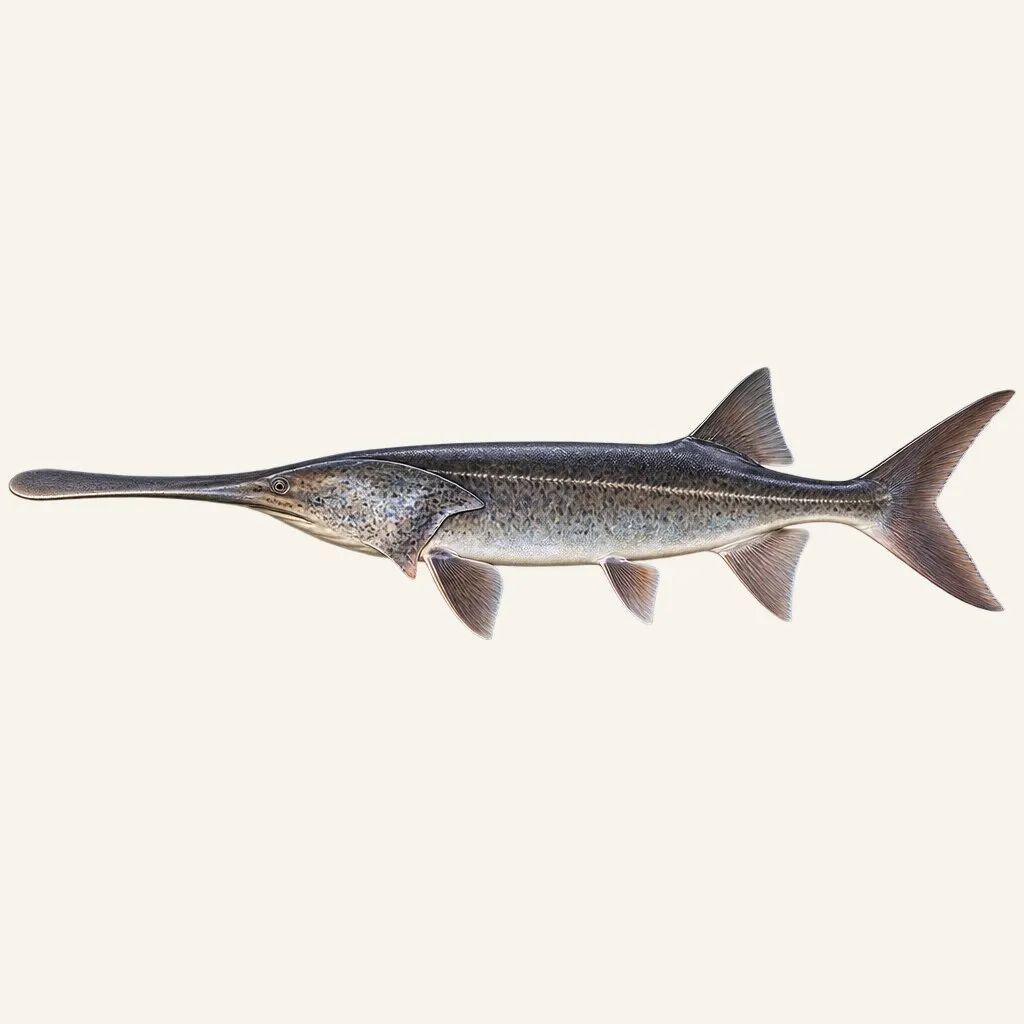
Large primitive freshwater fish with a long flattened paddle-shaped rostrum, a plankton filter-feeder of the Mississippi basin.
Calendar
Recorded in 1 country
GBIF occurrence records — native and introduced populations combined.
Its range
A basin gone, and a hedge on it. The species is recorded as formerly present in the Great Lakes basin and probably extirpated there, and the qualifier is the point. Confirming the absence of an animal that lives half a century, takes no bait and filters open water is not a survey anyone runs cheaply, so probably may stand for a long while yet.
What remains is the Mississippi basin from southwestern New York to Montana and south to Louisiana, plus Gulf Slope drainages from Mobile Bay in Alabama across to Galveston Bay in Texas.
Off the continent the file records the reverse situation: at least one country reports adverse ecological impact after introducing it. The same fish is retreating where it belongs and unwanted where it was taken, which is a reminder that a declining species and an introduced one are not two kinds of animal.
Identifying it
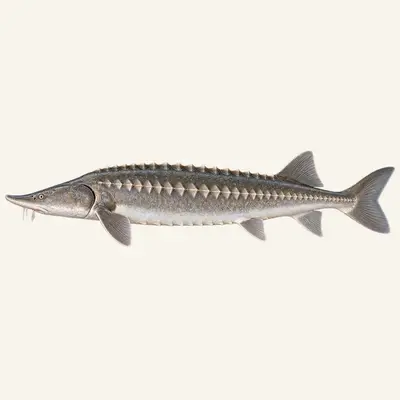
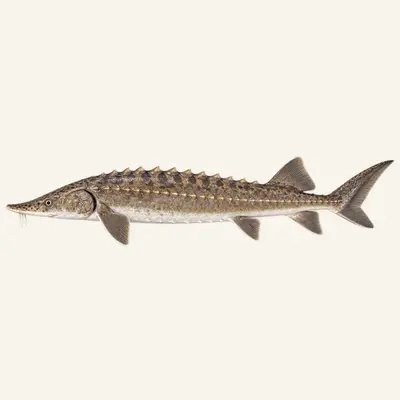
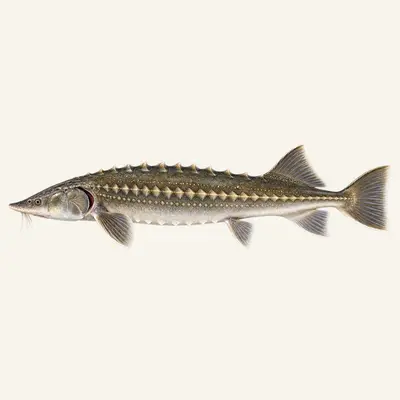
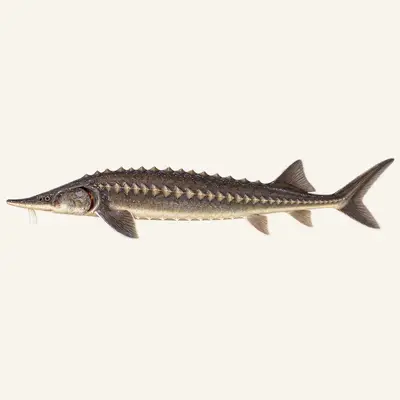
Two characters, and the published morphology contains nothing else. The snout is long and shaped like a canoe paddle. The gill cover ends in a large fleshy pointed flap that lies back along the flank.
That is the entire morphology rubric for the largest fish in its river system — no ray counts, no vertebral count, no proportions. Whatever else is known about this animal, its written description is two clauses long and both of them are about the outline.
The water it needs
The file cannot say where in the water this fish lives, and that is the one thing worth knowing about it.
It is classed as demersal, which puts it on or near the bottom. Its food is plankton, which is not there. The environment line gives a depth range starting at 2 m; the biology rubric puts adults in water deeper than 1.2 m. Neither figure is a preference and the two do not agree, so what survives is a floor of somewhere around a metre and no ceiling at all.
The rest is consistent: slow-flowing large rivers, lakes and impoundments, between 10 and 18 degrees.
That band is narrower than the rivers it lives in. A reach of the Mississippi basin down towards Louisiana spends a good part of the year above 18 degrees, so the temperatures on record describe when and where the species has been met rather than what it endures.
Areas
- Mississippi River basin
- Missouri River
- Midwestern US reservoirs
- Lower reaches of large rivers
Techniques
- Snagging
- Heavy weighted casting
- Drift fishing from a boat
- Slow trolling
Baits
- Weighted treble hooks (snagging, no bait)
- Heavy sinkers and stout leaders
- Plankton imitations (rarely effective)
- No bait (filter feeder)
What it eats
It eats plankton. Common length in this species is 120 cm, and the animal lives on what the other fish of its river eat as larvae — everything else on this page follows from that mismatch.
The paddle's part in it is unsettled. The reference text says the extended upper jaw may help to channel plankton into the mouth: a conditional, in a standard work, about the single most conspicuous organ the species has. A century of description has not moved that from a plausible association to a demonstrated function, and the hedge is better reproduced than tidied away.
How to catch it
The bait list for this species on this site includes the entry "no bait (filter feeder)". That is an unusual thing for a bait list to say and it is the correct thing. An animal that pursues nothing can be offered nothing: no scent, no imitation and no presentation reaches it.
What the site lists instead is snagging, together with heavy weighted casting, drifting from a boat and slow trolling — methods that put a hook through a fish rather than into its mouth. Whether any of that is permitted, and in what form, is a matter for the competent authority, and the answer is not the same from one state to the next.
Location is the part that can be reasoned about. The fish is in the body of the water rather than on the bed or against a bank; its floor is around a metre and its band is 10 to 18 degrees; and its food gathers where flow slows and dies. Reservoir tails, the slack at the end of a current tongue, the deeper part of a backwater. The season shown here is short, March to May, which is the stretch of the year when that thermal band is available in the upper water.
Conservation · Vulnerable (IUCN) — This species is threatened with extinction. Always release it (no-kill), handle it with the utmost care and check local rules — fishing for it may be prohibited.
Conservation
Fifty-five years of recorded life, and no published age or length at first maturity. That gap is the most serious thing in this species' file.
Without a maturity figure a catch cannot be interpreted. There is no way to say whether a fish taken had spawned once, ten times or never, and no way to say how many years separate one year class from the next. A fishery can hold its tonnage steady for a decade while reproduction has stopped, and the number that would show it does not exist.
The pressures themselves are named: over-harvesting, habitat loss and pollution. The first two combine in a particular way in a potamodromous animal, one that makes all its movements inside the fresh-water network. Every transverse structure does two things at once — it takes habitat out, and it cuts what is left into pieces the fish cannot move between. A map showing the species still present in a basin says nothing about whether the fish in it can still reach one another.
International trade in the species is monitored under Appendix II of CITES.
Regulations
Strictly regulated and protected in several states (permits, quotas, tagging and specific seasons); check local regulations.
For guidance only. Legal sizes, quotas and open seasons vary by location and season: always check the local regulations in force before fishing.
Other names
The accepted English name carries a continent: American paddlefish. That is an odd qualifier for a fish nothing in its own rivers resembles, and it is not doing its work at home — it separates this species from the other, Asian member of the family.
Five languages then name the same implement. Spatule américaine, pez espátula americano, pesce spatola americano, peixe-espátula-americano: a paddle or a spatula, taken from the outline. German is the exception and files the animal instead, as Amerikanischer Löffelstör, a spoon-sturgeon, the only one of the six to say what sort of fish is under discussion.
The scientific name goes somewhere else again. Spathula keeps the snout, but Polyodon means many-toothed — an announcement of dentition, attached in perpetuity to an animal that strains water.
Sources: fishbase.se · api.gbif.org