Russian sturgeon
Acipenser gueldenstaedtii · Acipenseridae
- Freshwater
- Sturgeons
- Hard
- Size
145–236 cm
- Weight
23–115 kg
- Lifespan
46 years
- Water temp.
10–20 °C
- Depth
2–100 m
Where to fish
- Estuary
- Pond
- River
Habitat icons: Flaticon
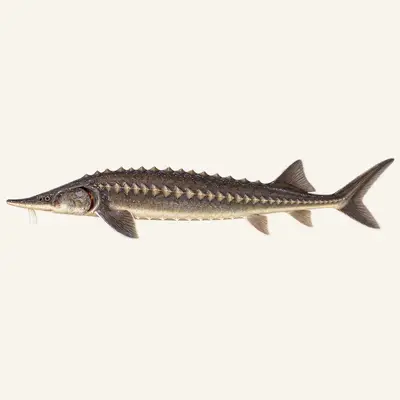
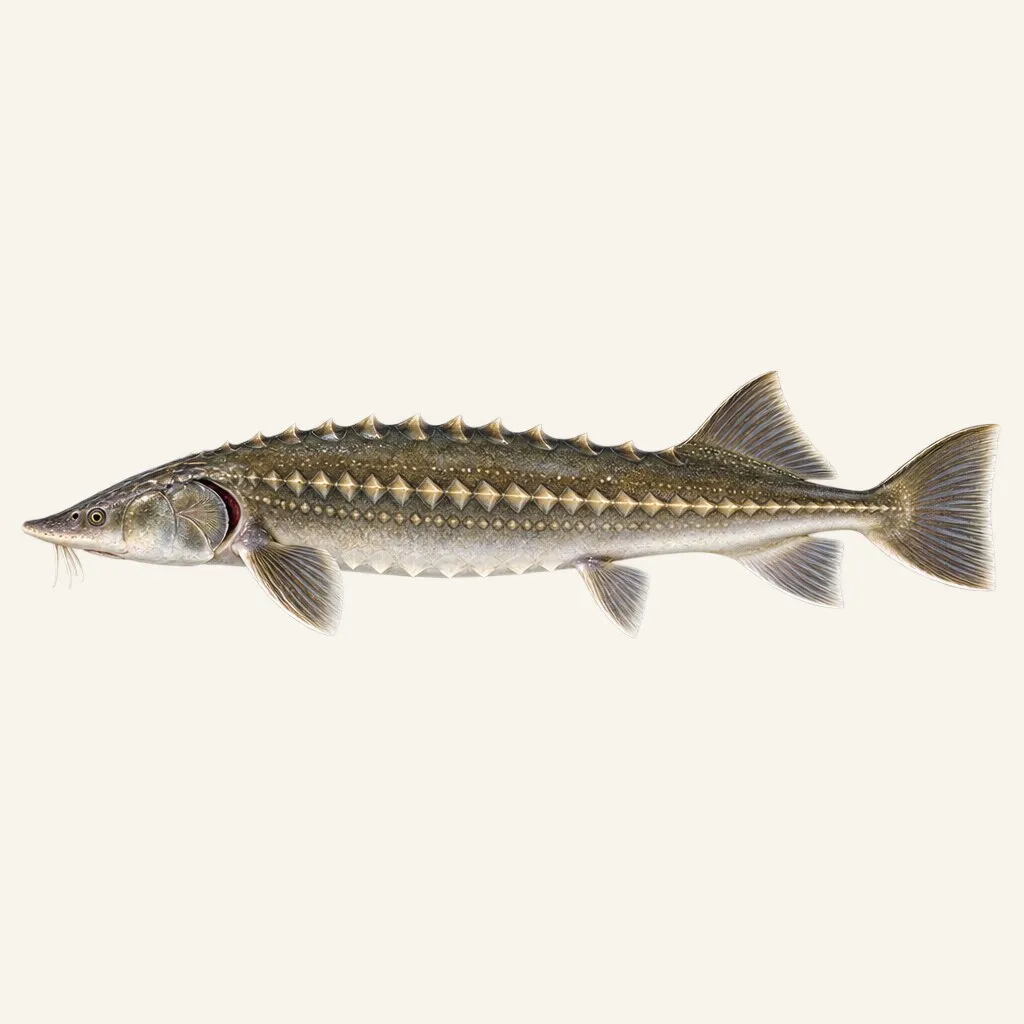
A large anadromous sturgeon with a short, rounded snout, famed for its Ossetra caviar and now critically endangered.
Calendar
Identifying it
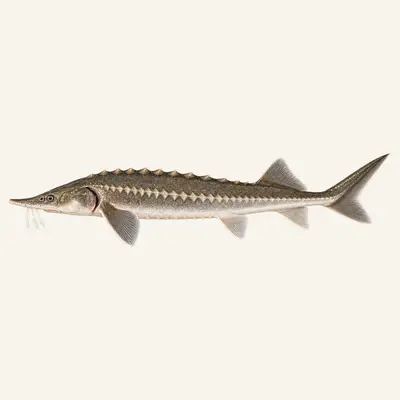
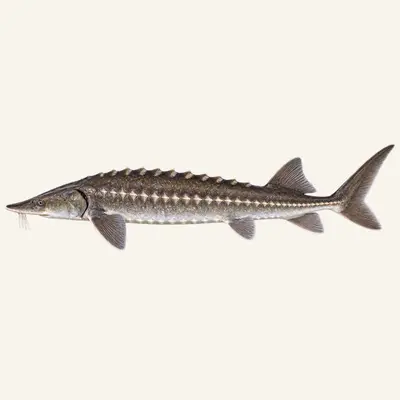
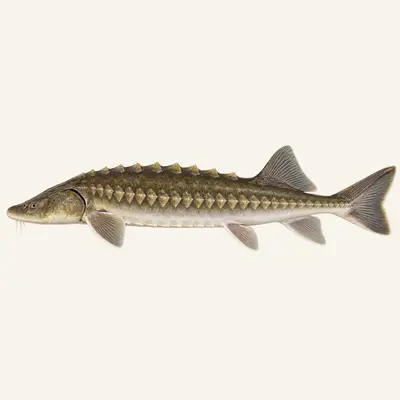
The cross-section is round. That alone separates this fish from the angular-bodied acipenserids the moment it is held, and it is the fastest character available. The back is olive-grey, the flanks lighter, the belly white.
The rows of scutes are sparse for an animal of this size: seven to 19 on the back, 24 to 44 per flank, six to 13 down each side of the belly, with lines of small star-shaped plates filling the space between the dorsal and ventral rows. The lower lip is interrupted at its centre.
The ray counts, by contrast, have a disconcerting spread, 27 to 48 in the dorsal and 16 to 35 in the anal. That is not sloppy measurement. It reflects how heterogeneous the species is, and part of the reference description is drawn up under the name of the Black Sea form, A. g. colchicus. The taxonomy of the group is not settled.
Breeding
Breeders enter the rivers from April to June, a few in autumn, and lay on stone or gravel in watercourses that are both large and deep, under a current between one and 1.5 m per second.
The decisive fact sits in one line of the reference file: natural spawning is no longer extensive, and the species is maintained chiefly by artificial propagation. The rivers of its range no longer produce enough juveniles to offset adult mortality, and hatcheries supply most of the recruits released each year.
That substitution changes what a count means. A stable number no longer measures the health of a river but the activity of the stations, and stopping a programme would produce a collapse without a single parameter of the environment having moved.
The water it needs
Two forms exist, one anadromous and one wholly riverine, which is uncommon in the genus and explains why the fish turns up both at sea and hundreds of kilometres from a river mouth. At sea it stays on shallow coastal ground and in estuaries; in fresh water it occupies the deep sections of large rivers with a moderate to swift current, usually near the bank, over sand and mud.
Depths run from two to 100 m, but most of the life happens between 10 and 25, in water of 10 to 20 °C.
Social behaviour has two settings. The animal is solitary for most of the year, then packs into dense masses at two moments: wintering in the holes, and the spawning run. Those gatherings assemble a considerable fraction of an otherwise scattered population on a handful of known sites.
Areas
- Caspian Sea basin
- Black Sea basin and Danube delta
- Sea of Azov
- Private stocked lakes (Europe)
Techniques
- Bottom fishing (ledgering)
- Weighted bottom rig
- Feeder fishing
- Specialised sturgeon pay-lake fishing
Baits
- Earthworms
- Sturgeon-specific boilies
- Sinking pellets
- Fish pieces
- Shrimp
What it eats
It takes benthic molluscs, crustaceans and small fish off the bed. The sand and mud of the margins, where it spends most of its time, are precisely the substrates richest in burrowing molluscs, so the diet and the preferred ground are the same statement made twice.
How to catch it
Two windows of vulnerability follow directly from that social pattern. A solitary fish is hard to find; the same individuals, stacked in a wintering hole or committed to a run, are taken in lots. That mechanism is what allowed the species to be fished to collapse, and it applies to poaching today exactly as it applied to the legal fishery before.
International trade moves under Appendix II certificates: roe from this species travels with paperwork, and the labelling carries the trace. On open water within the range, what is permitted is settled basin by basin, with the fisheries manager concerned.
The Russian sturgeon that most European anglers actually meet comes from somewhere else entirely. It is farmed, and it is fished in specialist stocked waters, over clean bottoms where a bait left lying stays available to a ventral mouth that sucks rather than bites.
Conservation · Critically Endangered (IUCN) — This species is threatened with extinction. Always release it (no-kill), handle it with the utmost care and check local rules — fishing for it may be prohibited.
Conservation
The trade name of its roe made the fish valuable and then finished it. Ossetra is a luxury taken from females that have to be waited on for years, in rivers where the same works that light the cities close the way to the stone beds.
The result is a species whose demography has changed in kind. It barely reproduces on its own and holds on by release, which shifts the question entirely: restoration is no longer about protecting adults but about making passable a run of several hundred kilometres and a gravel bed swept by a metre-per-second current.
A genetic consequence sits on top of that. A stock rebuilt from a small number of hatchery breeders loses the diversity the original populations carried, and no further release reverses that loss.
Regulations
Protected wild species (CITES Appendix II, IUCN Critically Endangered): capture banned in the wild, angling allowed only in stocked waters under local regulations.
For guidance only. Legal sizes, quotas and open seasons vary by location and season: always check the local regulations in force before fishing.
Other names
Russian sturgeon in English, also Danube sturgeon, which invites confusion since several acipenserids use that river. The name the public knows best belongs to the eggs rather than to the animal: ossetra, spelled a dozen ways, is the caviar of this species.
That points at a general problem with English sturgeon names. The trade sorts roe into grades, ossetra among them, and those grades are what appear on tins and menus, so the market word and the species name come apart. A grade is a commercial category, not a determination, and reading one as the other is how a fish gets misidentified before anybody has looked at it.
Sources: fishbase.se · api.gbif.org