Beluga sturgeon
Huso huso · Acipenseridae
- Freshwater
- Sturgeons
- Hard
- Size
200–700 cm
- Weight
63–1,500 kg
- Lifespan
118 years
- Water temp.
10–20 °C
- Depth
70–180 m
Where to fish
- Estuary
- River
Habitat icons: Flaticon
An anadromous giant of the Caspian and Black Sea basins, the beluga is one of the largest freshwater fish in the world and the source of the most prized caviar.
Calendar
Its range
The Caspian, Black Sea, Azov and Adriatic basins — and the entry that follows the list is the one that counts: extirpated from the Adriatic. That is not a nuance of range. It is an entire basin gone, recorded in the same breath as the range itself, and it is the only part of the distribution that can be stated as finished.
Identifying it
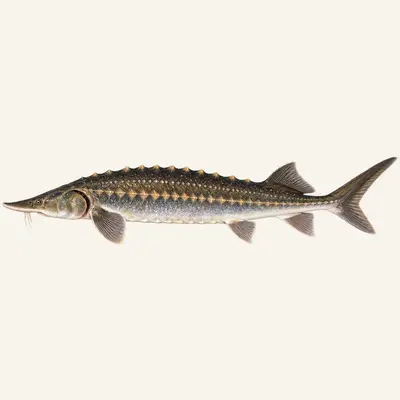
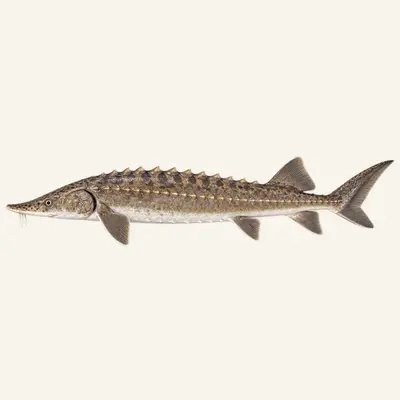
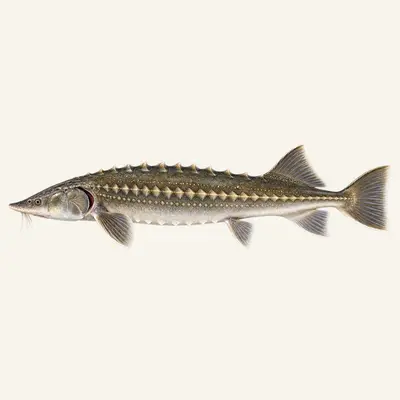
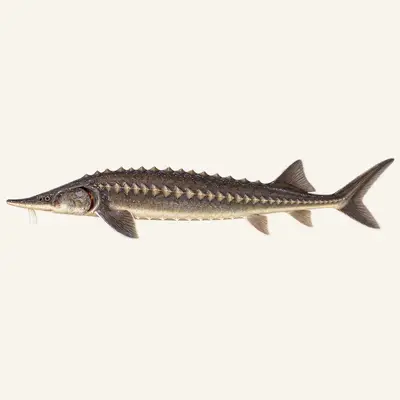
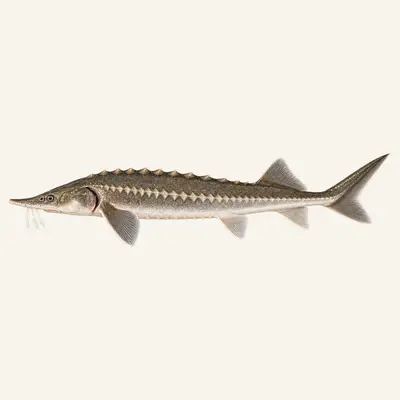
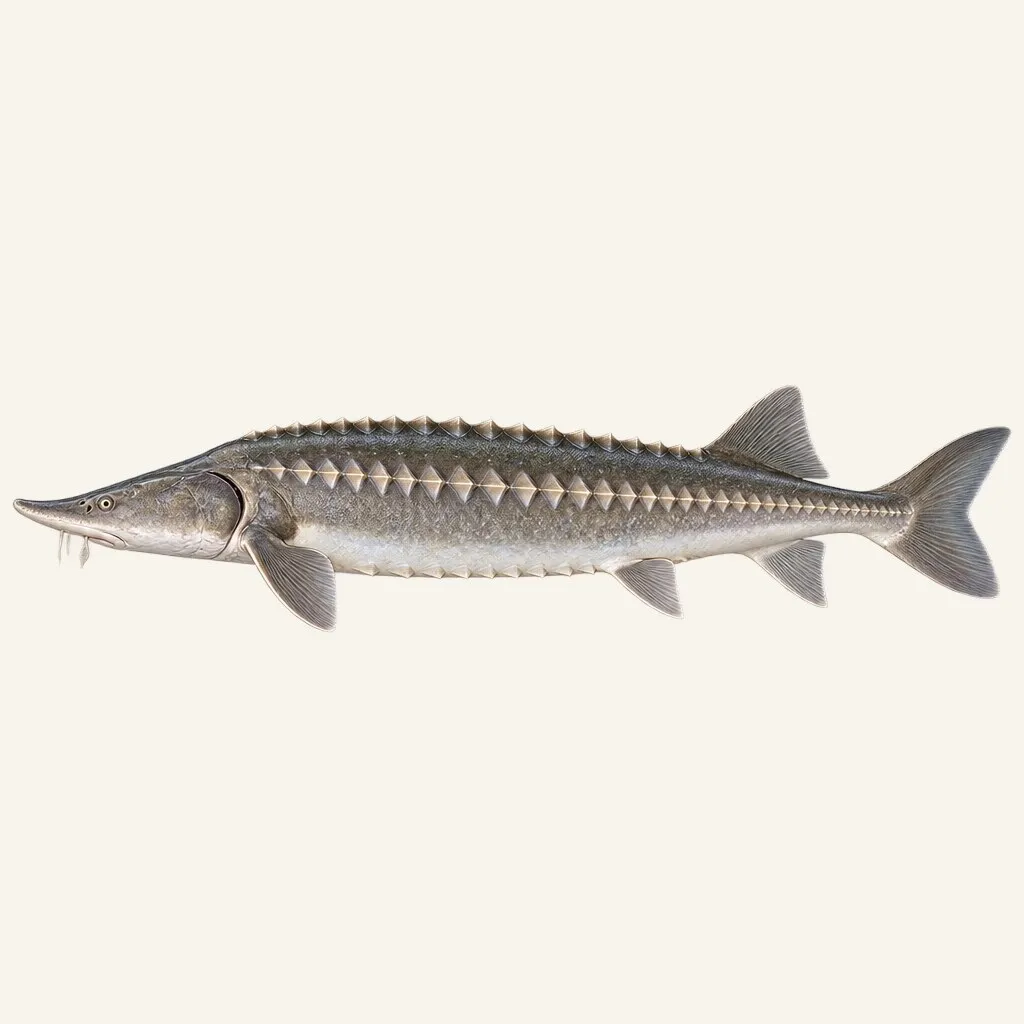
The barbels are the quickest character. They are oval or flattened, leaf-like towards the rear, and they reach almost to the mouth — which is worth checking against the relative it is most often confused with in trade: the European sturgeon's own description has its four barbels stopping halfway between the snout tip and the mouth and not reaching it.
The lower lip is interrupted at its centre rather than running across. The snout is moderate, pointed, and turns slightly upward.
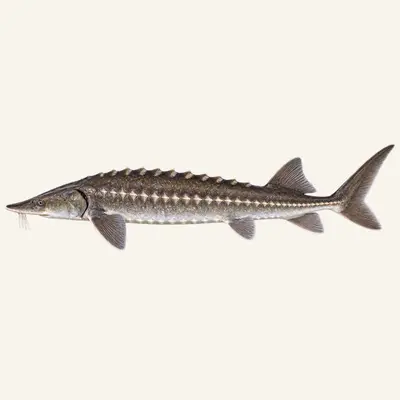
Five rows of scutes, and the numbers are worth carrying: 11 to 14 on the back, of which the first is the smallest, 41 to 52 along each flank, and nine to 11 down each side of the belly. The cross-section is given as circular, where the European sturgeon's file gives a pentagon. Back ash-grey or greenish, flanks lighter, belly white. The dorsal carries 62 to 73 soft rays and the anal 28 to 41 — high counts, and they go with the size of the animal.
Breeding
Three numbers, and together they describe the most exposed breeding biology in this catalogue.
A female carries 360,000 to 7,700,000 eggs. She carries them once every five to seven years. And maturity does not arrive below two metres.
Set them side by side. A breeding female represents well over a decade of growth before her first spawning, and after it she is out of the cycle for most of every decade that follows. Removing one does not cost a spawning, it costs a series of them, spread across the years that would have come after.
The run starts in March, mostly April and May, sometimes again in autumn. Spawning happens in the main course of large, deep rivers, in strong current, over stone or gravel. And then the file adds the sentence that settles the species' present condition: it survives largely by artificial propagation. The rivers are no longer what makes belugas.
The water it needs
Three waters in sequence, and all three are required. Juveniles spend their first summer in shallow riverine habitat. Adults are pelagic at sea, between 70 and 180 m, in water of 10 to 20 degrees, following prey. Between the two lies the deep, fast main channel that spawning needs.
A fish with that itinerary is only as available as its weakest link, and the links are separated by hundreds of kilometres of river.
Areas
- Lower Danube
- Volga basin
- Caspian rivers (Ural)
- Black Sea estuaries
Techniques
- Bottom/ledger fishing
- Live bait fishing
- Heavy float fishing
- Slow trolling
Baits
- Dead or live fish
- Bunches of worms
- Herring chunks
- Meat-based boilies
What it eats
This sturgeon eats fish, and the prey are named: Black Sea whiting, anchovies, flatfishes, gobies and the fry of bottom-living fishes, with crustaceans, molluscs, mysids and amphipods alongside them.
That is the list of a hunting animal rather than of a sediment-sifter, and it is the reason this species reaches the size it does. At sea it is pelagic and follows its prey instead of working a patch of bottom.
How to catch it
In practice this is not an angling target. Trade in the species is monitored under Appendix II of CITES, and it is carried on Appendix II of the convention on migratory species — the instrument through which the states along one migration route act together, which is the only arrangement that reaches a fish spawning in one country's river and feeding at sea off several others. What is permitted where is a matter for the competent authority, without exception.
Two things are still worth knowing. The maximum reported age is 118 years against a common length of 215 cm: a large individual is older than most of the institutions now trying to protect it, and older than the dams that closed its rivers.
And identification is no longer straightforward, because of what is being farmed. The bester — a cross between a female of this species and a male sterlet — is cultivated successfully for the quality of its eggs. A large sturgeon in a pond, or a tin on a shelf, is not necessarily this animal, and the hybrid exists precisely because it does not have to be.
Conservation · Critically Endangered (IUCN) — This species is threatened with extinction. Always release it (no-kill), handle it with the utmost care and check local rules — fishing for it may be prohibited.
Conservation
Three mechanisms, each sufficient on its own.
The reproductive interval comes first. A female spawning once in five to seven years, and not before two metres, gives a population almost no capacity to answer anything inside a management cycle. The spawning requirement comes second: a large, deep, fast river reach with a stone or gravel bed is exactly what the dams on the Volga and the Danube removed. The value of the roe comes third, because it puts a price on the mature female specifically — the one class of fish the population cannot spare.
The recorded threat is overfishing at sea for meat and in the estuaries for caviar, and the file states its conclusion rather than implying it: survival can only depend on stocking. The species still exists. It is no longer reproducing in its rivers at a scale that would maintain it.
The Adriatic shows what the end of that process looks like.
Regulations
Critically endangered (IUCN), strictly protected and CITES-listed; commercial fishing banned, capture generally prohibited or catch-and-release per local regulations.
For guidance only. Legal sizes, quotas and open seasons vary by location and season: always check the local regulations in force before fishing.
Other names
Beluga belongs to two animals that could hardly be less alike — this fish and a white whale of the Arctic — and in both cases the name comes from the Slavic root for white, applied separately. The catalogue writes beluga sturgeon, with the second word doing the work of keeping the whale out.
European sturgeon is the trap. It is used for this species in some sources, and it is the standard English name of Acipenser sturio, which this catalogue gives it: a different fish, a different range, and the two are not interchangeable in a literature search.
German says Hausen, Italian storione ladano. The record notes this as the largest sturgeon and the largest European freshwater fish, and it appears in the Guinness Book of Records as the most expensive fish — a listing that is really about the roe, which carries the same name as the animal.
Sources: fishbase.se · api.gbif.org