Lake sturgeon
Acipenser fulvescens · Acipenseridae
- Freshwater
- Sturgeons
- Hard
- Size
98–270 cm
- Weight
6.1–125 kg
- Lifespan
152 years
- Depth
5–9 m
Where to fish
- Lake
- River
Habitat icons: Flaticon
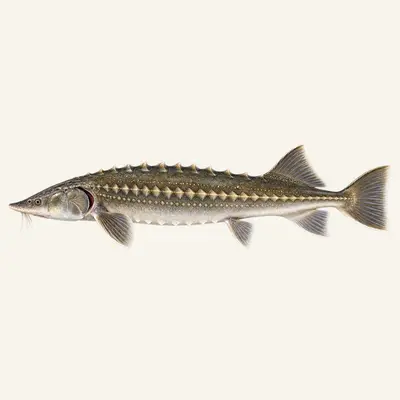
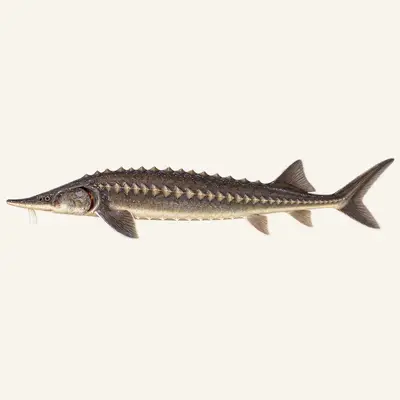
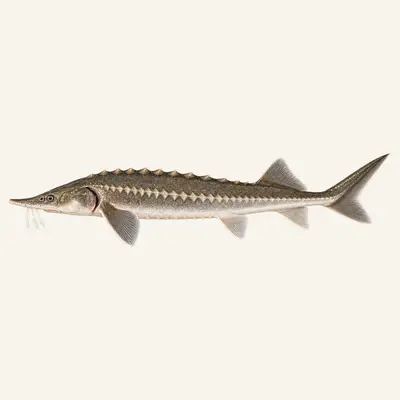
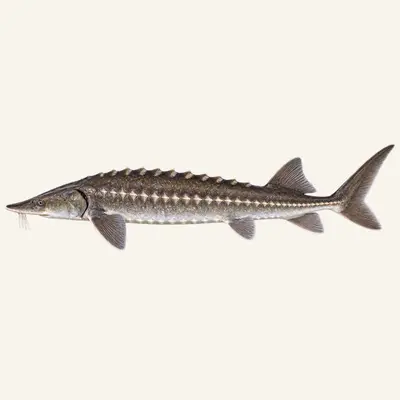
A large primitive freshwater fish with a torpedo-shaped body covered in bony scutes and equipped with barbels, living for many decades.
Calendar
Recorded in 2 countries
GBIF occurrence records — native and introduced populations combined.
Its range
Three drainages and no more: the St. Lawrence with the Great Lakes, Hudson Bay, and the Mississippi. Those networks were connected as the ice withdrew, and the fish moved between them without ever needing salt water to do it.
Brackish water is entered only occasionally. The whole cycle runs in fresh water, which sets this species apart from the anadromous sturgeons of both American seaboards.
Identifying it
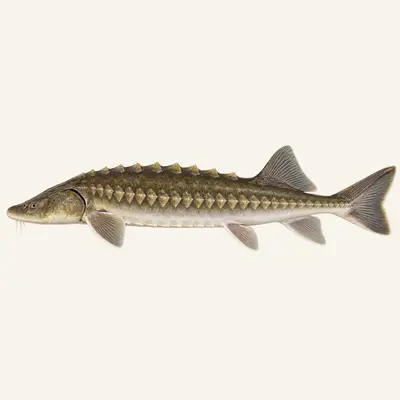
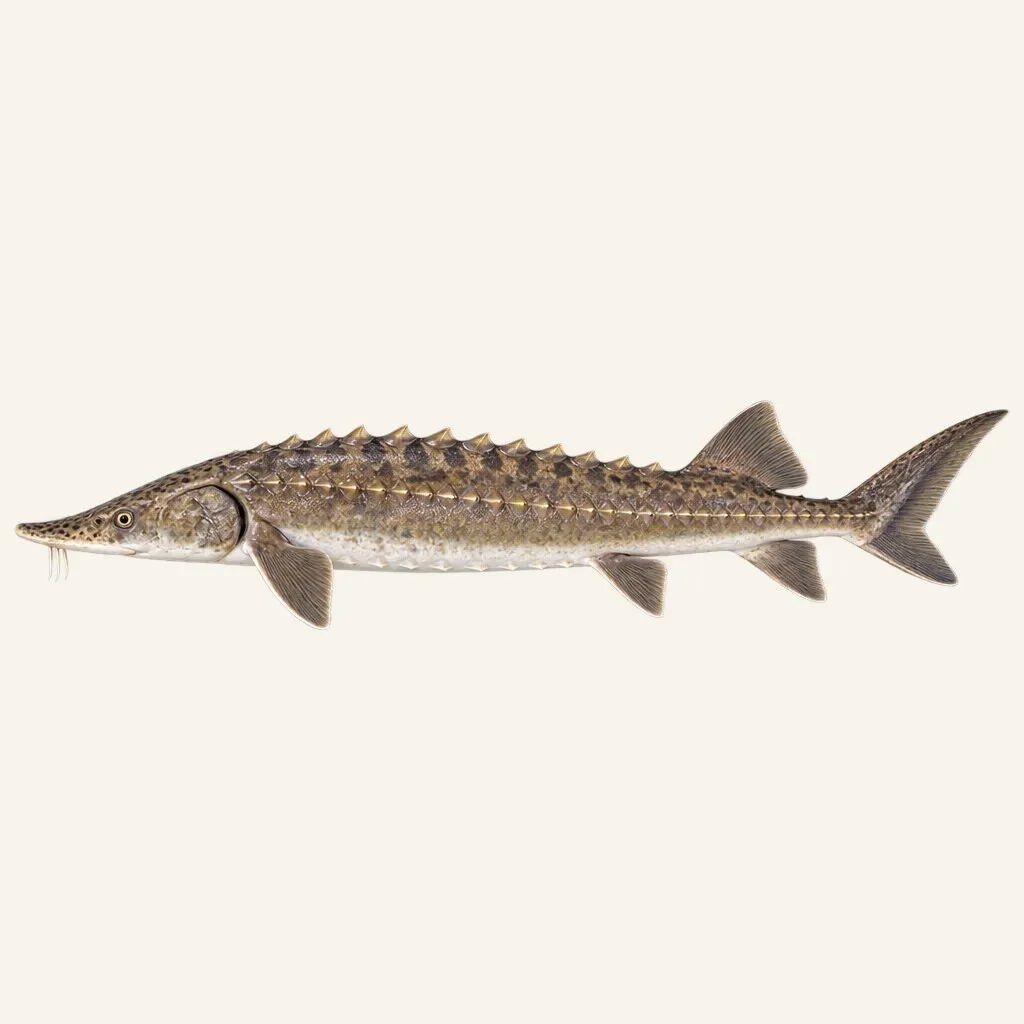
A single row of shields sits ahead of the anal fin. It stays invisible until the fish is turned over, and it is what separates this sturgeon from the others of North America. The anal fin also starts further back than the dorsal, which is checkable without touching anything.
The next thing to look at is the upper surface. Large, well-defined dark blotches cover the front half of the snout and the back, on a paler ground; underneath, the fish is whitish. Most sturgeons are plain. This one is mottled.
The scutes are exactly the colour of the skin around them, which flattens the outline and makes the rows hard to read at any distance. There is no soft area on the top of the head, and the viscera are black.
Breeding
The spawning ground is rocky and strewn with boulders, on the outside of a river bend. That is not an accident of geography. The outside of a bend is where the current scours, where the water runs deepest and where fines do not settle; a clean bed of stone in a loaded river is found there and rarely anywhere else.
Maturity arrives around a metre, between 90 and 120 cm, which already represents decades of growth. Against that, a fish taken in 1952 was credited with 152 years.
Those two numbers describe the demography on their own. A population of this species is not a stock that turns over from year to year but an accumulation of old individuals. Its structure still carries the mark of what happened to it a century earlier, and a decade of heavy fishing is still legible a hundred years later.
The water it needs
Adults hold the bottom of lakes and large rivers, usually in five to nine metres, over mud, sand and gravel. They move continuously and close to it, without a fixed lie and without structure to sit against. Depth alone will not locate them; the bed type will.
Areas
- Great Lakes region
- St. Lawrence River basin
- Mississippi River basin
- Lake Winnipeg and Canadian Prairie rivers
Techniques
- Still bottom fishing
- Fixed weighted leger rig
- Slow-drifted worm bait
- Fishing from shore or anchored boat
Baits
- Bunched nightcrawlers
- Aquatic larvae and nymphs
- Small dead baitfish
- Fish eggs
What it eats
Omnivorous is meant literally here: more or less anything edible that enters the mouth is drawn in and swallowed. The barbels, dragged just clear of the bed, work as a tactile and chemical probe, and the search is continuous rather than selective.
The handling of a food item is worth spelling out, because it decides how the fishing goes. Prey is not seized but sucked in, then worked in the mouth, often partly ejected, then taken back. The same object can go in and out several times before it goes down.
How to catch it
That manner of eating rules out a fast response. Tension that appears, drops away and returns is a fish trying the bait, not a missed bite; striking at the first signal pulls the bait out of the mouth during the ejection phase.
Everything else follows from how it lives. Mud, sand or gravel in five to nine metres, a rig that rests without dragging, and slow prospecting, since the fish has no station and is simply passing through. The outside of a large river bend concentrates both the substrate it wants and the depth.
The species has game-fish standing in several North American jurisdictions, but what is allowed changes from one state or province to the next, and that is a question for the agency managing aquatic wildlife in the territory concerned.
Conservation · Endangered (IUCN) — This species is threatened with extinction. Always release it (no-kill), handle it with the utmost care and check local rules — fishing for it may be prohibited.
Conservation
The history of its exploitation turns on a reversal. In the 1800s this fish was taken in bulk for its oil, burned in steamboat boilers, and for animal feed and fertiliser: an animal rendered into fuel. It then became a luxury, sold smoked, turned into caviar and into isinglass from the swim bladder, to the point that 2,000 pounds of caviar came out of its roe in Canada in 1951 alone.
That switch happened to a fish that matures near a metre and can live a century and a half. The takings of the two periods therefore landed on the same year classes, with no room for a recovery to fit in between.
Three current pressures are recorded: over-harvesting, habitat loss and pollution. They apply to an animal whose spawning is confined to a handful of rock beds per river, which makes every individual site decisive rather than merely useful.
It also remains an important food for Indigenous peoples in North America, a dimension that weighs on stock management alongside the fisheries arithmetic.
Regulations
Protected or heavily regulated depending on jurisdiction (quotas, slot limits, mandatory release); subject to local regulations.
For guidance only. Legal sizes, quotas and open seasons vary by location and season: always check the local regulations in force before fishing.
Other names
Lake sturgeon is the English name, and it points at the wrong half of the life. The fish does occupy lakes, but it spawns in rivers, on boulder ground that only a current keeps clean. The French esturgeon jaune picks a different feature again, the pale underside. Neither name mentions the dark mottling on the snout and back, which is the character that actually identifies it in the hand.
Sources: fishbase.se · api.gbif.org