Siberian sturgeon
Acipenser baerii · Acipenseridae
- Freshwater
- Sturgeons
- Hard
- Regulated
- Size
100–200 cm
- Weight
9.3–210 kg
- Lifespan
63 years
- Water temp.
1–19 °C
- Depth
0–200 m
Where to fish
- Estuary
- River
Habitat icons: Flaticon
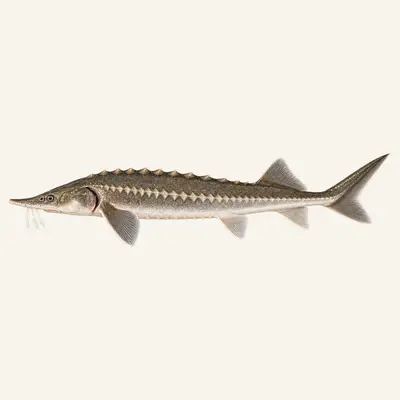
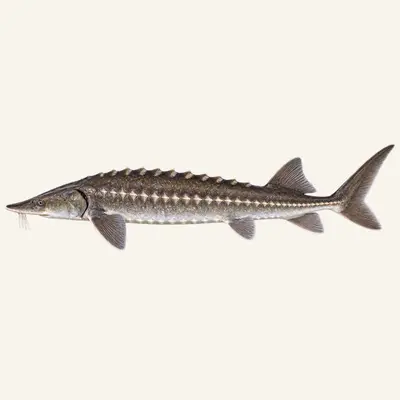
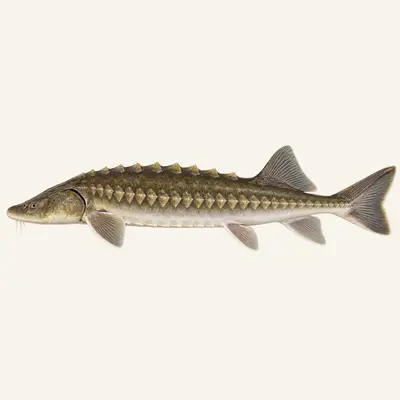
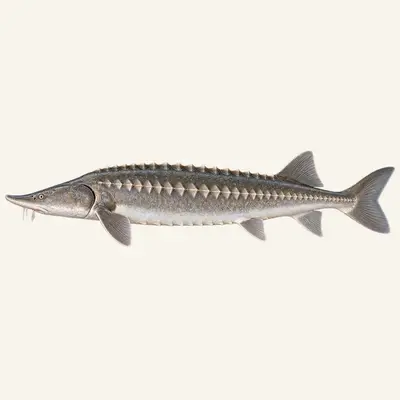
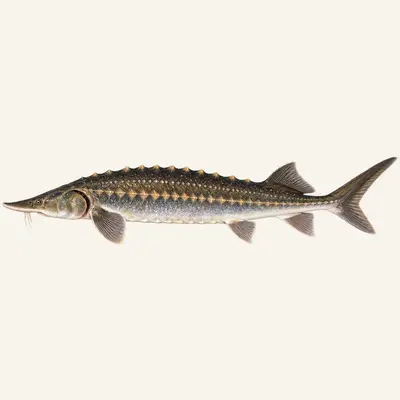
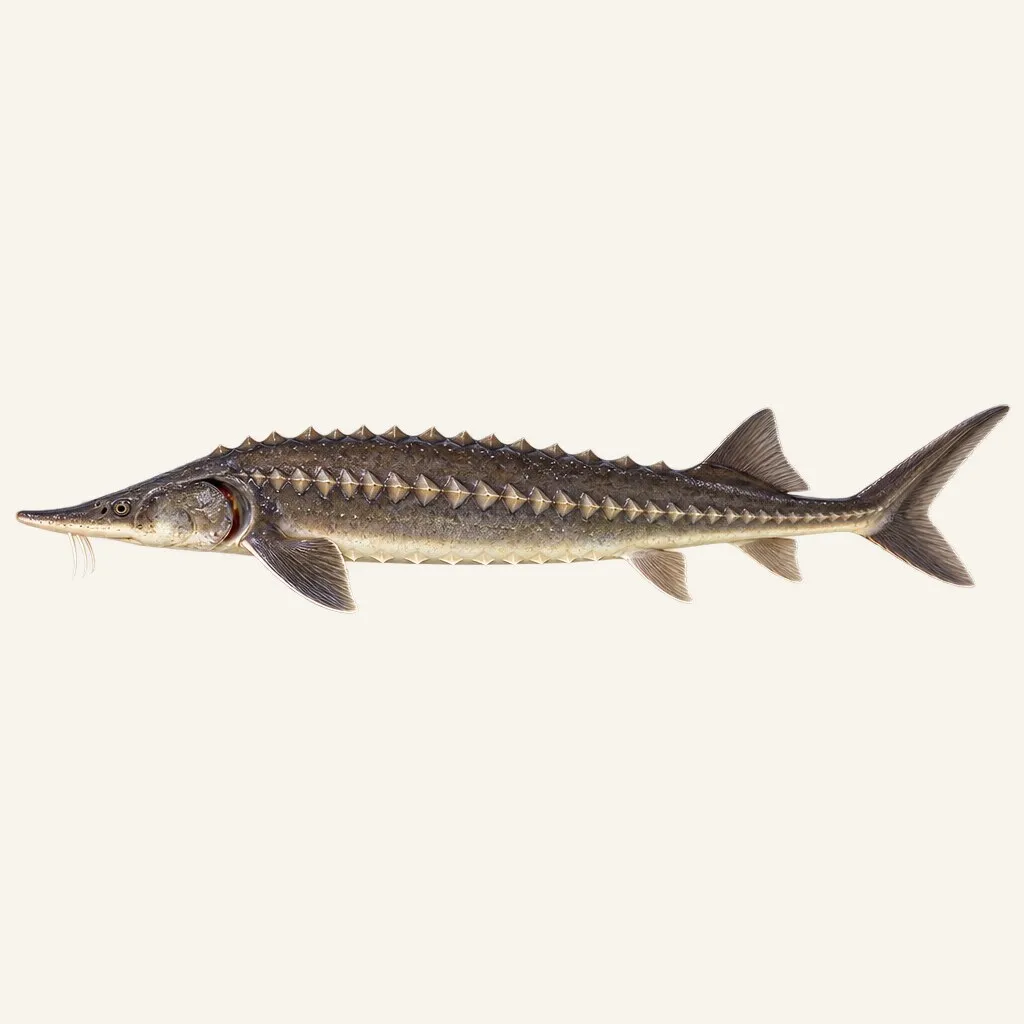
The Siberian sturgeon is a large fish with a fusiform body covered in bony plates (scutes) arranged in rows, with an elongated snout and a ventral tube-like mouth adapted for bottom foraging.
Calendar
Recorded in 22 countries
Argentina · Austria · Belgium · Canada · China · Czechia · Denmark · Finland · France · Germany · Iran · Italy · Kazakhstan · Netherlands · Poland · Romania · Russia · South Korea · Sweden · Türkiye · United States · Uzbekistan
GBIF occurrence records — native and introduced populations combined.
Its range
The natural range sits entirely on the Arctic slope of Siberia — Ob and Irtysh, Yenisei, Lena, Kolyma, Khatanga, Pyasina, Anabar, Olenyok, Yana, and Lake Baikal. Cold water throughout: the band occupied runs from one degree to 19.
The feature that counts is not the list but its compartmenting. Every one of those systems holds populations that do not migrate, and the fish completes its cycle without ever needing the sea. A basin emptied of them is not restocked from the next one along. It stays empty.
Anywhere outside Siberia, the presence of this sturgeon is commercial rather than natural. It is farmed for caviar on several continents, and the fish met in European water came out of that industry.
Identifying it
The skin between the large scutes is sown with small star-shaped plates, over its whole surface. That granulation, more than the rows themselves, gives the back its dull, rasping finish.
Colour then settles it. The belly runs from white through to a clear yellow while the back stays in light grey or dark brown. A warm tint underneath is uncommon in the genus, and on a fish taken out of a European pond it narrows the possibilities to one.
The lower lip is distinctly split, the snout drawn out, and the four barbels sit forward of the mouth rather than under it. Counts for the rows: 10 to 19 on the back, 32 to 59 along each flank, seven to 16 down each side of the belly.
Breeding
A male in a Siberian river becomes capable of breeding somewhere between nine and 15 years old, a female between 16 and 20. The same species held in a recirculating system can be ripe at five. That gap is the central fact of its applied biology. It separates a river population, which needs two decades to replace a female taken out of it, from a tank stock that turns one out in a fifth of the time.
Laying happens in summer, generally in alternate years, in the main channel over stone and gravel or gravel and sand, always under a firm current. The eggs measure 3 to 3.6 mm.
Their membranes turn progressively stickier after fertilisation, which glues them to the substrate and holds them against the flow. In a hatchery the same property welds a batch into an unusable mass, and the answer is to wash the eggs in a suspension of clay or diatomaceous earth before the adhesive sets.
Incubation runs about 16 days at 10 to 15 °C. Larvae hatch at 10 to 12 mm and need some 20 days more to finish developing at 18 °C.
One figure fixes the economics of the animal: the unfertilised oocytes of a ripe female can exceed a tenth of her body mass.
The water it needs
Adults use the deep and the shallow reaches alike, on condition that the current is moderate to swift, and normally hold between one and eight metres, though records go down to 200.
Water chemistry is less forgiving than depth. The pH band recorded is narrow and barely above neutral, a tighter tolerance than most cold-water fish need, which rules out the acid, peat-stained systems of the same latitudes. Some individuals enter estuaries; the species is otherwise a freshwater one throughout.
Areas
- Deep pools of large rivers
- Sandy and gravelly bottoms with moderate current
- River confluences and mouths
- Pools below rapids
Techniques
- Worms
- Special pellets (farm-raised)
Baits
- Earthworms
- Maggots and bloodworms
- Shrimps and fish pieces
- Flavored bottom paste baits
How to catch it
The species is listed on Appendix II of CITES: its products move under monitoring, and caviar sold under its name carries traceability. On the open water of Siberia, what is permitted depends on the basin and is a matter for the Russian fisheries administration.
In Europe, a Siberian sturgeon on the end of a line is a pond fish, put there or escaped from the farms. That changes how the fishing is organised, not how the fish eats.
And it eats by contact. The mouth is ventral, toothless and protrusible; the barbels sweep the bed just ahead of it and trigger the suction. A bait lying still on clean ground enters that mechanism. A bait held a few centimetres above it, or trundling in the current, does not, and that is the commonest reason for a blank on this species.
The take follows from the same mechanism. There is no strike, only a suction, usually followed by a slow steady run without the sharp knock a predator gives.
Regulated — Often governed by quotas, size limits, seasons, or reporting rules.
Conservation · Critically Endangered (IUCN) — This species is threatened with extinction. Always release it (no-kill), handle it with the utmost care and check local rules — fishing for it may be prohibited.
Conservation
Decline and industrial success rest on the same product. Wild populations have been fished for their roe for a long time, and the farming that was meant to relieve them first turned that roe into a global commodity.
The maturity schedule forbids any quick rebuild. Twenty years before a Siberian female breeds for the first time, then a clutch every second year: replacing a year class is work on the scale of a human life, while removing one takes a season of nets. The oldest fish recorded was 63.
Compartmenting makes it worse. Each river carries resident stock, so a dam on a main channel does not merely cut a migration. It takes out of the system the one strong-current reach where laying succeeds, and nothing upstream or downstream substitutes for it.
There is a quieter effect on top. A hatchery can produce a ripe female in five years where the river needs twenty; what it supplies is a stock of fish, which is not the same thing as a restored population.
Regulations
Strictly protected species in many countries — check local regulations (protection status, capture ban, mandatory release).
For guidance only. Legal sizes, quotas and open seasons vary by location and season: always check the local regulations in force before fishing.
Other names
Siberian sturgeon in English, after the only region that holds it naturally. The name in wider circulation is not the fish's but the roe's: caviar from this species trades as baerii, the specific epithet used on its own as a grade, and most people who have met the word have met it on a tin. The epithet itself honours Karl Ernst von Baer.
Sources: fishbase.se · api.gbif.org