Sterlet
Acipenser ruthenus · Acipenseridae
- Freshwater
- Sturgeons
- Medium
- Regulated
- Size
40–125 cm
- Weight
0.3–16 kg
- Lifespan
36 years
Where to fish
- River
Habitat icons: Flaticon
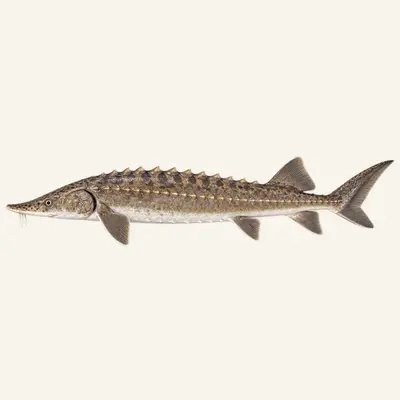
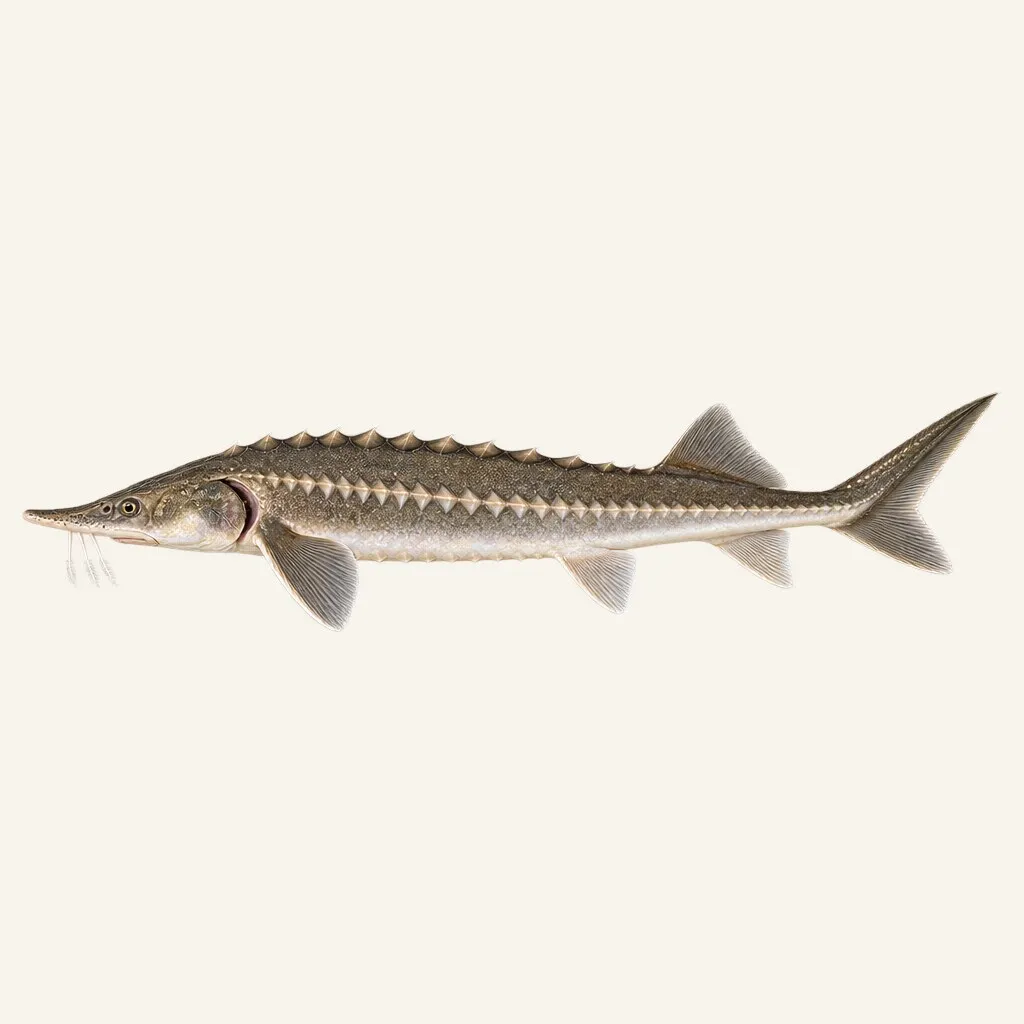
Smallest European sturgeon - Pointed snout - Fringed barbels
Calendar
Its range
Two blocks carry natural populations: the rivers draining to the Black Sea, the Sea of Azov and the Caspian, and western Siberia from the Ob to the Yenisei.
The rest of Europe received the fish by introduction, and this is where the map needs reading with care. None of those introductions produced a population able to sustain itself. A sterlet caught in a western or central European river does not indicate a stock standing behind it. It indicates a release, and says nothing about breeding in that basin.
A second loss happened inside the original range. Forms that dropped down to brackish water and ran back up to spawn once existed; those migratory populations are gone. What survives across most of the range is strictly fluvial nuclei, each shut inside its own river.
Identifying it
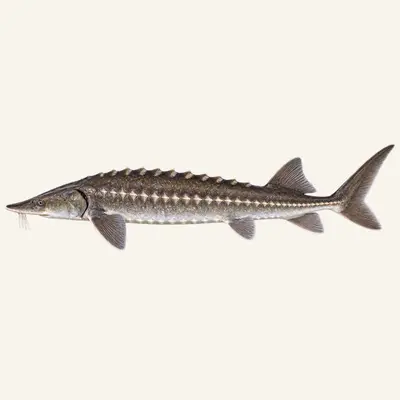
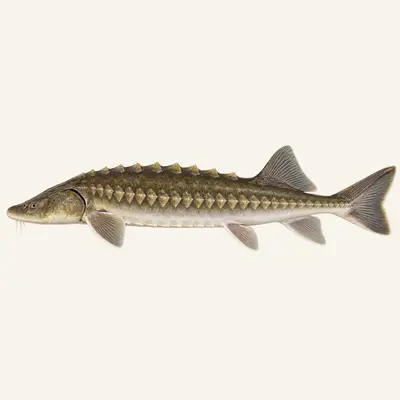
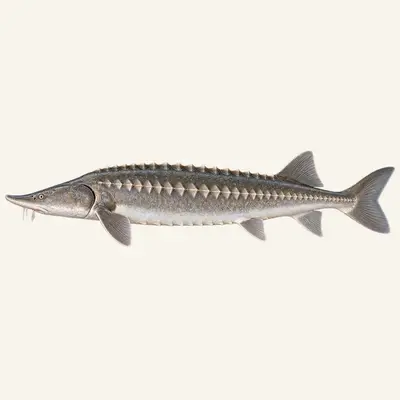
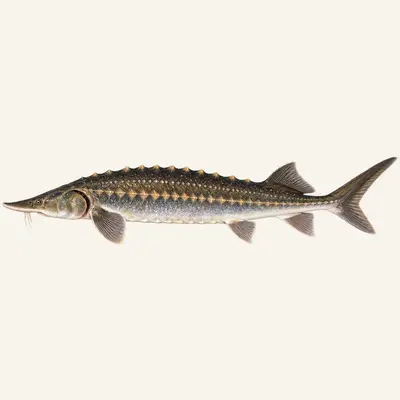
The barbels are fringed. Long, carried under a narrow pointed snout, they are edged with small tassels that no other European sturgeon has. One barbel examined closely closes the question.
The scute count confirms it and separates the species for good: 56 to 71 lateral shields, where the other European acipenserids rarely line up more than forty. Add 12 to 17 on the back and 10 to 19 on the belly.
Two further characters complete the identification. The first dorsal scute is not fused to the head, and the lower lip is interrupted at its middle. Gill rakers number 11 to 27.
The colouring is plain: back and flanks beige, the lateral and ventral shields very pale, nearly white, so that the rows stand out instead of disappearing into the skin.
Breeding
Eggs are scattered on gravel in a strong current, more rarely on a gravel-and-sand mix or over ground that has just been flooded. There is no nest and no guarding.
Maturity comes at 40 to 45 cm. That is small for an acipenserid, and it is the biological particularity with the heaviest consequences. Where its relatives must reach a metre and wait two decades, this fish closes its cycle at a size and an age that give a population a real chance of rebuilding itself.
The water it needs
This is a river fish in the strict sense, holding the large watercourses and their tributaries, sitting in the current and looking for depth. When levels rise it moves onto the flooded ground to feed, which makes a flood a feeding opportunity rather than a period of waiting.
Winter inverts that pattern. The fish gathers in bottom holes and cuts its activity to almost nothing, motionless for weeks. At the ice break it leaves the holes, works upstream and reaches the spawning ground.
Juveniles, for their part, stay in river habitat through their first summer.
Areas
- Main channels of large rivers
- Sandy and gravelly bottoms with moderate current
- Secondary arms and confluences
- Deep pools below rapids
Techniques
- Worms
- Larvae (where permitted)
Baits
- Earthworms
- Aquatic insect larvae
- Maggots
- Fresh shrimps
How to catch it
The calendar on a sterlet river is set by that winter cycle. A fish packed into a deep hole, barely feeding, cannot be caught; the same fish some weeks later is running the current and feeding over ground the flood has just covered. The ice break marks the switch between the two states.
The lies are those of a deep-current fish: the main channel, the tail of a rapid, confluences, and freshly flooded margins when the level climbs. The mouth is ventral and toothless and lifts food off the bed; the fringes on the barbels increase the contact area with the substrate, so the animal finds what it eats in loaded water without visibility playing any part.
The sterlet carries an Appendix II listing and its trade is monitored. Fishing rules change from one riparian country to the next and are a question for whoever issues the fishing right on the basin concerned.
Regulated — Often governed by quotas, size limits, seasons, or reporting rules.
Conservation · Vulnerable (IUCN) — This species is threatened with extinction. Always release it (no-kill), handle it with the utmost care and check local rules — fishing for it may be prohibited.
Conservation
The disappearance of the migratory forms is the heaviest event in the recent history of the species, and the mechanism is understood: a fish that has to link the lower reaches of a river to its spawning sectors does not survive that river being cut into sections. The nuclei still present are the ones that had no such journey to make.
What remains depends on a precise combination. Deep holes for wintering, a firm current over gravel for laying, and floodable ground for feeding. Engineering a river usually removes all three at once, the channel trained, the flow smoothed, the floodplain disconnected.
One qualification is worth stating. Massive introductions across Europe have restored nothing anywhere, and their uniform failure indicates that the question is not putting fish back but giving them a river.
Regulations
Protected and regulated species in many countries — check local regulations (protection status, quotas, permitted capture seasons).
For guidance only. Legal sizes, quotas and open seasons vary by location and season: always check the local regulations in force before fishing.
Other names
Sterlet came into English from Russian, and it describes nothing: no colour, no shape, no use. Most central and eastern European languages use a near-identical form of the same word.
The confusion worth flagging runs the other way from the usual one. Sterlet is a precise name, while sturgeon on a fishmonger's slab is a category covering a dozen species and, more often than not, whichever one was farmed nearest. This is also the acipenserid most often kept in public aquaria, where a small sturgeon under a generic label is very likely to be this one.
Sources: fishbase.se · api.gbif.org