White Sturgeon
Acipenser transmontanus · Acipenseridae
- Freshwater
- Sturgeons
- Hard
- Size
150–610 cm
- Weight
25–816 kg
- Lifespan
104 years
- Water temp.
0–23 °C
- Depth
1–122 m
Where to fish
- Estuary
- Lake
- River
Habitat icons: Flaticon
North America's largest freshwater fish, a long-lived giant whose body is armored with rows of bony scutes.
Calendar
Recorded in 2 countries
GBIF occurrence records — native and introduced populations combined.
Its range
The natural range is a strip of the eastern Pacific from the Gulf of Alaska to Monterey in California, with records off northern Baja California. That is what an anadromous fish produces: a continuous coastal band.
The inland points say something else. Populations are shut inside the Columbia drainage and in Montana, perhaps in Lake Shasta, and the lower Colorado received transplanted fish in Arizona. Those resident nuclei are not colonisations. They are fractions of a population that dams separated from the sea, and that now complete the whole cycle above the works.
The map therefore combines an ocean frontage with continental pockets whose existence dates from the building of the northwestern hydroelectric schemes.
Identifying it
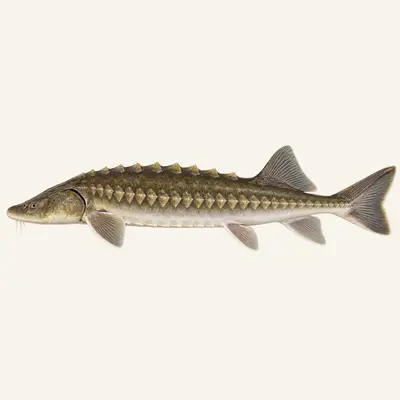
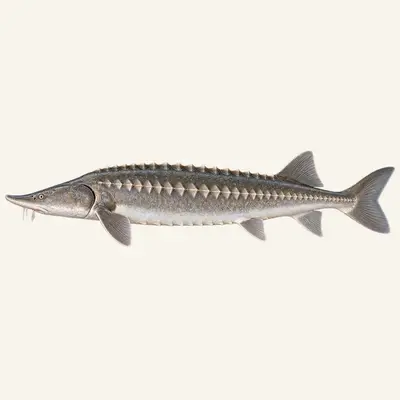
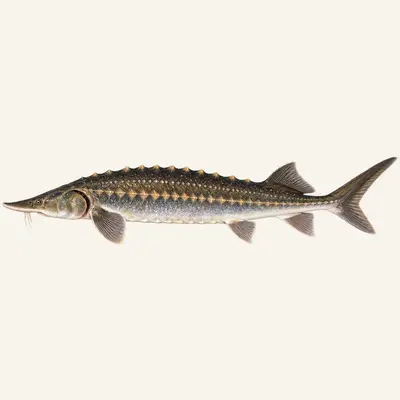
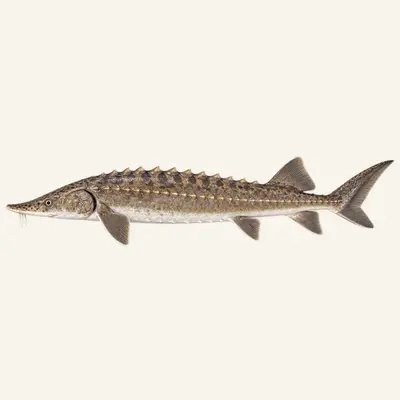
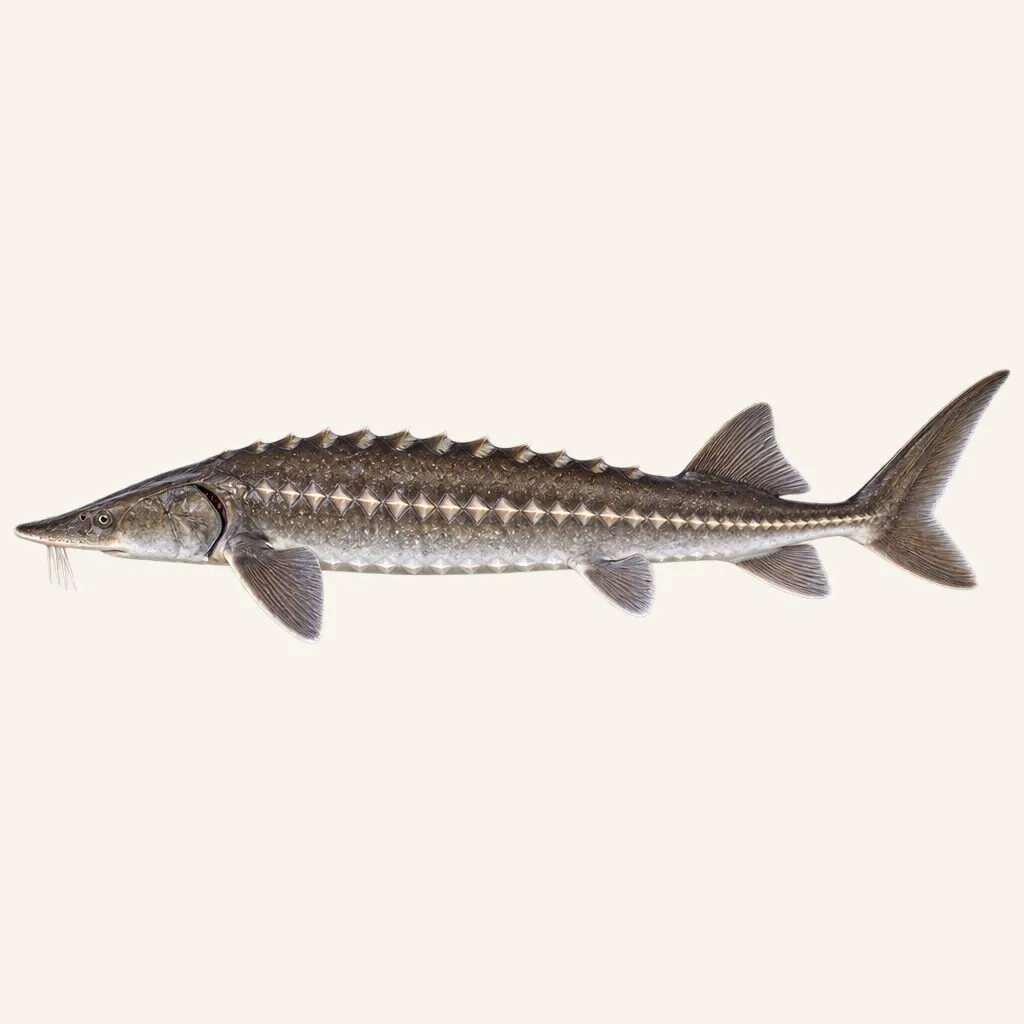
The character that decides sits underneath, between the vent and the anal fin: two rows of four to eight bony plates run along the midventral line. No other sturgeon of the Pacific coast carries them arranged that way.
The second mark is an absence. Behind the dorsal and behind the anal there are no distinct scutes, where other acipenserids continue their rows to the caudal peduncle. The barbels are set closer to the tip of the snout than to the mouth.
Colour is no help at all: grey or brownish above, paler below, grey fins, no markings anywhere. The dorsal ray count, around 45, finishes the job; the anal carries 28 to 31.
Breeding
A young female spawns about every four years. An old one, every 10 or 11. The interval lengthens with age instead of shortening, which is the opposite of the intuition and of what most fish do.
The management consequence is direct. The largest individuals are not the most productive over time, but each of their spawning events is irreplaceable, since the decade separating it from the next exceeds the length of most monitoring programmes.
The journey itself is a straightforward anadromous one. Adults enter the estuaries of large rivers and move far inland to lay, then drop back to the sea. Feeding stops just before spawning, so an animal in the last phase of its run is no longer eating anything at all.
First maturity is reported around 1.6 m, a size that already takes many years in a fish whose recorded lifespan passes the century.
The water it needs
The fish spends most of its time at sea, close inshore, and tolerates a thermal range wide for the genus, zero to 23 °C. Depths run from one metre to 122, which covers estuarine shallows and river holes alike. An animal that handles ice-cold water and water in the low twenties is not limited by temperature anywhere in its range; the limits it meets are physical ones.
Areas
- Columbia River
- Fraser River
- Sacramento River
- Pacific estuaries
- San Pablo Bay
Techniques
- Bottom fishing (weighted rig)
- Sliding sinker rig
- Anchored boat fishing
- Controlled drift fishing
Baits
- Lamprey
- Fresh shrimp
- Smelt / anchovy
- Salmon roe
- Nightcrawlers
What it eats
A threshold splits the diet in two. Below about 48 cm the fish lives mainly on chironomid larvae, with small crustaceans, other insects and molluscs alongside. Above it, the diet becomes largely piscivorous.
The same individual therefore occupies two trophic levels in succession, and a large white sturgeon is not a mud-grubber but a fish predator working the bottom.
How to catch it
That switch dictates the bait. Adult-sized fish answer to whole and cut baitfish and to salmon roe, not to the fine offerings that take juveniles. Going after a very large one with a small one's bait is addressing the wrong diet.
The season has a hard limit. An adult committed to its spawning run stops feeding before laying, and no presentation compensates for that.
The species has game-fish standing in several fisheries, the Columbia among them, and it is one of the few sturgeons an angler can legitimately set out to catch. What is allowed changes by river and by year, and the agency managing the basin publishes it.
Size is then the practical problem. A fish at the top of the range this species reaches cannot be lifted, and a large one meant to go back is best kept in the water throughout. The body is armoured and the scutes cut a hand; the mouth is toothless and does nothing.
Conservation · Vulnerable (IUCN) — This species is threatened with extinction. Always release it (no-kill), handle it with the utmost care and check local rules — fishing for it may be prohibited.
Conservation
Dams have changed this species more than anything else, and their effect is still legible on the map: entire populations, cut off from the ocean, run their cycle inside one reach of river. A resident population no longer has the growth the sea provides, nor any genetic exchange with other basins.
The harvest history is that of the big sturgeons. Flesh was sold fresh, smoked and frozen, the eggs marketed as caviar, and the swim bladder rendered into isinglass. Those three outlets bore on females that have to reach 1.6 m first, and then wait a decade between clutches once they are old.
International trade falls under Appendix II. The species is not covered by the convention on migratory species, which is notable for an anadromous animal whose range spans three countries.
The spawning interval is the fact to carry into a boat. A very large female may be between two events separated by 10 or 11 years, and what happens in those minutes is not averaged out by the rest of the population.
Regulations
Strictly regulated species: slot limits, quotas and mandatory catch-and-release zones vary by jurisdiction; check local regulations.
For guidance only. Legal sizes, quotas and open seasons vary by location and season: always check the local regulations in force before fishing.
Other names
White sturgeon in English, and the reference description gives a fish grey or brownish above, paler below, with grey fins. Nothing about it is white. The name is no use in the field, and the ventral plate rows are what actually separate it from the other sturgeon of the same coast.
The epithet transmontanus means beyond the mountains, given from the far side of the continental divide. It records where the describing naturalist stood rather than anything about the animal, which is a common enough fault in the genus but unusually blatant here.
Sources: fishbase.se · api.gbif.org