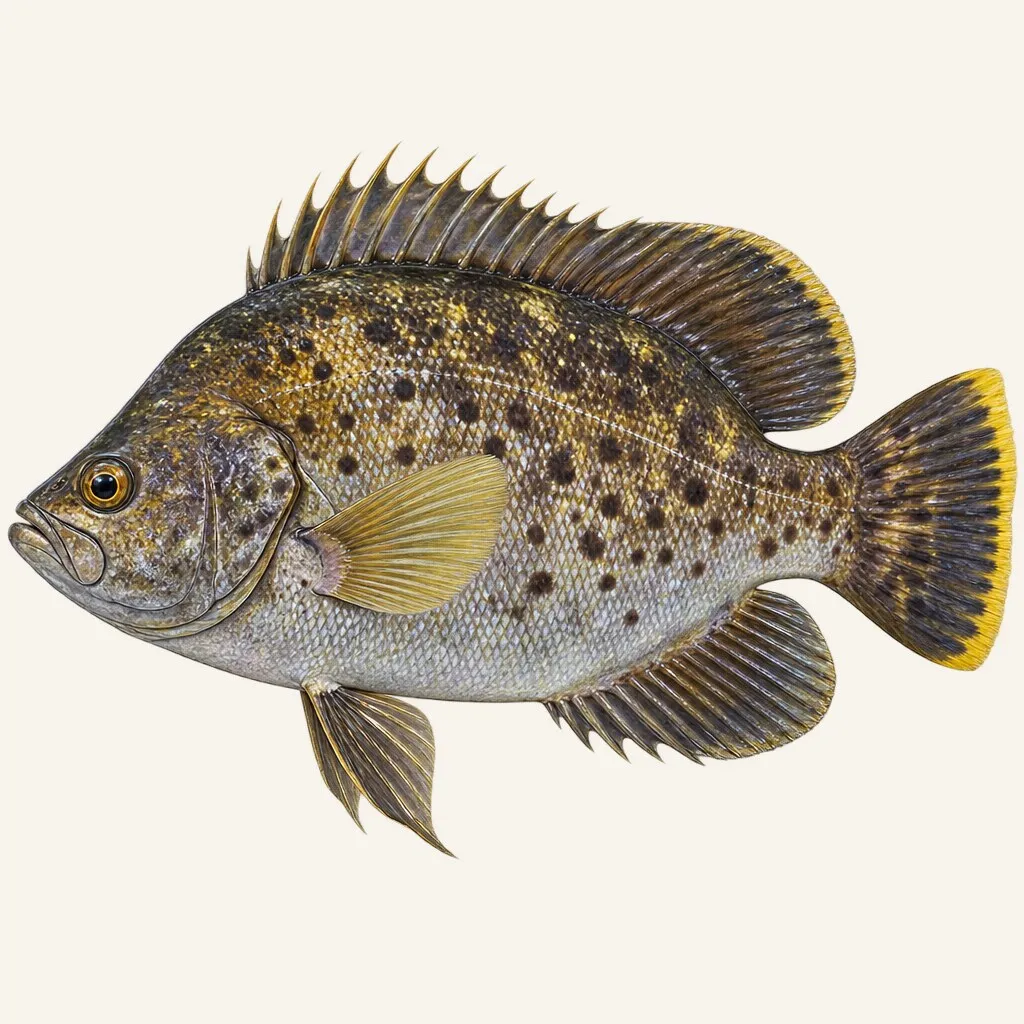
Atlantic tripletail
Lobotes surinamensis · Lobotidae
- Saltwater
- Coastal
- Medium
- Size
80–110 cm
- Weight
14–19 kg
- Depth
0–70 m
Where to fish
- Estuary
- Rocky shore
Habitat icons: Flaticon
A robust coastal fish recognized by its rounded dorsal and anal fins extending rearward, creating the illusion of three tails.
Calendar
Recorded in 17 countries
Australia · British Indian Ocean Territory · Cameroon · Colombia · Côte d’Ivoire · French Southern Territories · Gabon · Ghana · Guinea · Japan · Madagascar · Mayotte · Mexico · Mozambique · Seychelles · Singapore · United States
GBIF occurrence records — native and introduced populations combined.
Its range
Tropical and subtropical water in every ocean, 45 degrees north to 53 south — and a map with more hedges in it than most.
In the western Atlantic the range runs from New England and Bermuda to Argentina and the Falklands. In the eastern Atlantic it is presumed to follow the coast from the Straits of Gibraltar to the Gulf of Guinea, Madeira included, while reliable records are still lacking from Angola, the Canaries and Cape Verde. In the Indo-Pacific it goes from East Africa through South-East Asia to Taiwan and southern Japan, northern Australia to southern Queensland, New Guinea to New Britain and south to Fiji. Ponape, Hawaii and Tahiti have it as a rare visitor. Records from the eastern central and south-eastern Pacific await confirmation and may belong to Lobotes pacificus.
A range assembled like that is what passive dispersal looks like on paper. An animal that spends part of its life alongside drifting objects arrives where the objects arrive, which accounts for the pantropical spread, for the isolated visitors, and for the fact that the map has to be written with presumably in it.
Identifying it
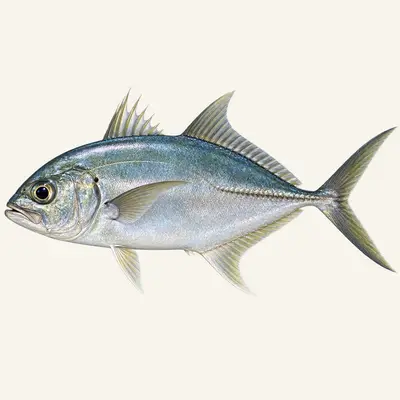
The tail looks like three tails. The caudal fin is rounded, and the soft parts of the dorsal and anal fins reach so far back and end in such distinct lobes that all three read as one fin with three lobes. The English name records the illusion, and nothing else on these coasts is shaped that way.
Colour confirms it in the hand: dark brown or greenish yellow above, silvery grey below, pale yellow pectorals, the remaining fins darker than the body, and a yellow margin along the tail. The body is deep and compressed.
Eleven or 12 dorsal spines, 15 or 16 soft rays, three anal spines and 11 or 12 rays.
The water it needs
The behaviour that defines this fish is a posture. It lies on its side at the surface, in the company of floating objects — the record calls it a sluggish offshore fish and puts it there, on its flank, beside whatever is drifting past. It goes over reefs occasionally.
Juveniles carry the same idea further. They occur in rafts of floating Sargassum and mimic a floating leaf, attitude included.
The same rubric then places adults somewhere else entirely: bays, muddy estuaries and the lower reaches of large rivers. Both halves are on record, the depth range runs from the surface to 70 m, and the honest reading is of an animal with two working lives — a drifter out on the open surface, and an inshore fish of turbid water.
Areas
- Buoys and markers
- Floating objects and debris
- Estuaries and river mouths
- Wrecks and coastal structures
Techniques
- Sight casting near floating objects
- Casting with soft plastics
- Live bait fishing
- Fly fishing
Baits
- Live shrimp
- Small live baitfish
- Soft plastic lures
- Jigs
- Streamers
What it eats
Benthic crustaceans and small fish.
That does not match the posture. Food taken off the bottom is not collected by an animal lying on its flank at the surface, which means the drifting is not feeding time, or not all of it. The bays, estuaries and river mouths in the habitat list are where the recorded diet is actually available.
It is worth being exact about what the sources do. They describe the surface behaviour and they describe the diet. They do not connect the two, and the connection is the part that would be invented.
How to catch it
Everything turns on floating objects. A plank, a weed patch, a buoy, a log: that is where the species is sought, and the search is conducted for the object rather than for the fish.
Since it lies on its flank in plain sight, the fishing is largely visual and a bait can be put in front of one identified animal. The apparent lethargy predicts nothing about the response.
Bays and muddy estuaries are the other context and the closer one, reachable from a bank. There the fish is not visible, and the recorded diet — bottom crustaceans, small fish — is what guides the choice of bait instead.
Common length is 80 cm. A deep, compressed body of that size turns itself broadside in the water, and the resistance owes little to the weight.
Conservation
Nothing in the record describes a decline, and what can be reasoned about here comes from the behaviour rather than from the biology. A fish that gathers at floating objects gathers at a countable number of them. A marked buoy, a moored raft or a known drift line can hold what a long stretch of coast has to supply, and a fishery that works the objects one after another is working the population rather than the water.
The juveniles depend on floating Sargassum, a habitat with no fixed position, which makes it a difficult thing either to survey or to protect.
One taxonomic caveat has a practical edge. Eastern Pacific records may refer to Lobotes pacificus, so catches attributed to this species in that ocean may be two species pooled under one name.
Regulations
Minimum landing size applies in some Gulf of Mexico states; per local regulations.
For guidance only. Legal sizes, quotas and open seasons vary by location and season: always check the local regulations in force before fishing.
Other names
Atlantic tripletail in English: the name is a description of the outline, and it is accurate. German Dreischwanzbarsch counts the same three tails. Spanish dormilona, the sleeper, names the immobility instead, and Portuguese prejereba names neither.
Surinamensis records where the species was described and is the least informative part of the whole name — the fish occupies warm water in every ocean, and Suriname has no particular claim on it. Its Pacific counterpart Lobotes pacificus is the reason records from that side of the world are queried at all.
Sources: fishbase.se · api.gbif.org