Black jack
Caranx lugubris · Carangidae
- Saltwater
- Coastal
- Medium
- Size
70–100 cm
- Weight
5.0–18 kg
- Lifespan
12 years
- Depth
12–354 m
Where to fish
- Reef
- Rocky shore
- Offshore
Habitat icons: Flaticon
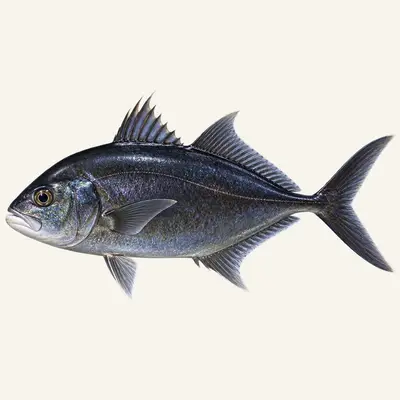
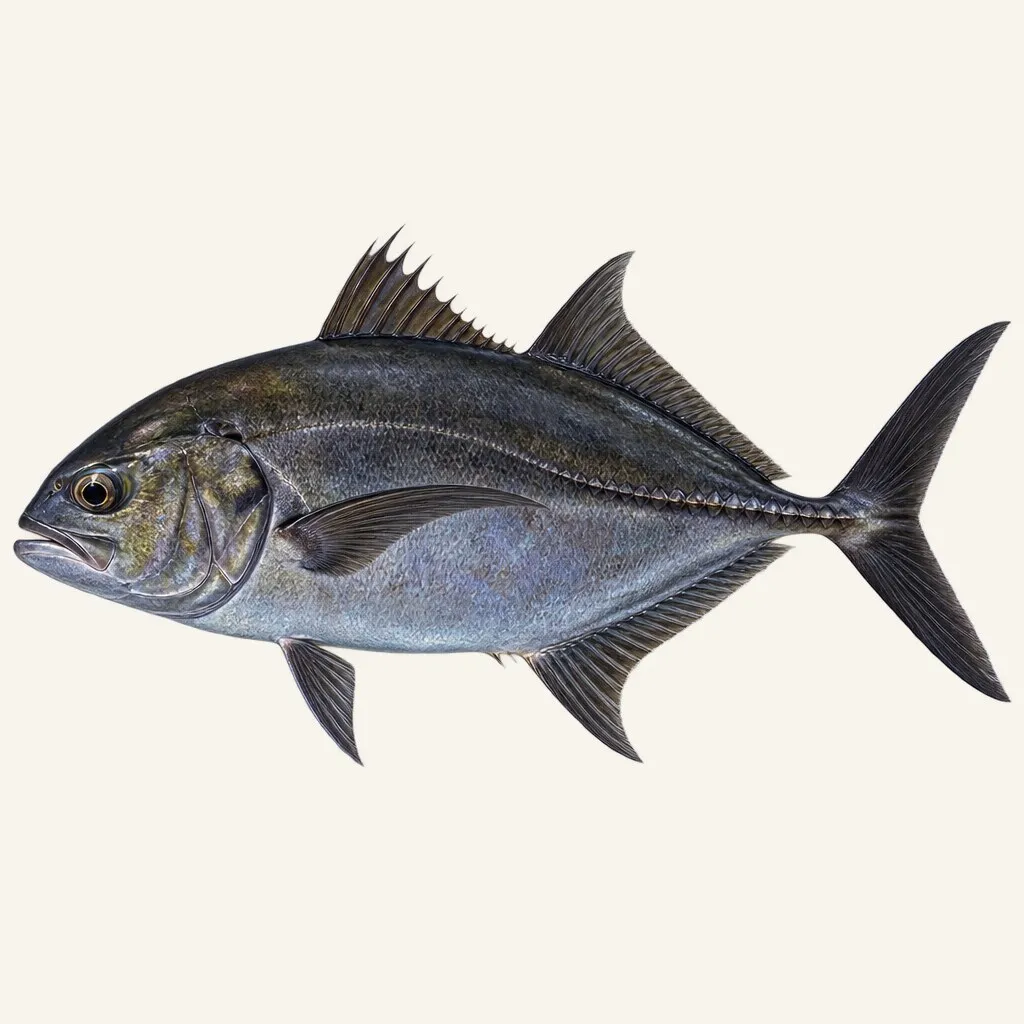
The Black Jack is a deep-water oceanic carangid with a distinctively dark, almost black coloration. It frequents offshore waters around islands and seamounts, recognized by its stocky body and uniform dusky pigmentation.
Calendar
Recorded in 31 countries
American Samoa · Australia · Bahamas · Brazil · Cameroon · Caribbean Netherlands · Cayman Islands · Colombia · Congo - Brazzaville · Costa Rica · Côte d’Ivoire · Ecuador · French Polynesia · Gabon · Ghana · Guadeloupe · Guinea · Guinea-Bissau · Japan · Liberia · Maldives · Marshall Islands · Mexico · Nigeria · Northern Mariana Islands · Puerto Rico · Senegal · Sierra Leone · St. Helena · U.S. Virgin Islands · United States
GBIF occurrence records — native and introduced populations combined.
Its range
The range is described as circumtropical, but the list of known localities tells a different story from a continuous belt. Western Indian Ocean: Natal and East London in South Africa, Réunion, Mauritius, the Cargados Carajos, the Seychelles. Eastern Atlantic: the Azores, Madeira, St Paul's Rocks, Ascension, Cape Verde, the Gulf of Guinea. Western Atlantic: Bermuda and the northern Gulf of Mexico down to Brazil. Western Pacific: southern Japan to New Caledonia, with a recent report from Tonga. Eastern central Pacific: Mexico, the Revillagigedo Islands included, to Costa Rica.
Almost every name on that list is an island, an archipelago or a rock. It matches what is known of the animal, which is oceanic and insular, tied closely to clear offshore water and rarely found on shallow banks. The range is not a band but a scatter of points — wherever deep clear water meets a steep slope, and nowhere on the shelf in between.
The consequence is a matter of distance. One island population reaches the next only across hundreds of kilometres of open ocean.
Identifying it
The fin counts are no help, and knowing that in advance saves time with a key. Nine dorsal spines, 20 to 22 soft rays, three anal spines, 16 to 19 rays: every one of those values falls inside the range of at least one other jack, and not a single one of them is decisive on its own.
What decides is the overall tone. The fish is dark and uniform, and every language that names it has named the colour. The body is fusiform and laterally compressed, without the opercular spots or the pale fin tips that flag its relatives.
The third character is where the fish was caught, and it is nearly as reliable as anything anatomical. A dark jack brought up from an oceanic drop-off, well away from any continental shelf, at 40 m off an isolated island, has very few alternative identities.
The water it needs
Depth runs from 12 to 354 m, but the working band is 24 to 65. A 40-metre window inside an amplitude of that size is narrow enough to fish directly.
The station is the drop-off, at the outer edge of the reef where the slope tips away into blue water. The fish holds benthopelagically, neither on the bottom nor at the surface, and forms schools occasionally.
Areas
- Deep reef drop-offs
- Offshore wrecks
- Open blue water
- Rocky points and headlands
Techniques
- Metal lure fishing
- Rigged dead bait
- Vertical jigging
- Trolling
Baits
- Metal lures
- Whole dead fish
- Lead jigs
- Soft plastic lures
What it eats
It feeds on fishes, and it feeds at night.
A fish-eater posted on an oceanic slope intercepts forage that is not the forage of the lagoon. What passes along the edge is small pelagic fish and open-water species, not the residents of the coral flat, and the size and behaviour of those prey is what a lure is being asked to imitate.
How to catch it
The drop-off between 24 and 65 m is the whole brief. Working the flat or the coastal shallows produces nothing, because the species is absent from shallow banks and its presence depends on deep water being immediately at hand.
Feeding is nocturnal, which shifts the best hours away from most reef fishing. The occasional schooling habit stops short of true gregariousness: one fish does not reliably promise the next.
The build is modest for the genus — a common length of 70 cm, maturity from 38, twelve years at the oldest reported. This is a mid-sized jack, and tackle chosen for the Indo-Pacific giants is out of proportion to it.
Conservation
The isolation of the populations is the fact that governs everything else. A species distributed as insular units separated by open ocean is not one stock but a collection of small local ones, and recruitment at one island does not readily replace what was removed at another.
That structure makes any global verdict uninformative. It applies to the sum, while the fishing happens one island at a time, and the reference assessment for this species dates from August 2012 — the oldest of the large jacks.
Commercial exploitation is minor, which limits the pressure for now. What will actually decide the outcome is the artisanal fishery of small islands, where a dark jack off the drop-off can be a meaningful share of the catch.
Regulations
Check the local regulations in force (legal size limits, closed seasons, bag limits).
For guidance only. Legal sizes, quotas and open seasons vary by location and season: always check the local regulations in force before fishing.
Other names
Black jack or black trevally in English, jurel negro in Spanish, xaréu-preto in Brazilian Portuguese, schwarze Stachelmakrele in German. For once every language has taken the same character and there is no ambiguity to untangle from one country to the next.
The Latin lugubris means mournful, of mourning. The naturalist named the colour before the fishermen did, and in the same terms.
Sources: fishbase.se · api.gbif.org