Australian bonytongue
Scleropages jardinii · Osteoglossidae
- Freshwater
- Predators
- Medium
- Size
55–100 cm
- Weight
2.2 kg
Where to fish
- Lake
- Pond
- River
Habitat icons: Flaticon
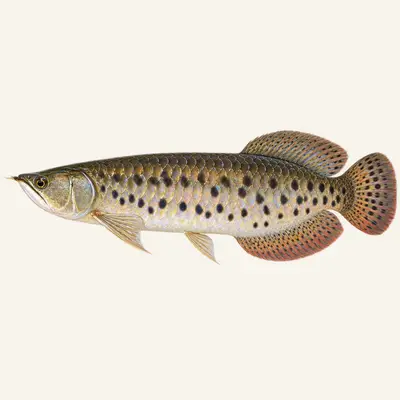
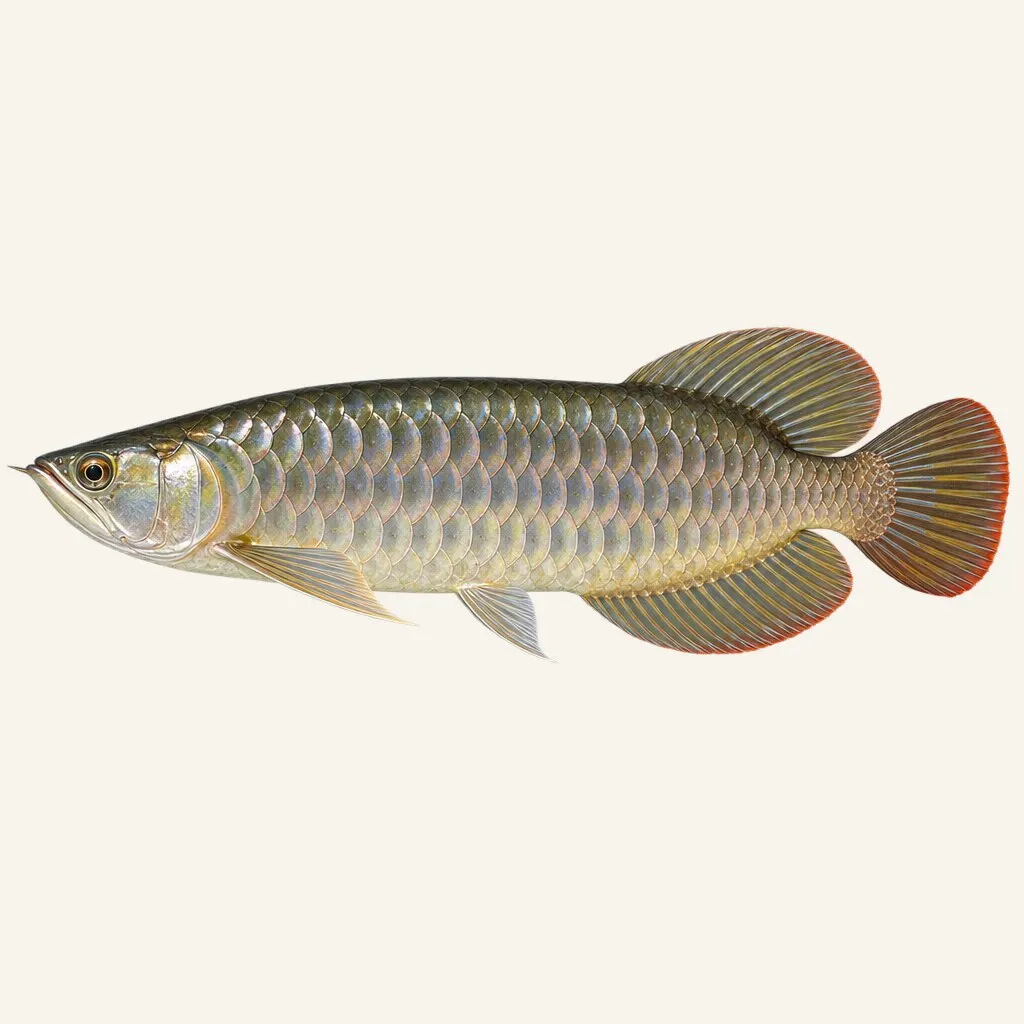
Large, slender fish with golden scales marked by an orange half-crescent on each scale, native to freshwaters of northern Australia and New Guinea.
Calendar
Recorded in 3 countries
Australia · China · Papua New Guinea
GBIF occurrence records — native and introduced populations combined.
Its range
The wet season draws this range, more than any barrier does. Breeding is released as surface temperatures approach 30 °C in the weeks before the rains, and that combination exists across monsoonal northern Australia and central-southern New Guinea. Where the monsoon stops, the condition stops with it.
The sea between the two halves is the part a map makes look decisive and is not. No strictly freshwater fish crosses salt water, so the split is recent and marine while the connection it interrupted was old and continental.
Identifying it
Every scale carries a mark. On a golden ground, each one bears an orange half-crescent, so the flank does not read as a field of colour but as ranks of crescents — a pattern that survives poor light and a wet photograph. That character comes from the catalogue description printed on this page; the FishBase diagnosis for the species offers counts and nothing else.
Those counts are worth having anyway, because they say something about the animal. The dorsal is carried on 20 to 24 soft rays, the anal on 28 to 32, and neither fin holds a single spine. The two long bases occupy the rear of a fusiform body, the anal being the longer of them.
A complete absence of spines has a practical side at the net. Nothing in the unpaired fins of this fish pricks, which is unusual in a predator of the size, and the hand is safer here than on most of them. Those long soft bases are propulsion and trim; they were never a deterrent.
Breeding
The female incubates, and the sequence is documented step by step.
Fertilised eggs are taken into her mouth. Hatching follows in one to two weeks. The larvae, carrying a swollen yolk sac, are then kept in the mouth or close against it for another four or five weeks — the wording matters, because a refuge that can be left and regained is not confinement but shelter within reach.
The young begin to feed on microcrustaceans at two to three centimetres, while the yolk is still there. The two energy supplies therefore overlap, and the fish learns to hunt before it has to live by hunting. Independence comes between 3.5 and four centimetres.
Read the last figure again, because it is the point of the whole arrangement. What leaves this female's mouth is not a cloud of millimetric larvae handed over to statistics: it is a small number of four-centimetre animals that already feed themselves. Six or seven weeks of one adult's mouth buys the brood past the stage at which most fish lose almost all of theirs.
The trigger is thermal. Spawning comes ahead of the wet season, when surface water approaches 30 °C — so the young are turned loose into water that is about to spread, not into a habitat that is closing down.
The water it needs
Adults hold still water in streams and swamps, and they hold it in two dimensions at once: near the surface, and close to the shore among aquatic vegetation. The volume available to them is a band a few dozen centimetres deep along a fringe a few metres wide.
They are also solitary and territorial, which turns that fringe into a series of owned stations rather than a habitat shared out. A good length of margin holds one fish.
Areas
- Billabongs and tropical lakes
- Northern Australia flooded plains
- Banks with emergent vegetation
- Slow-flowing rivers
Techniques
- Surface lures
- Poppers
- Streamer fly fishing
- Live bait at surface
Baits
- Small live fish
- Frogs
- Colored poppers
- Surface soft plastic lures
What it eats
Adults feed at the surface across a wide list: terrestrial and aquatic insects, small fishes, frogs, crustaceans, and a share of plant material. The young start on microcrustaceans.
The move from a water flea to a frog happens inside one habitat, without a change of layer or of season. Nothing about the fish's address changes as it grows; only the gape does, and the gape drags the whole diet behind it.
How to catch it
Territoriality is the tactic. Since the margin is parcelled into stations and each is held by one animal, the productive approach is to move along it and put a lure into each in turn, rather than to work one promising bay from several angles. A refusal here is more often an empty station than a wrong choice.
The maturity figures then tell you what you are handling. First maturity arrives around 45 cm and the common length is 55 — a small gap, with a direct consequence: the fish met in the ordinary way of things has already spawned at least once.
The season deserves looking at squarely. The weeks before the rains are the laying weeks, and a carrying female has a full mouth for six or seven weeks after a one-to-two-week incubation. She does not feed. If she takes something anyway, the brood goes with it. Fishing for this species then means working a population of which part is unavailable and the rest is costly to disturb.
The file also contradicts itself on the fish's value, and both halves are defensible. The uses line files it as of no interest to fisheries; the biology rubric calls it an important food fish and a valuable aquarium fish. The reconciliation is straightforward. A fish caught and eaten where it was caught appears in no landing statistic — it counts for everyone except the figures.
Regulations
Check the local regulations in force (legal size limits, closed seasons, bag limits).
For guidance only. Legal sizes, quotas and open seasons vary by location and season: always check the local regulations in force before fishing.
Other names
Five of the six vernacular entries this catalogue holds call the fish a saratoga. English alone calls it a bonytongue, naming the animal by an internal character rather than by a place — and bonytongue is a group word, covering the family instead of the species.
The qualifiers do not agree either. French, Spanish and Italian say gulf, after the Gulf of Carpentaria; German and Brazilian Portuguese say northern. Neither wording reaches New Guinea, which holds half the range. That population is not secondary in any biological sense, only further from the naturalists who fixed the usage.
The epithet jardinii is a dedication and says nothing about the animal, which is the ordinary fate of an eponym.
Sources: fishbase.se · api.gbif.org