Arawana
Osteoglossum bicirrhosum · Osteoglossidae
- Freshwater
- Predators
- Medium
- Size
90 cm
- Weight
6.0 kg
- Water temp.
24–30 °C
Where to fish
- Estuary
- River
Habitat icons: Flaticon
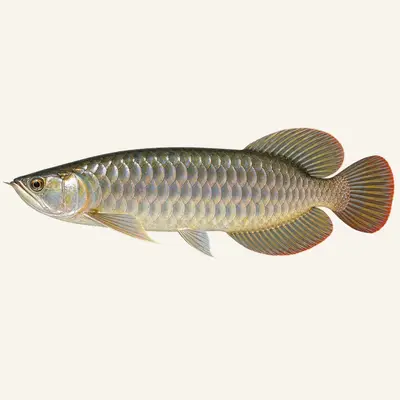
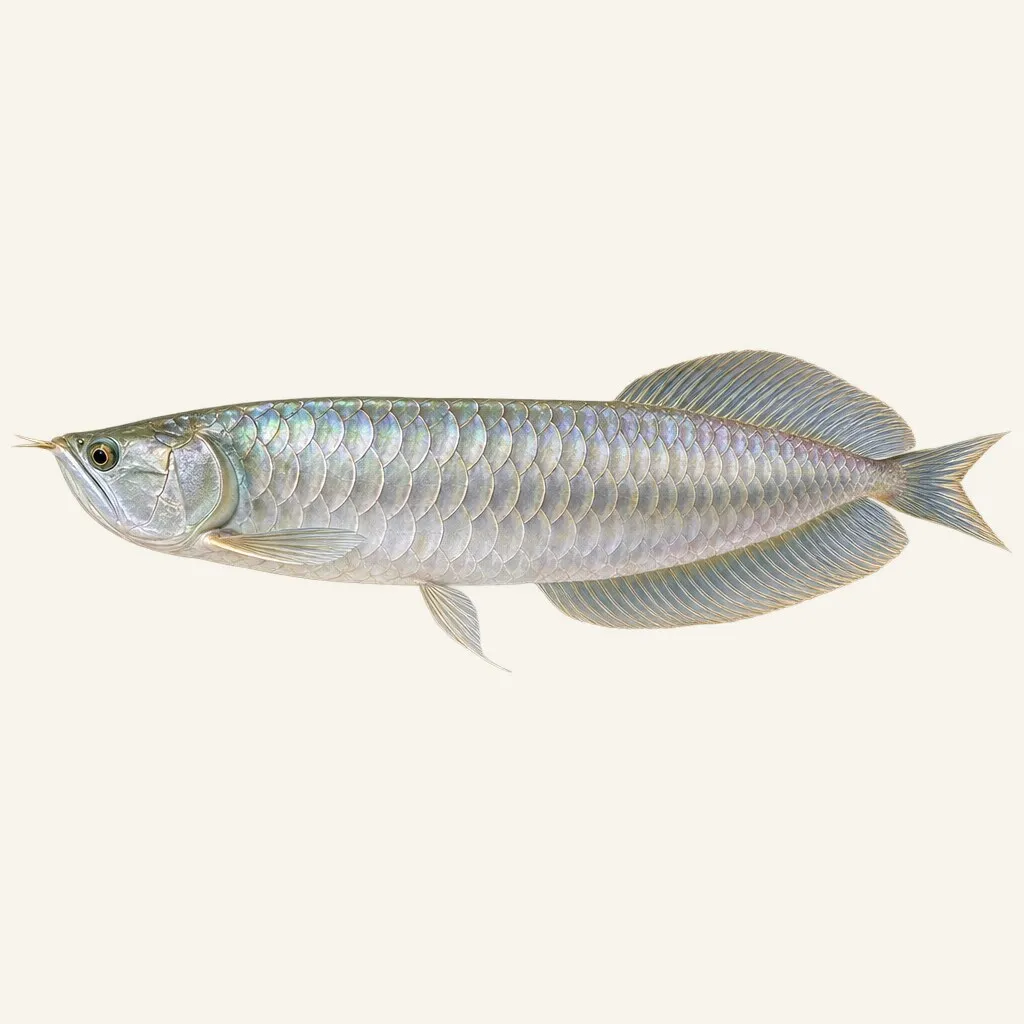
The silver arowana is a slender, elongated fish covered in large iridescent silver scales. A formidable surface hunter, it can leap out of the water to seize prey such as insects and small vertebrates.
Calendar
Its range
Three waters are named: the Amazon basin, the Rupununi in Guyana, and the Oyapock, the border river between French Guiana and Brazil.
Those three do not join up by their ordinary courses. A strictly freshwater fish present in all of them therefore implies that the wet season connects what low water separates — and annually flooded ground does precisely that. At the height of the flood, terrain that is dry for the rest of the year becomes one continuous sheet, and a surface fish crosses it without ever leaving fresh water.
Identifying it
Two barbels sit at the very extremity of the lower jaw, and their position deserves a second look. The mouth is set high and opens upward, which makes the tip of the lower jaw the leading edge of every strike — and that is exactly where the sensory pair has been planted.
The scales are very big, big enough to be counted by eye on a living fish. The body is elongated with an oval cross-section: a ribbon rather than a spindle.
Dorsal and anal are almost fused with the caudal. The unpaired fins therefore form one continuous fringe down the rear third, and that arrangement serves a long undulating stroke able to hold a position just under the surface without a beat of the tail. It is not built for a sprint.
Age shows in the colour. The adult is silvery; the juvenile carries blue glints and a yellow-orange bar, a mark that goes with growth and identifies a young fish immediately.
Breeding
The male carries. Eggs, then larvae, then early juveniles occupy his mouth for close to six weeks, which means the same cavity works as an incubator and then as a nursery the young return to after they can already swim.
Where the cost falls is the part worth noticing. In most fishes a male's contribution closes at fertilisation. Here it runs on for a month and a half, on an animal that cannot feed while it lasts, and it is the male who is out of circulation for the whole of it. Whatever this species produces in a season, half the adult population pays for it twice over.
The water it needs
The rubric records an ability to adapt to environments low in oxygen. It records an ability, not a requirement, and it does not describe air breathing — two things that are easily confused in this order of fishes and should be kept apart.
What the tolerance buys is tenure. Standing water in a floodplain — a closed side arm, a blackwater lagoon, the shaded margin under leaning trees — warms as the level drops and loses its oxygen as the vegetation in it rots. A fish that has to pull back to the main channel when that happens surrenders its ground twice a year. This one does not have to move.
That is why the productive water for this species is the water an angler would write off, and why the lies listed above are lagoons, oxbow channels and shaded banks rather than anything with current in it.
Areas
- Flooded areas with vegetation
- Shaded banks of blackwater rivers
- Lagoons and oxbow channels
- Surface of shallow zones
Techniques
- Surface lures
- Fly fishing (large flies)
- Light popper
- Live bait at surface
Baits
- Frog lures
- Small live fish
- Large artificial flies
- Surface insect imitations
What it eats
The word in the rubric is omnivore, with a leaning towards fish taken at the surface. Large insects fill out the rest, beetles among them, taken in the air or off the vegetation.
An omnivore inspects. A predator that will accept items as different as a fry and a beetle takes the time to look at what it is about to eat, and that single habit does more to explain refusals here than any question of lure choice.
How to catch it
Start with the jump, because it tells you where the feeding surface actually is. This fish leaves the water to take large beetles, which means its ceiling is not the waterline: it extends up into low branches and leaning foliage. A bait placed under an overhang and left still is inside a register the animal already knows.
Then the mouth. The strike cone sits entirely above the fish, because the jaw is built to seize prey while rising from below. A lure passing beneath this animal does not exist for it. A lure passing above is in its field. The whole presentation therefore happens in the top few dozen centimetres of the column, and a metre of extra depth removes it from play altogether.
Pace follows from the diet. Something that examines its food needs time to examine it, and a retrieve fast enough to convince a pure piscivore will simply outrun this one.
There is one cost to know about before hooking anything in the season. A brooding male has a mouth full of young for six weeks, and a hooked fish empties it.
Conservation
Two markets take the same animal. It supports a commercial fishery, and it supports an ornamental trade also described as commercial. The same species is sold dead on a slab and alive in a tank, and neither use substitutes for the other.
The incubation is what makes that double draw expensive. Taking a carrying male removes an adult plus everything he was holding: the loss is not one fish but the entire output of that breeder for the year. A male who spits his mouthful when hooked does not gather it up again.
The country list on this page is worth reading with that in mind. It reaches Singapore, Vietnam, Hong Kong and Taiwan, well past the three river systems the diagnosis names — a commercial footprint sitting on the same map as a biological one, with nothing to tell the reader which is which.
Regulations
Check the local regulations in force (legal size limits, closed seasons, bag limits).
For guidance only. Legal sizes, quotas and open seasons vary by location and season: always check the local regulations in force before fishing.
Other names
Silver arowana is the usual English name; this catalogue's English entry is Arawana, and five of its six vernacular entries name the silver. All of them are naming one age: the adult is silvery and the juvenile, with its blue sheen and orange bar, is not.
Arowana on its own is a trap in English. In the aquarium trade the word usually means the Asian Scleropages, so it identifies a body plan rather than a continent, and a fish described simply as an arowana could as easily be from Borneo as from the Amazon.
Bicirrhosum means two cirri, which are the barbels on the chin — a name that describes what is in front of you. Osteoglossum names the bony tongue of the group, a toothed plate that bites upward against the roof of the mouth rather than against an opposing jaw.
Sources: fishbase.se · api.gbif.org