Bleak
Alburnus alburnus · Cyprinidae
- Freshwater
- Carp & coarse
- Easy
- Size
15–18 cm
- Weight
0.0–0.1 kg
- Water temp.
10–20 °C
Where to fish
- Canal
- Lake
- River
Habitat icons: Flaticon
Tiny silvery fish forming huge shoals - fast-paced fishing
Calendar
Recorded in 24 countries
Austria · Belarus · Belgium · Czechia · Denmark · Estonia · Finland · France · Germany · Hungary · Lithuania · Luxembourg · Netherlands · Norway · Poland · Portugal · Romania · Russia · Slovakia · Spain · Sweden · Switzerland · Ukraine · United Kingdom
GBIF occurrence records — native and introduced populations combined.
Its range
The species holds most of Europe north of the Caucasus, the Pyrenees and the Alps, running east as far as the Ural and the Emba. That is lowland and middle-altitude country, framed by mountain chains rather than by meridians.
The natural absences define the limit better than the presences do. The fish was missing from the Iberian Peninsula, from the Adriatic and Aegean basins apart from the Maritza, from Italy, from Ireland, from Great Britain outside the south-east, from Norway and from Scandinavia beyond 67 degrees north, and from the Caspian basin south of the Volga. In Anatolia it is confined to the Marmara basin.
Several of those holes have since been filled by hand. Local introductions established it in Spain, Portugal and Italy, and at least one country has recorded an adverse ecological effect following its arrival. The Italian case deserves a note: the peninsula has a native congener of its own, and a shoaling planktivore of larger size has now been laid over the top of it.
Identifying it
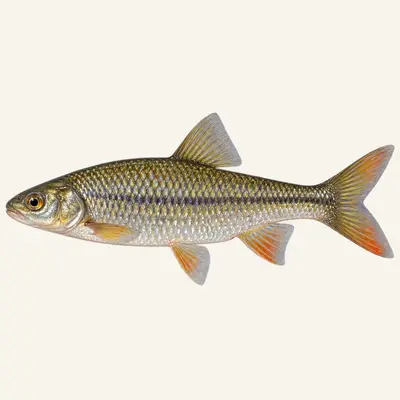
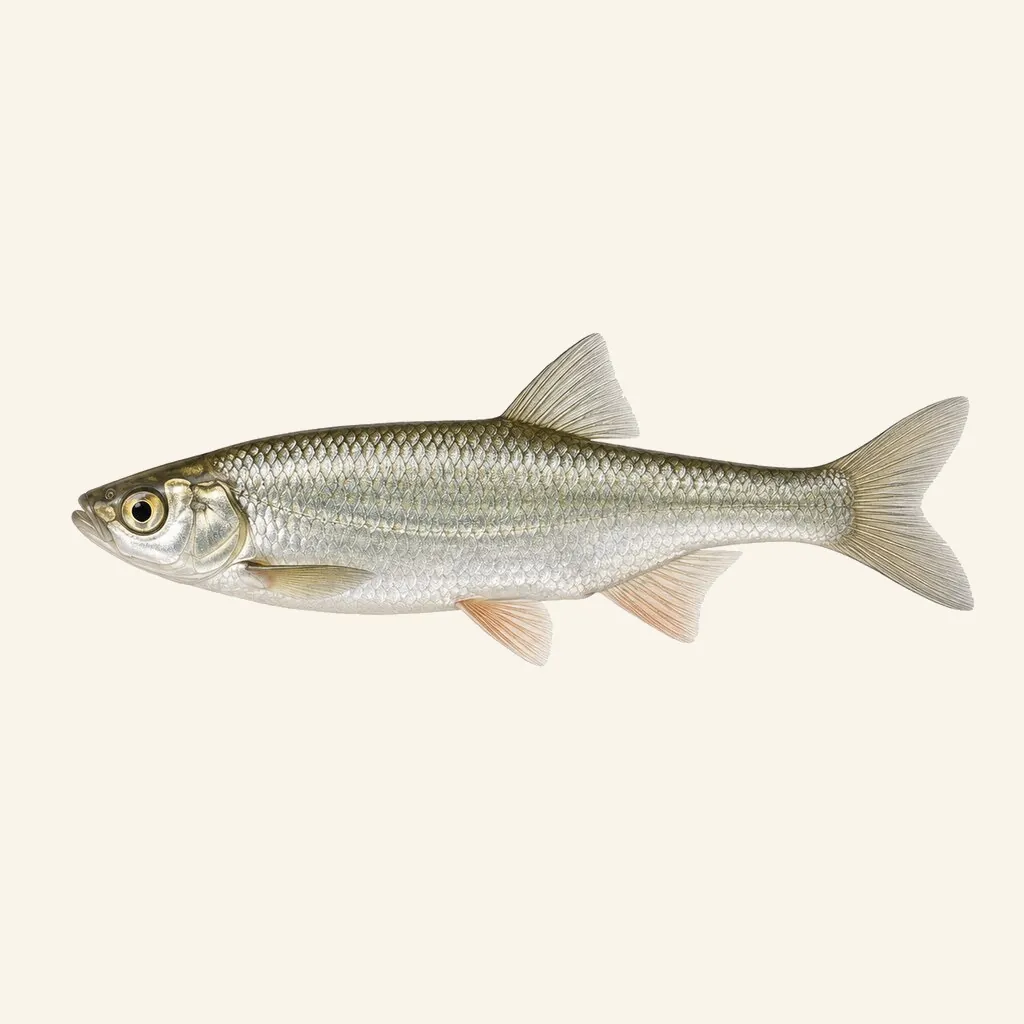
The mouth tilts upward. Only slightly, but far enough that the lower jaw leads and the opening faces the ceiling rather than the bed. On a fish of 15 cm that detail is worth more than any count, because it states where the animal lives and what it takes.
The side carries nothing. There is no dark longitudinal band in life, and no more than an uncertain trace on a preserved specimen — an absence that works as a character, since several close relatives show a well-marked stripe. The whole flank is hard silver, near enough a mirror, under a greenish back.
Counts resolve the doubtful cases. The anal fin begins beneath the fourth and fifth branched rays of the dorsal; the lateral line holds 45 to 48 scales with three more on the tail; the anal carries 17 to 20 and a half branched rays; there are 16 to 22 gill rakers, 41 to 44 vertebrae and 19 rays in the tail. The ventral keel is stripped of scales along its whole length, from the vent forward to the base of the pelvic fins.
Dimensions close the subject. Maturity arrives at barely 10 cm and common length is about 15, so the entire adult life of this fish fits in a closed hand. Published maxima for the species differ from one another by more than half, which is a reason to distrust any of them.
Breeding
Eggs go onto stone in shallow water: thin riffles, the shingle margins of lakes, occasionally over submerged plants. The bed is hard and clean rather than silted.
Incubation takes about four days, and the brevity changes the nature of the risk. This spawning does not need a stable substrate for weeks, only water that behaves for ninety-six hours. A clutch that hatches inside four days absorbs a spate far better than one left sitting on gravel through a fortnight of unsettled weather, and it allows a shoal to use shallows that will not last the month.
The water it needs
This is a fish of open water and of the surface layer. It occupies the free water of lakes and of medium to large rivers, in shoals held near the top, in water of 10 to 20 degrees, neutral to alkaline and on the hard side.
Its life changes theatre as it grows, and in the opposite direction to most cyprinids. The larvae stay in the littoral zone; the juveniles then leave the margins for the pelagic zone, where they live on plankton, drifting insects and invertebrates that have fallen onto the surface. The shallows are not the nursery here — the open water is.
Winter gathers everything somewhere else. The shoals quit the open water and form very heavy concentrations in backwaters and other still water. A lake that looks empty in January is not: the fish are massed in the side waters.
Areas
- Surface
- mid-water
- calm zones
Techniques
- Ultra-light pole/coarse fishing
- Flying waggler
Baits
- Maggots
- Pinkies
- Bloodworms
What it eats
Plankton, in the main — planktonic crustaceans and insects. Nothing that has to be searched for on the bed, nothing that requires digging through a substrate.
The consequence follows from the set of the mouth. A fish that looks upward takes what drifts and what falls, and it goes up to get it: a hatch, a wind that loads the surface, a tree shedding its passengers all concern the shoal directly. It is also what makes the species catchable on a fly, which is not what a cyprinid of this size normally offers.
How to catch it
The rig is set in centimetres below the surface. The fish hold the top layer, and a shot that carries the bait to mid-depth takes it under the entire shoal. Minute hooks, a bait scaled to the mouth, and offerings that drift rather than sink.
It is fishing at a cadence. The shoal is numerous and the bite immediate, so the return depends on the rhythm of unhooking more than on the subtlety of the tackle. Fine loose feed, scattered on the top, holds the fish in place instead of calling them from a distance. The smallest hook available and a fly as bait is a documented method, and the flesh is good eating despite the size.
Most of the value of this fish to an angler is nevertheless indirect. It is the reference livebait for predators, and it is reared commercially for that purpose; its presence determines that of the fish which follow it, the asp having made it a staple. Spotting bleak flickering at the surface says as much about what is underneath them as about what can be caught.
One last thing, historical rather than practical: this fish was once netted for its scales and not for its flesh. They supplied Essence d'Orient, the pearly coating applied to artificial pearls, and a single necklace consumed a startling number of fish.
Conservation
Nothing much presses on the species in its own range. It is of little interest to commercial or sport fisheries there because of its size, and it is abundant enough to serve as the forage base for everything that hunts in open water.
The question is the other way round. Outside that range it is the pressure. Introduced into Spain, Portugal and Italy, it competes directly with small native cyprinids for the same layer of water and the same plankton, at a larger size and in bigger shoals, and one country at least has recorded the damage. The Italian introduction sits on top of a native congener with an identical diet, which is the clearest case of the pattern.
There is a second-order effect worth registering, since this fish is transported deliberately. A bucket of livebait moved between catchments is a stocking operation, whatever it is called, and this is the species most often in the bucket.
Regulations
Check the local regulations in force (legal size limits, closed seasons, bag limits).
For guidance only. Legal sizes, quotas and open seasons vary by location and season: always check the local regulations in force before fishing.
Other names
Bleak in English, from an old northern word for pale, which is also what the scientific name says: albus, white, and the binomial repeats it twice over, in the genus and again in the species.
The name to be careful with is the Italian alborella. In ordinary use it belongs to the native Italian fish, a separate species, and translations move it onto this one without noticing — which matters here, because the two now share water in the Po plain. German Ukelei and Spanish alburno cause less trouble.
Sources: fishbase.se · api.gbif.org · fishbase.se