Dusky grouper
Epinephelus marginatus · Serranidae
- Saltwater
- Coastal
- Hard
- Size
150 cm
- Weight
60 kg
- Lifespan
60 years
- Depth
8–300 m
Where to fish
- Rocky shore
Habitat icons: Flaticon
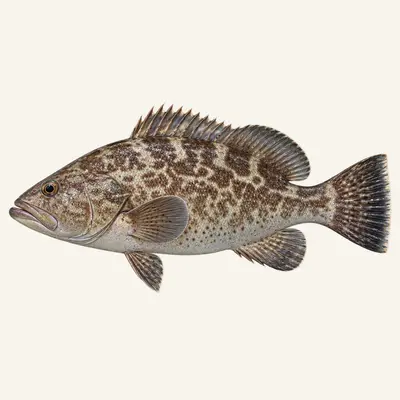
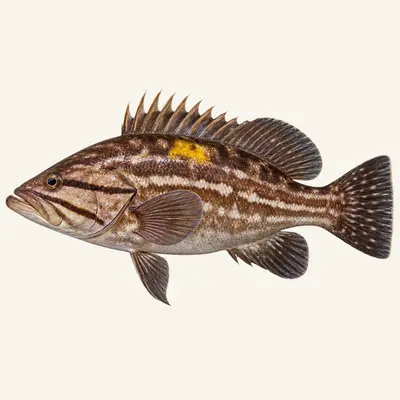
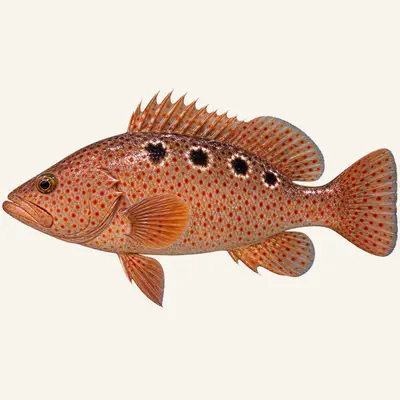
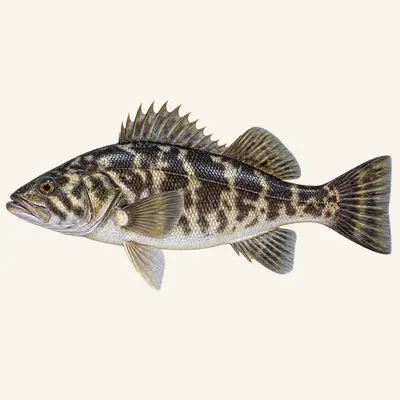
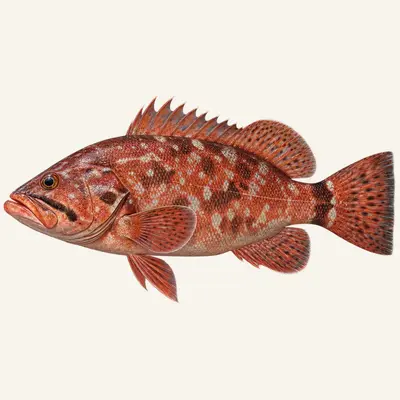
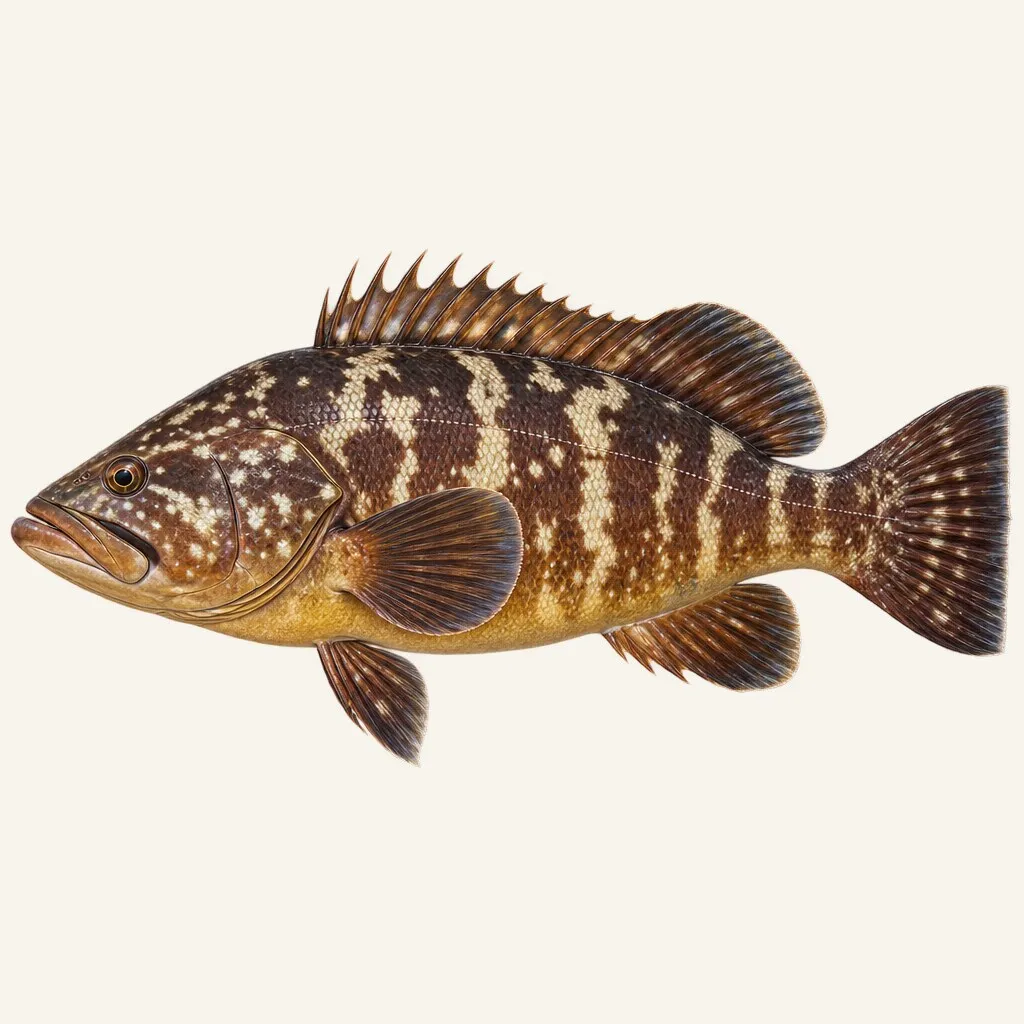
The dusky grouper is a robust serranid with a massive body, reddish-brown and scattered with small pale blotches. Its snout is short and its large mouth points upward. A protandrous hermaphrodite, it lives on rocky bottoms and seagrass beds in the Mediterranean and East Atlantic, holding a fixed territory.
Calendar
Recorded in 29 countries
Albania · Angola · Benin · Brazil · Cameroon · Congo - Brazzaville · Côte d’Ivoire · Croatia · Cyprus · Equatorial Guinea · France · Gabon · Ghana · Greece · Guinea · Guinea-Bissau · Israel · Italy · Liberia · Malta · Mozambique · Nigeria · Portugal · Senegal · Sierra Leone · South Africa · Spain · Tunisia · Türkiye
GBIF occurrence records — native and introduced populations combined.
Its range
The species occupies the eastern Atlantic from the southern Bay of Biscay to the tip of Africa, the whole Mediterranean, the south-western Atlantic off south-eastern Brazil, Uruguay and Argentina, and the western Indian Ocean from southern Africa up to southern Mozambique and southern Madagascar. It is recorded from Oman and from Réunion.
Strays have reached the British Isles and the eastern Channel off Normandy. Individual fish that far north prove nothing on their own, but they are the kind of record that accumulates, and they are worth watching for what they say about where the northern limit is going.
Identifying it
Head and back are dark reddish brown or grey, the belly gold. Between the two, irregular pale blotches — white, greenish yellow or silvery grey — are scattered over the flank and the head, and they tend to line up in vertical series rather than at random.
A dark streak marks the maxilla, more or less clearly from one fish to the next. The median fins are deep brown, and the trailing edges of the anal and caudal fins, often the pectorals too, are finished with a narrow white line. The pelvic tips are blackish; the front edge of the spiny dorsal and the base of the paired fins are frequently gold.
Proportions confirm it. Head length goes 2.3 to 2.5 times into standard length, the area between the eyes is convex, the preopercle is rounded and finely serrated with slightly enlarged teeth at the angle. Eye diameter is the useful growth marker: as wide as the interorbital space or wider in fish of 10 to 30 cm, distinctly narrower in fish over 40 cm.
Fin counts are 11 dorsal spines, 14 to 16 soft rays, three anal spines and eight or nine rays.
Breeding
Every one of these fish begins life female. There are no primary males in this species, which is what monandric means here: a male is a fish that used to be a female and changed.
The timing of that change is the fact around which everything else on this page arranges itself. In European waters it happens at 14 to 17 years of age and between 80 and 90 cm. A separate study puts the switch at 88 cm and 12 years, with individual variation from 52 to 77 cm and from seven to 17 years. First maturity, as a female, comes at about five years; the change to male follows after ten, and some females delay it further.
The consequence arrives every time a large fish comes up. A big dusky grouper is a male, and there is no other kind of male. Removing the large fish from a stretch of coast removes its entire breeding male population, and nothing in the year classes below can replace them for a decade or more.
Spawning happens in summer, and mature fish gather to do it.
The water it needs
Adults want rock. They live alone on it and they defend it, which is the single most useful thing to know about finding them. A grouper takes a crevice, a drop-off or a cave and stays with it for years, so the species is not located by covering ground but by knowing where the holes are and which ones are occupied.
Juveniles keep closer inshore, in rocky tide pools, and the species enters brackish water.
Depth runs from 8 m down to 300, but the bulk of the population sits above 50, which puts most of it inside the range of a diver and of coastal fishing gear at the same time.
Areas
- Coastal rocky bottoms
- Underwater caves and overhangs
- Posidonia and seagrass beds
- Coastal wrecks
Techniques
- Slow coastal trolling
- Live or dead bait fishing
- Coastal jigging
- Texas-rigged soft lure on bottom
Baits
- Octopus piece
- Fresh cuttlefish
- Live coastal fish
- Whole shrimp
- Squid
What it eats
Crabs and octopus make up most of the diet. Larger individuals shift towards fish, mostly reef-associated species, without abandoning the crustaceans.
That shift is what an ambush predator's diet looks like when the predator grows: the hunting method does not change, only the size of what fits. A fish that waits at the mouth of a hole and takes what passes will take a larger share of swimming prey once it is large enough to catch it.
How to catch it
One line in the literature frames the entire problem: this species is readily caught. A territorial animal that stays at a known address for years, is inquisitive rather than shy, and lives for six decades has no defence against anyone who knows the address.
That is what emptied stretches of Mediterranean coast before protection came in, and it is why this fish cannot be discussed apart from the question of how much of it is taken. Spearfishing and angling for the species are subject to specific measures across much of its range, moratoriums included, and those must be checked with the competent authority before going out.
Where it is permitted, the fishing is a reading of structure: crevices, drop-offs, caves and wrecks between 10 and 50 m. The fish does not pursue. It comes out of its hole and it goes back in, and a hooked grouper that reaches the hole is gone, along with the terminal tackle.
Size and age change what a capture means. The oldest fish on record had reached 60 years. A large one has been on that piece of rock longer than most of the people who go looking for it have been alive.
Conservation · Vulnerable (IUCN) — This species is threatened with extinction. Always release it (no-kill), handle it with the utmost care and check local rules — fishing for it may be prohibited.
Conservation
The traits stack, and that is the mechanism. Slow growth. Six decades of potential lifespan. A fixed territory that makes an individual findable. A recognised ease of capture. And a late sex change that turns every large fish into an irreplaceable male.
None of these is a problem by itself. Together they describe a species that can disappear from a coastline within a few seasons and take decades to come back, because coming back requires fish to reach 14 years old before any of them is male.
Spawning aggregations complete it. Animals that are solitary for eleven months of the year concentrate in summer at known points — precisely when and where taking them costs the most.
Regulations
Check the local regulations in force (legal size limits, closed seasons, bag limits).
For guidance only. Legal sizes, quotas and open seasons vary by location and season: always check the local regulations in force before fishing.
Other names
Dusky grouper is the standard English name. South African usage has yellowbelly rockcod, which describes the fish better. Older literature files it under Epinephelus guaza, a name that persists in books and in some fisheries records.
Grouper itself is a loose word. The family carries rockcods, hinds, coral groupers and lyretails in English, the divisions between those names being regional rather than taxonomic, and a fish called grouper on one coast is called rockcod on another with no change of animal.
Around the Mediterranean the local names are the ones on the market slab: mérou in French, cernia in Italian, mero in Spanish and Portuguese, garoupa further south. All of them cover dozens of species whose sizes, habits and conservation situations have nothing in common.
Sources: fishbase.se · api.gbif.org