Gag grouper
Mycteroperca microlepis · Serranidae
- Saltwater
- Coastal
- Medium
- Size
50–145 cm
- Weight
1.4–37 kg
- Lifespan
31 years
- Depth
30–160 m
Where to fish
- Reef
- Rocky shore
Habitat icons: Flaticon
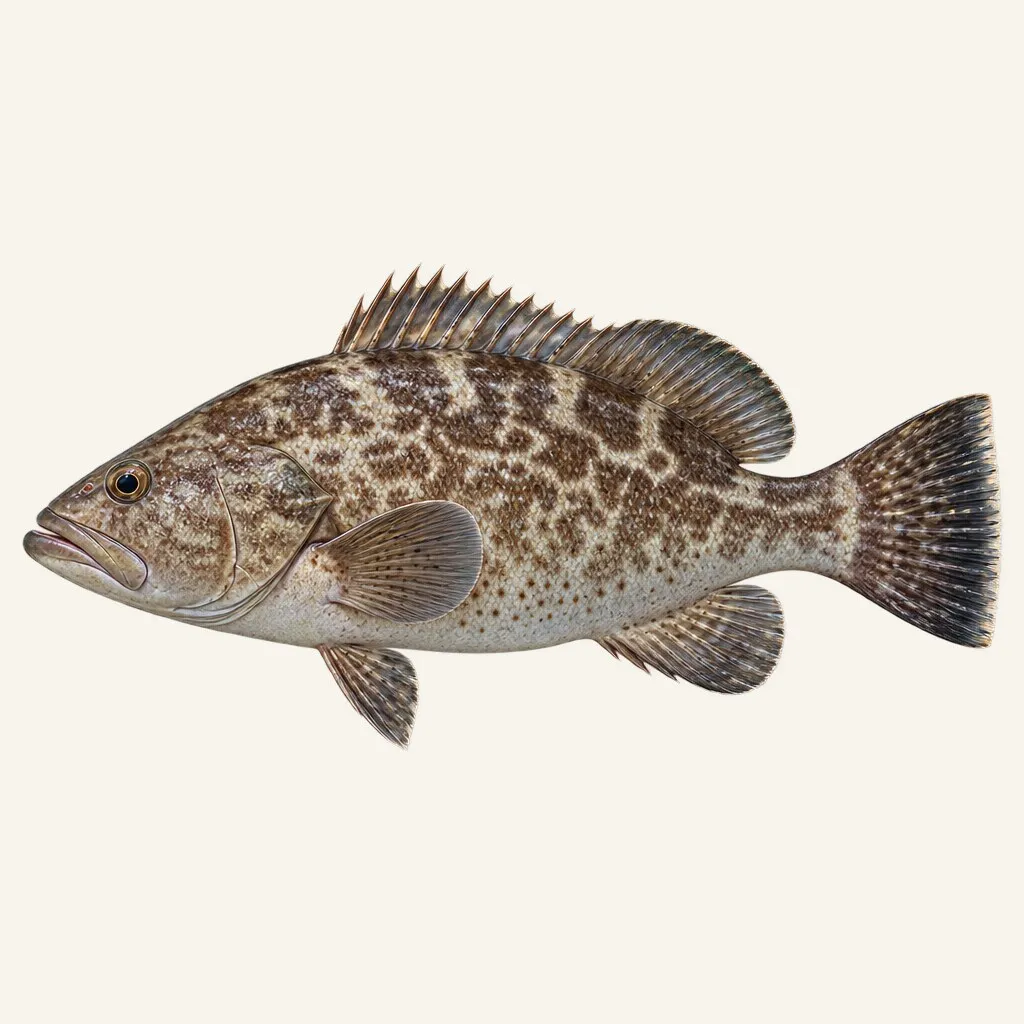
The gag grouper is a large coastal serranid of the western Atlantic, with a robust grey-brown body marked by dark blotches that fade in older fish. Adults inhabit rocky bottoms and seagrass beds from 5 to 100 metres deep.
Calendar
Recorded in 2 countries
Puerto Rico · United States
GBIF occurrence records — native and introduced populations combined.
Its range
North Carolina to the Yucatán peninsula — with juveniles occurring as far north as Massachusetts. The species is rare in Bermuda, has been recorded once in Cuba, and has also been reported from eastern Brazil.
The gap between those first two statements is the interesting part. The nursery reaches roughly a thousand kilometres beyond the northern limit of the adults. Young fish grow up on a coast where the species does not breed and does not, as an adult, live, and they must move south to join the population that produced them.
A range described as North Carolina to the Yucatán therefore understates where this fish can be encountered and overstates where it can reproduce. Those are two different maps, and only one of them appears in a range statement.
Identifying it
This fish has three appearances, and treating them as three fish is the standard mistake made with it.
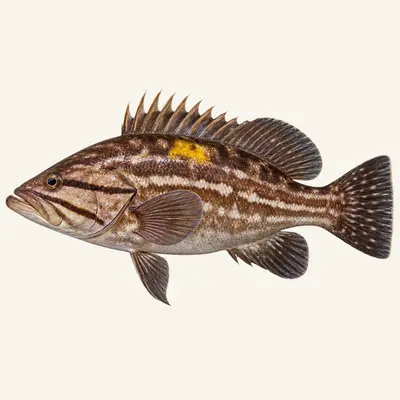
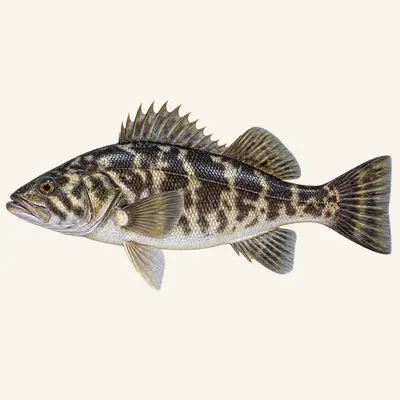
The default is what juveniles and adult females wear: brownish grey overall, worked across with dark, worm-like vermiculations. Anyone who has only seen the species in this state has seen it in the state it is usually in.
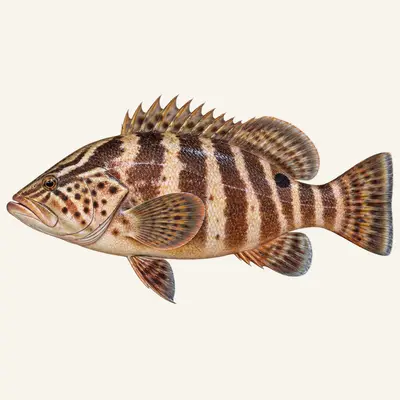
The second is the camouflage phase. Five dark brown saddles appear below the dorsal fin, separated by short white bars — a bold, high-contrast pattern that has nothing in common with the vermiculated version and that the same individual can be wearing an hour later.
The third belongs to large males and is displayed only sometimes. In the black-belly form the fish is mostly pale grey with faint dark reticulation below the soft dorsal, while the belly and the whole underside above the anal fin go black, along with the margin of the soft dorsal, the centre of the rear edge of the caudal and the trailing edges of the pectorals and pelvics. A black-back form is described as well.
So colour identifies a phase, not a species, and the phase carries information of its own: the vermiculated fish is probably a female or a juvenile, the black-bellied one is a large male. What identifies the species is structure. The angle of the preopercle is drawn out into a rounded lobe bearing enlarged serrations. In adults the rear nostrils are much larger than the front ones. The lateral scales are smooth except for those covering the pectoral fin. Body depth is contained 3.0 to 3.5 times in standard length, head length 2.5 to 2.7, and the space between the eyes is convex. Eleven dorsal spines and 16 to 18 soft rays, plus three anal spines and 10 to 12 rays.
Breeding
The species is classed as an indeterminate multiple spawner. In plain terms: total fecundity cannot be worked out by counting eggs in an ovary at one moment, because new batches are recruited during the season and the fish is not carrying its whole year's output at any single point.
That is a technical classification with a practical tail. Egg production in this species is estimated with more uncertainty than in a fish that commits its whole season's eggs in advance, and every stock assessment built on those estimates carries the same uncertainty forward.
First maturity is given at about 63 cm, with a lower bound reported at 51. Set that against a common length of about 50 cm and the shape of the problem appears: the ordinary fish is at or under the size at which the species is held to begin breeding. Maximum recorded age is 31 years.
The water it needs
Adults sit offshore on rocky bottom, in a band running from 30 m down to about 160, the deepest part of it reached only occasionally. They turn up inshore now and then over rock or grass. On the rocky ledges of the eastern Gulf of Mexico this is the commonest grouper there is.
Juveniles occupy estuaries and seagrass beds, and the species is recorded from brackish water — a tolerance most of the family does not have.
The social arrangement is the odd feature, and it has no middle setting. Adults are either solitary or in groups of five to 50 individuals. Nothing between those two states is described, so a fish found on a piece of structure gives no indication of how many others are on it.
Areas
- Coastal reefs
- Seagrass beds
- Rocky bottoms
- Wrecks
Techniques
- Bottom fishing
- Jigging
- Cast and retrieve with soft lure
- Live bait fishing
Baits
- Live fish
- Squid
- Crabs
- Soft lures
What it eats
Adults feed mainly on fish, with crabs, shrimps and cephalopods making up the remainder. Below about 20 cm the diet is almost entirely crustaceans taken in shallow grass beds.
The dependence of the young on grass is therefore twofold, and it is worth separating the two halves. The beds are cover, which is the obvious part. They are also the entire food supply of the fish at that stage, which is the part that gets left out. A degraded estuary does not just cost a juvenile grouper somewhere to hide.
How to catch it
Offshore rocky ledges in 30 to 160 m are where the adult fish is, and in the eastern Gulf they hold more of this species than of any other grouper.
The all-or-nothing sociality is what makes a session unpredictable. A fish taken from a ledge is either the only one there or the first of up to fifty, and there is no way to tell which before the second drop. Working a mark hard after a single capture is therefore a reasonable decision here in a way it is not with the strictly solitary groupers.
Adults eat fish first, so baits and lures that suggest a swimming prey animal are appropriate, unlike the crab-and-lobster presentations that suit the bottom-crushing members of the family.
The colour phases have one practical use. A large fish showing the blackened belly and fin margins is a male, and that is readable in the water before anything is decided about it.
Juveniles are taken inshore, in estuaries and over grass, which is a different fishery for the same animal.
Conservation · Vulnerable (IUCN) — This species is threatened with extinction. Always release it (no-kill), handle it with the utmost care and check local rules — fishing for it may be prohibited.
Conservation
The nursery lies outside the adult range, and that is the structural problem. Estuaries and seagrass beds from the Carolinas up to Massachusetts grow fish for a population whose breeding grounds are hundreds of kilometres to the south. The habitat that produces the stock and the habitat that is fished are not merely different environments; they are frequently under different management, and damage to the first shows up in the second only after years.
Coastal development, turbidity and nutrient loading remove those beds without any fishing vessel being involved, which means the two pressures on this species are almost entirely independent of one another.
The response time then makes everything slow. Thirty-one years of potential lifespan, first maturity above 60 cm, and a common length below that. A decision taken now — in either direction — is read in the stock over decades, and the fecundity estimates that would tell anyone whether it was the right decision are the loosest part of the whole picture.
Regulations
Check the local regulations in force (legal size limits, closed seasons, bag limits).
For guidance only. Legal sizes, quotas and open seasons vary by location and season: always check the local regulations in force before fishing.
Other names
Gag in English, and it is a genuine oddity among fish names: short, of unclear origin, and describing nothing at all. Gag grouper is the fuller form. Almost every other member of the family is named for a colour, a mark or a place, which makes this one hard to remember and impossible to reason from.
Caribbean Spanish uses cuna aguají, French badèche baillou.
The specific epithet microlepis means small-scaled. That does describe the fish, and it is more informative than the English name — though the scales are also smooth, which is the character actually worth checking.
Sources: fishbase.se · api.gbif.org