Cutthroat trout
Oncorhynchus clarkii · Salmonidae
- Freshwater
- Salmonids
- Medium
- Size
99 cm
- Weight
19 kg
- Lifespan
13 years
- Depth
0–200 m
Where to fish
- Lake
- River
Habitat icons: Flaticon
Found in most streams draining into the Pacific.
Calendar
Recorded in 3 countries
Canada · Sweden · United States
GBIF occurrence records — native and introduced populations combined.
Its range
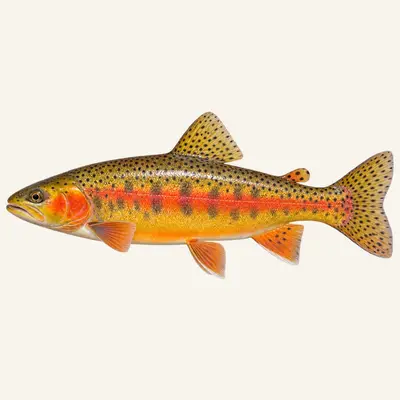
At least 14 subspecies have been recognised over time, each attached to its own drainage. Speaking of the cutthroat trout in the singular is close to meaningless: the form in one basin differs from the form in the next, and that mosaic is the whole biological interest of the species as well as its weakness.
The continuous coastal line — the northern part of Prince William Sound down to the Eel River in northern California, in most streams that reach the Pacific — belongs to one of those forms. The southern edge falls near the fortieth parallel, and the thermal ceiling used for the species is 23 °C; the two statements describe the same limit.
Migratory behaviour is fragmented in the same way. Anadromous adults run up from the sea; the young stay a year or two in the stream before going down; some populations never reach salt water at all. In the other direction, individuals out of sea-going stock occasionally remain in fresh water for as long as eight years.
Stocking has been done inside the native range as well as into a few lakes in eastern North America. The first is not the harmless half: putting one strain into another's basin brings together forms that geography had kept apart.
Identifying it
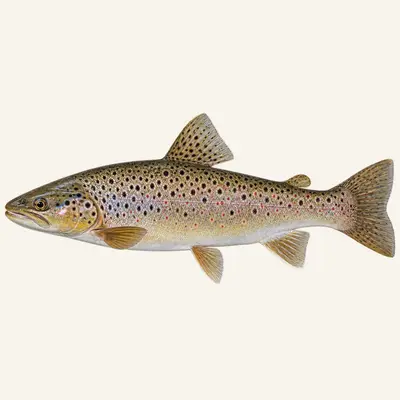
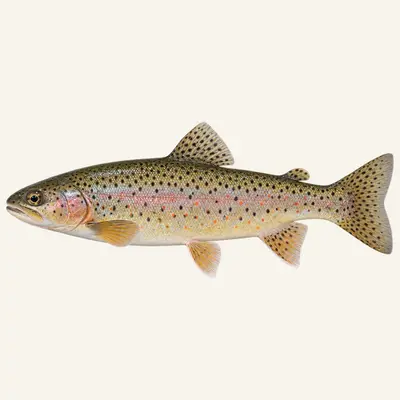
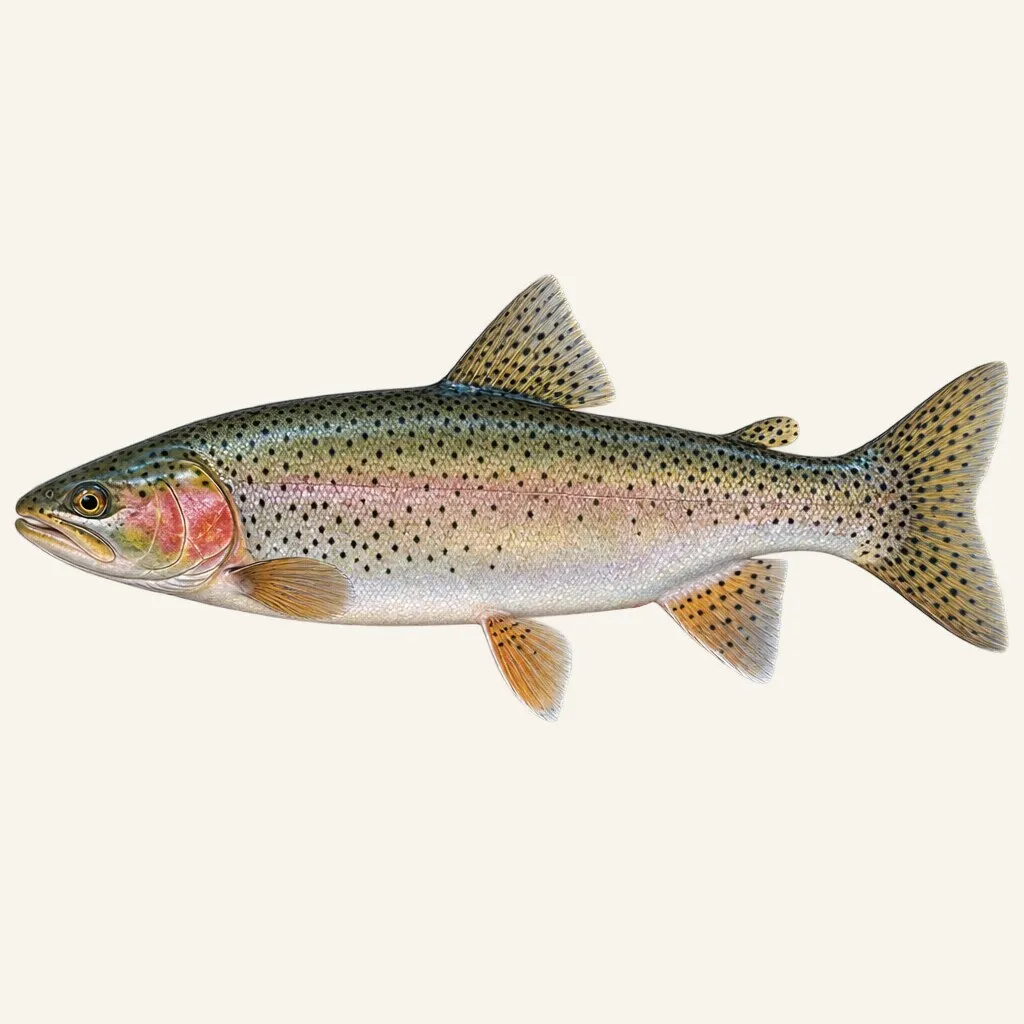
Two red slashes run beneath the lower jaw, one on either side of the throat. They name the fish in English and in every language that borrowed the English name, and any identification starts there.
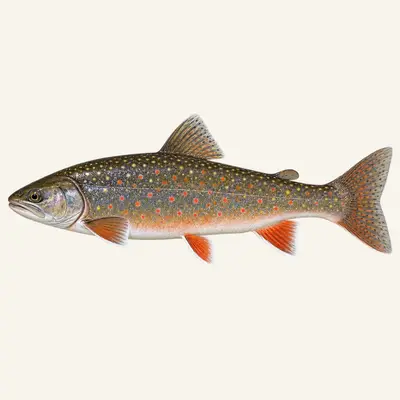
The rest of the colouring is too variable to decide anything alone. The ground is dark green to greenish blue over the back, olive green on the upper flank, silver low down and on the belly, with pinkish gill covers. The distribution of the spots does carry information: those below the lateral line are more numerous towards the front of the body, and irregular marks sit on the dorsal, adipose and caudal fins and on the bases — not the whole surface — of the anal, pectoral and pelvic fins.
A fish in from the sea, or newly into fresh water, looks like none of that: silvery, blue-backed, yellowish on the lower flanks and fins, sparsely spotted. The slashes still read.
Eight to 11 soft rays in the dorsal, 8 to 12 in the anal. The body is oval in section.
The spread of sizes is extraordinary for one species. Maturity arrives between 15 and 18 cm, a length at which a headwater fish is already breeding, while the biggest individuals on record fall in a wholly different size class and the oldest reach 13 years. The same inheritance makes a fish that fits in a hand and a fish that fills a net.
Breeding
Spawning goes on by day and by night alike, which is uncommon among salmonids and makes the activity harder to catch in the act than the season would suggest.
The female finds the site and shapes the pit while the male displays and clears off competitors. She settles into the depression, he follows, and both release together: the eggs drop into the spaces between the stones and stay there. She then returns to the upstream margin and works until the batch is entirely buried.
What comes next is particular to this species. With the new pit finished she may spawn in it where she stands, or abandon it and begin the whole sequence again somewhere else. Both sexes take one or more partners.
The water it needs
The water wanted is modest — fairly small streams with gravel beds and gentle gradients. Neither a steep torrent nor a large river matches the optimum. The fish holds near the bottom, and the marine form uses depths down to 200 m.
Density varies enormously from one stream to the next. In some it is the most numerous sport fish an angler will meet; in others the population stays tiny with no visible difference in the habitat. That unevenness owes less to the productivity of the water than to the history of each stream — what was put into it, what was taken out.
Areas
- Mountain streams
- High-altitude lakes
- Rapids and riffles
- Torrent confluences
Techniques
- Dry fly
- Nymph dead-drift
- Streamer
- Ultra-light with small lures
Baits
- Dry artificial fly
- Nymph
- Streamer
- Earthworm
- Freshwater shrimp
What it eats
Small fishes, crustaceans and insects, in proportions that follow the size of the individual and the richness of the water.
A generalist diet does not give it the advantage it might. This is a poor competitor and it yields ground to other salmonids placed in the same water. The difference is one of temperament rather than of menu, and it accounts for whole populations vanishing where other trout were released.
How to catch it
One sentence should come before any trip: this trout does not withstand fishing pressure. It comes readily, thins out fast, and a generous stream can be emptied in a season without the habitat changing at all. Release here is not a matter of style, it is the condition on which the population being fished still exists the following year.
Two things follow. On the size of the water: small low-gradient streams hold limited numbers that are easy to exhaust, so they are better strung together than worked hard. On the size of the fish: in most of those streams a breeding adult is under 20 cm, which means fine tackle and hooks in proportion if fish are to go back undamaged.
Lake forms and fish returned from the sea belong to another scale entirely, and the records come from them. They are also far scarcer.
Conservation
Three weaknesses stack, and they were identified together: it competes badly with other fish, it hybridises readily, and it does not stand up to sustained harvest. Any one of them would put a species in difficulty; combined, they explain stocks that collapsed with no pollution and no dam involved.
Hybridisation is the insidious one. It removes no fish. It dissolves what made a local lineage local, and the result still looks like a cutthroat. The 14 recognised subspecies are 14 separate inheritances that a single misplaced release can merge for good.
The species is therefore held or lost basin by basin, on management decisions — introducing nothing into a system that carries a local form — rather than on the protection of a habitat which, most of the time, has not changed.
Regulations
Check the local regulations in force (legal size limits, closed seasons, bag limits).
For guidance only. Legal sizes, quotas and open seasons vary by location and season: always check the local regulations in force before fishing.
Other names
Cutthroat trout, after the two slashes, and the name has travelled untranslated into most other languages. The named forms carry labels of their own and most of them are geographic: coastal, westslope, Yellowstone, Lahontan, Bonneville, Rio Grande, greenback. Two of the historically recognised forms have not been recorded in living memory. The specific name honours William Clark, whose expedition brought back the first accounts of the fish from west of the continental divide, which is why the trout of an entire continental slope answers to the surname of an army officer.
Sources: fishbase.se · api.gbif.org