European grayling
Thymallus thymallus · Salmonidae
- Freshwater
- Salmonids
- Hard
- Size
30–60 cm
- Weight
0.3–3.0 kg
- Lifespan
14 years
- Water temp.
6–18 °C
Where to fish
- River
Habitat icons: Flaticon
Distinctive large dorsal fin - Smells of fresh thyme - A delicate fish
Calendar
Spawning: fish are vulnerable. Check local rules — closed seasons vary by country.
Recorded in 18 countries
Austria · Belgium · Czechia · Denmark · Estonia · Finland · France · Germany · Italy · Liechtenstein · Luxembourg · Netherlands · Norway · Russia · Slovenia · Sweden · Switzerland · United Kingdom
GBIF occurrence records — native and introduced populations combined.
Its range
The species runs from the Barents basin west of the Urals through the Caspian, Black Sea, Baltic, White Sea and North Sea drainages, west along the Atlantic side as far as the Loire, into the Rhône system, and into the northern Adriatic east to the Soča. It has been introduced across most of southern and central Finland.
Water chemistry narrows that outline further than any map shows. Grayling want a pH between 7.0 and 7.5 and hard water, which rules out the soft acid streams other salmonids do well in and accounts for whole regions of absence inside an otherwise suitable climate.
Within the range the distribution is threadlike rather than continuous. The fish occupies the middle reaches of rivers, below the trout water and above the barbel water, and European stream typology named that band the grayling zone after it.
Identifying it
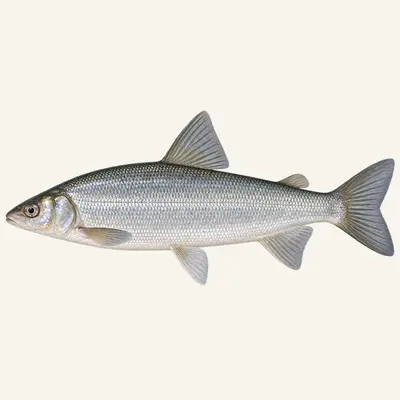
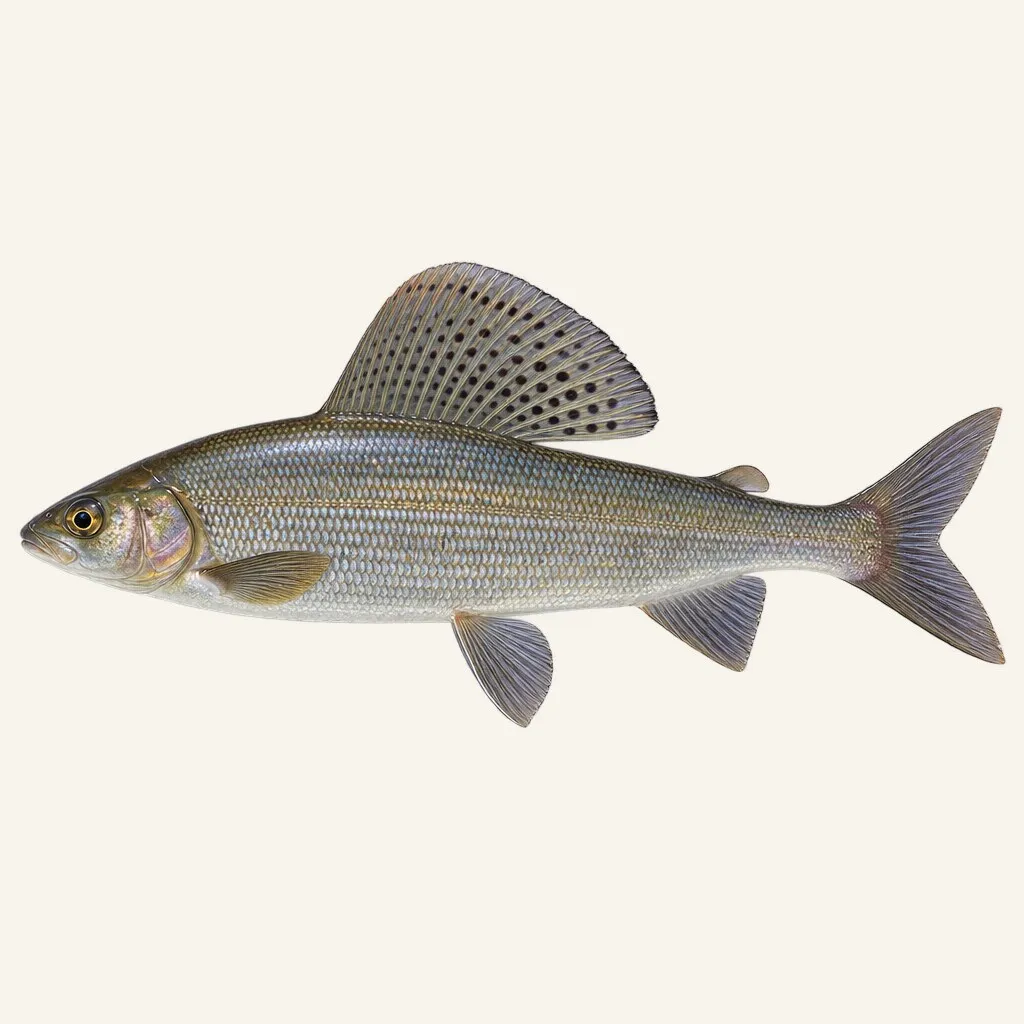
The dorsal fin closes the question before any other character is needed. It is enormous — 5 to 8 spines and 12 to 17 soft rays — and opens like a sail, greyish, marked with parallel rows of round dark spots. Nothing else in European fresh water carries anything comparable. On a displaying male it lengthens further and takes colour.
The rest of the animal is understated beside it: a clean fusiform body, grey-green over the back, silver flanks with a violet cast, and a small mouth set low on the head. The tail carries 19 to 21 rays. Behind the dorsal sits an adipose fin, which files the grayling among the salmonids however little it resembles a trout.
Against the Arctic grayling, three characters divide them. The maxillary reaches forward to the front margin of the eye. The pelvic fins are grey and carry no red streaking. The body bears no red spots. Gill rakers run from 19 to 30 and average around 24 to 26.
The last character is not visual at all. A grayling just out of the water smells of thyme, which is what the genus name has recorded since the eighteenth century.
Breeding
Spawning falls in spring, in water shallower and faster than most salmonid nests are cut in: 20 to 40 cm deep, or in riffles, over clean gravel, under a moderate current of about half a metre per second.
Clean is the operative word. Oxygen reaches the eggs by moving between the stones, and once fine material has packed those spaces the supply stops. A river that is silting up loses its grayling before it starts to look unwell.
Unlike salmon and trout, grayling excavate no deep nest. The eggs go into the surface layer of gravel, which leaves them more exposed to spates and to the fluctuating flows of spring than eggs buried 20 cm down would be.
The water it needs
The submontane reach is this fish's ground: a hard bottom of sand or stone, under cold, quick, well aerated water. It holds in the hollows behind boulders and in shaded water beneath overhanging vegetation, where the current is broken without being dead. In Scandinavia it also lives in clear lakes and in the freshened northern end of the Baltic.
It shoals, which is unusual among European salmonids and is the single most useful thing to know about it. Trout divide a river into individual holdings; grayling gather. Finding one usually means finding several, and a run can be empty for a hundred metres and then hold twenty fish.
Its sensitivity to pollution is pronounced and documented. It drops out of a reach ahead of the other species, which makes its presence a fair proxy for water quality and its disappearance an early signal rather than a late one.
Areas
- Moderate currents
- gravel beds
- well-oxygenated zones
Techniques
- Flies
- Light lures
- Worms
Baits
- Light spoon
- Micro-crankbait
- Dry flies/nymphs
What it eats
Insects, nymphs, small worms and crustaceans. The mouth is small and set low, aimed at the drift and at the surface rather than at anything substantial on the bed.
What distinguishes this species from the trout sharing its river is the absence of any change with age. A brown trout of 40 cm has largely switched to fish; a grayling of 40 cm is eating what a grayling of 15 cm eats, in greater quantity. Nothing in its life history opens a piscivorous phase.
How to catch it
Grayling are taken on insect larvae and on artificial flies, and the second built the reputation: this is a nymph and dry fly fish, on small patterns and fine tippet.
The small low mouth dictates the rest. Hooks are correspondingly small, and the strike is restrained rather than firm. The fish also inspects what it is offered. It will rise beneath a fly, drift back with it, drop away and come up again, so a refusal is not necessarily final, and a located fish repays persistence more than a change of ground would.
Prospecting follows the shoal and the fish's taste for broken current. Pockets behind boulders, seams running along overhanging cover and the tails of riffles concentrate them, and once a shoal is located the object becomes taking fish from it without burning it out.
It stays active in cold water, which on many rivers makes it the species available through the months when the trout season is shut. What is permitted, and when, varies by catchment and comes from the authority managing the water.
Conservation
Silt is what removes grayling from a river, and it removes them before it removes anything else. The eggs sit in the top layer of gravel and depend on water passing between the stones; soil washing off the land, discharges and any structure that slows the current enough to drop fine material will close that layer within a season. Straightening a channel does the same work faster.
Warming compounds it from the other direction, since the zone this species occupies is squeezed between the trout water above, which is colder, and the barbel water below, which is already too warm. There is nowhere for the band to move except upstream into a shorter and shorter reach.
Cormorant predation is cited across several basins as an additional load on populations that are already broken into fragments. A shoaling fish in shallow clear water has very little to get behind, and a flock working one reach can empty it.
The consolation is diagnostic. Because grayling fail first, a river that still holds them is telling you something reliable about the state of its bed.
Regulations
Check the local regulations in force (legal size limits, closed seasons, bag limits).
For guidance only. Legal sizes, quotas and open seasons vary by location and season: always check the local regulations in force before fishing.
Other names
Grayling in English, and in Britain the fish has a nickname of its own — the lady of the stream — earned by that dorsal fin and by the way it hangs under a fly. The bare word is ambiguous across the Atlantic: in North America grayling means Thymallus arcticus, the Arctic grayling, a congener but a different animal, so European grayling is the safer form in anything likely to be read on both sides.
Genus and species repeat the same word, and both come from thyme, for the smell of a freshly caught fish. German has Äsche, Italian temolo.
Sources: fishbase.se · api.gbif.org