Dolly Varden
Salvelinus malma · Salmonidae
- Freshwater
- Salmonids
- Medium
- Size
38–127 cm
- Weight
0.4–18 kg
- Water temp.
4–18 °C
- Depth
0–200 m
Where to fish
- Estuary
- River
Habitat icons: Flaticon
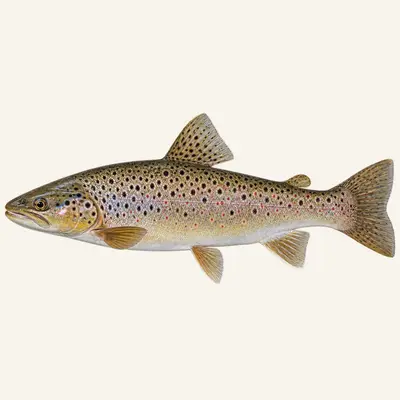
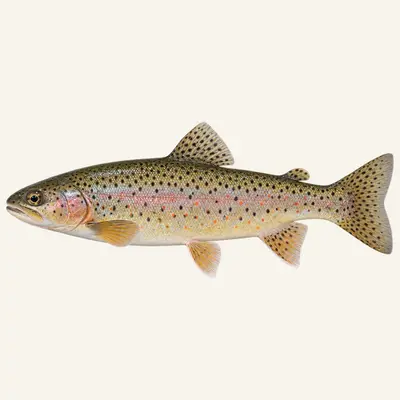
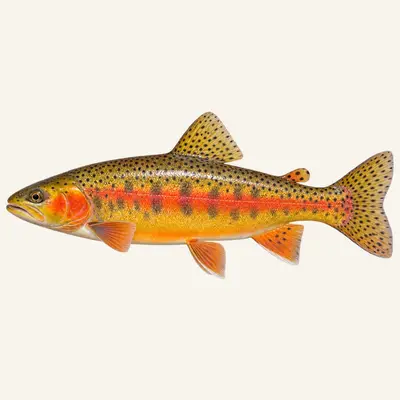
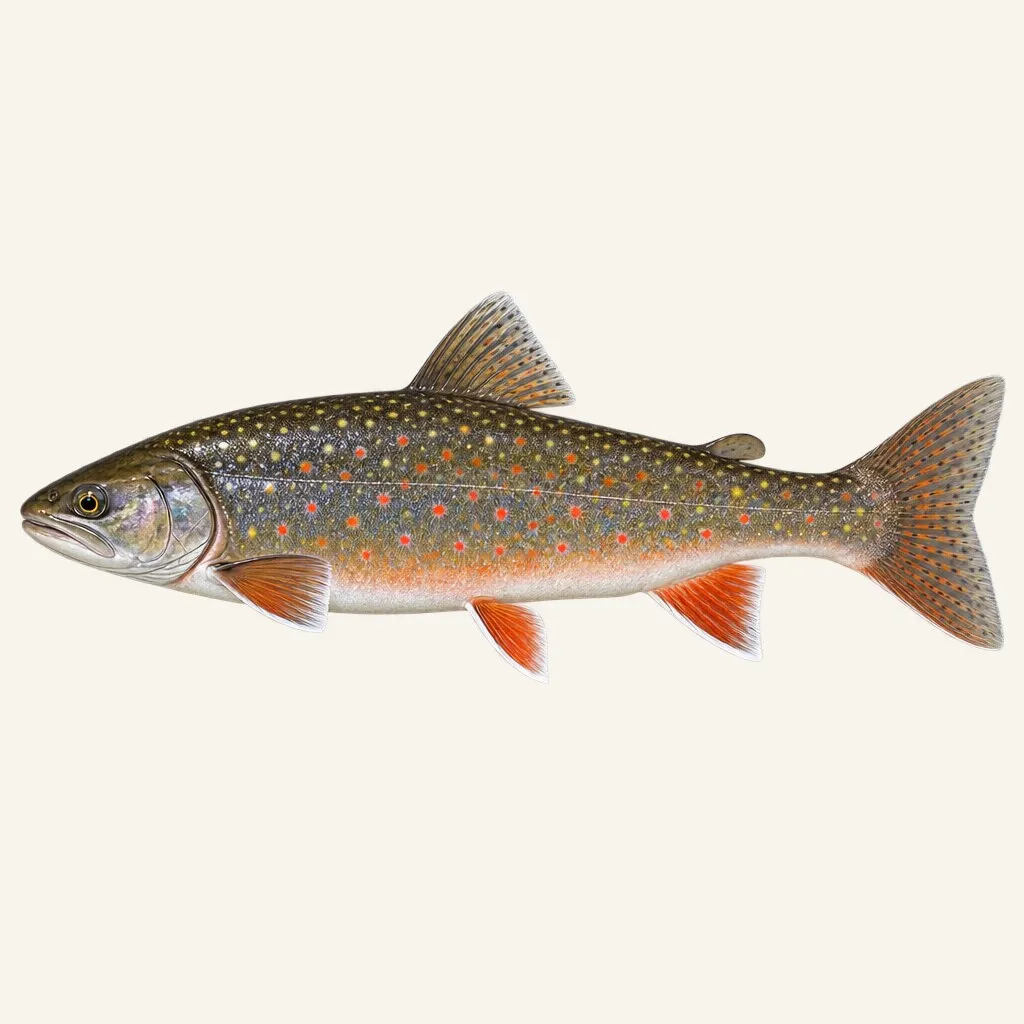
The Dolly Varden is a freshwater salmonid with silvery to olive flanks adorned with characteristic round pink to bright red spots. It inhabits the cold rivers and lakes of the North Pacific, from northwestern North America to the Asian coasts of Siberia and Japan.
Calendar
Recorded in 4 countries
Canada · Japan · Russia · United States
GBIF occurrence records — native and introduced populations combined.
Its range
The species holds Arctic and Pacific drainages from the lower Mackenzie in the Northwest Territories to Puget Sound and the Quinault River in Washington. In the northwest Pacific it runs from Korea to the Bering Sea.
Identifying it
Look above the insertion of the pelvic fin: there is a free-tipped fleshy appendage there, and it is the character worth learning. The tail is emarginate — notched, not deeply forked as in lake trout.
The body is elongate and fairly round, deepest below the dorsal, the head rather long. Fin counts run 10 to 16 soft dorsal rays and 10 to 15 anal rays, with no spines at all.
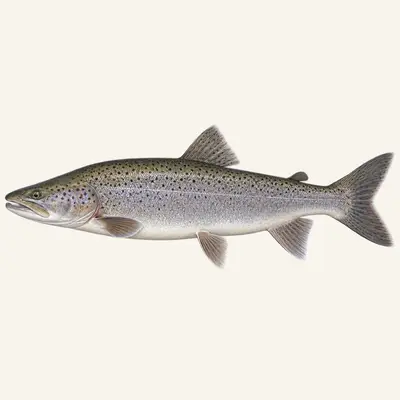
Colour is unreliable and varies with size, locality and habitat, which is exactly why the pelvic appendage earns its keep. Sea-run adults are dark blue over the back and upper head with silvery to white sides; freshwater fish are quite different.
Breeding
The female picks the site and starts digging the redd while the male keeps courting her and driving off rivals. When the redd is finished both drop into it and release eggs and milt, and this may be repeated several times.
The female then covers the eggs, swimming along the edge of the redd and sweeping gravel and small particles in with her tail and anal fin.
That last detail is the difference from lake trout, which digs nothing and leaves its eggs in open rock. Here the female builds and then buries, which lets the species use ground the other could not.
Maturity comes at about 24 cm, in a reported range of 12 to 21.
The water it needs
Adults use deep runs and pools of creeks and of small to large rivers, and also lakes and the sea. Very clean mountain streams are the type of water.
The species is typically anadromous, but many populations are landlocked. Sea-run fish appear to spend two or three years at sea, evidently close inshore, run upstream usually in autumn, and spawn in spring.
Depth reaches 200 m and the temperature window is 4 to 18°C — wider than lake trout's, which is part of why this fish can be a stream animal where the other cannot.
Areas
- Deep river pools
- Downstream of salmon spawning beds
- Stream confluences
- Estuaries during anadromous runs
Techniques
- Egg imitation streamer
- Wet fly
- Light spinner
- Fly fishing
Baits
- Artificial salmon eggs
- Fry imitation streamers
- Earthworms
- Nymphs
What it eats
The young stay in the streams for three or four years, feeding on insects, leeches, snails — and salmon eggs.
That last item is the fact to act on. A juvenile char that grows on the spawning of Pacific salmon is tied to the salmon run, and the productive water is downstream of a redd. It is also why the species is abundant where salmon are and thin where they have gone.
How to catch it
Fish below the salmon redds. A char whose young grow on drifting salmon eggs holds where those eggs drift, and egg imitations follow directly from the diet rather than from fashion.
The clean mountain stream is the setting, and the deep runs and pools within it are the lies. Sea-run fish come in on the autumn run and spawn the following spring, which puts two separate windows in the year.
Anadromous and landlocked populations sit side by side across the range, and they are not the same fish to fish for: one arrives on a schedule, the other is resident.
Common length is about 38 cm.
Conservation
The dependence on salmon eggs is the mechanism that matters, and it is second-hand: anything that reduces a salmon run reduces this char a few years later, with no direct pressure on the char at all.
Very clean mountain streams are the other requirement, and the phrase is not decorative — fine sediment closes the gravel the female sweeps over her eggs.
Landlocked populations carry the usual isolation problem: no reserve, no recolonisation, and a barrier that ends a run ends the anadromous form for good.
Regulations
Check the local regulations in force (legal size limits, closed seasons, bag limits).
For guidance only. Legal sizes, quotas and open seasons vary by location and season: always check the local regulations in force before fishing.
Other names
Dolly Varden in English — after a Dickens character in Barnaby Rudge, whose spotted dress the fish was thought to resemble, and one of the few fish names in the language taken from a novel. Also Dolly Varden trout and, confusingly, sometimes lumped with bull trout, from which it was separated only in the 1970s.
Sources: fishbase.se · api.gbif.org