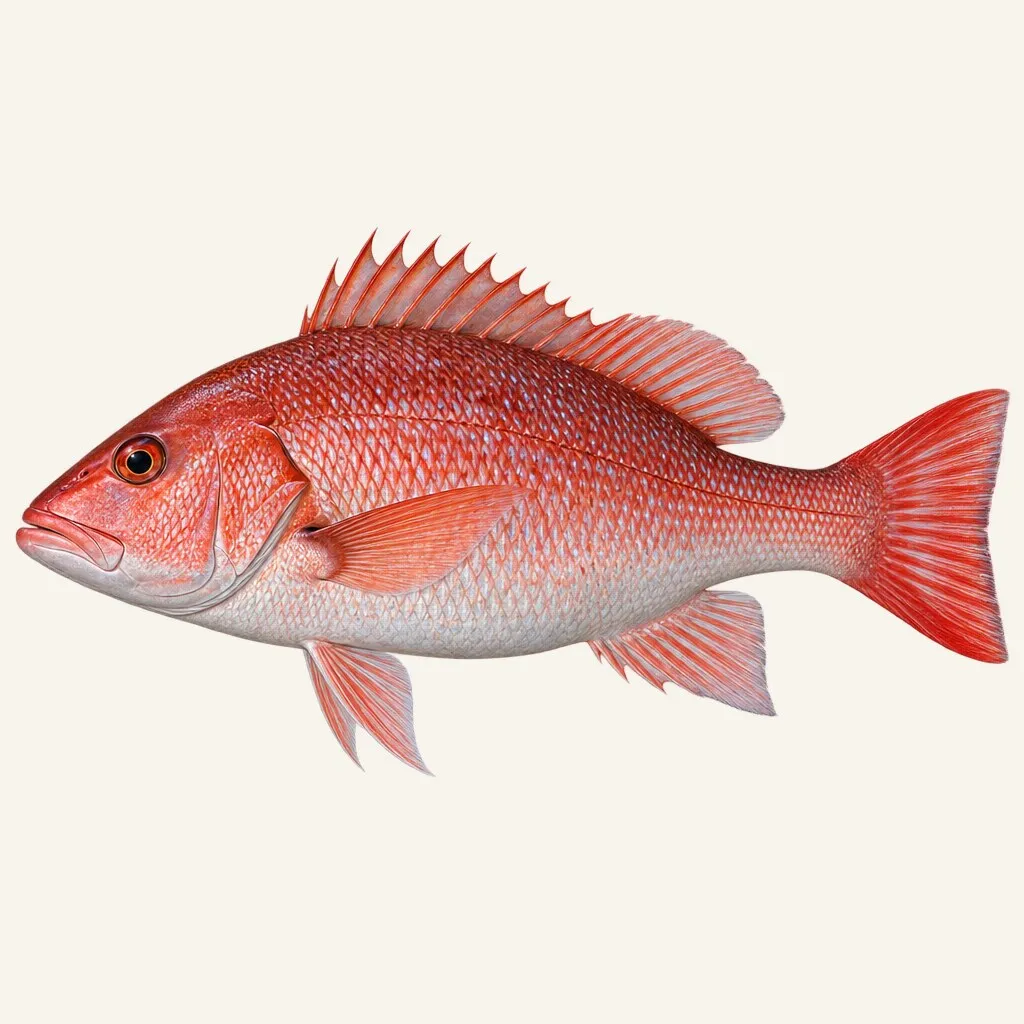
Northern red snapper
Lutjanus campechanus · Lutjanidae
- Saltwater
- Coastal
- Medium
- Size
60–100 cm
- Weight
2.7–23 kg
- Lifespan
57 years
- Depth
10–190 m
Where to fish
- Reef
- Rocky shore
Habitat icons: Flaticon
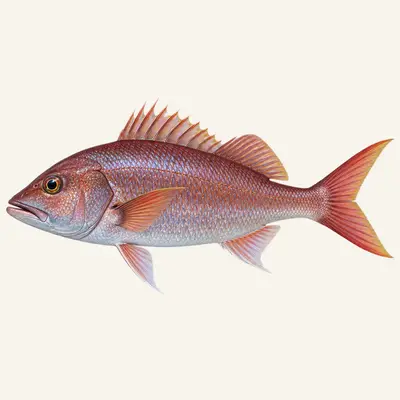
The red snapper is a reef fish with an oval, compressed body, uniformly vivid red on the back and flanks with a slightly paler belly. It inhabits coastal and deeper waters of the Gulf of Mexico and western Atlantic, commonly schooling around reefs and shipwrecks.
Calendar
Recorded in 2 countries
Puerto Rico · United States
GBIF occurrence records — native and introduced populations combined.
Its range
The Gulf of Mexico is the story. The species occupies it throughout, and that is where the population lives. Northwards the range follows the eastern coast of the United States as far as Massachusetts, but the fish becomes scarce beyond the Carolinas: those northern records describe a fringe, not a stock.
Latitude alone does not explain the shape. This is a hard-bottom animal of the shelf, so the range is a map of rock, ledge and wreck inside a temperature band rather than a map of coastline. Two adjacent stretches of the same shore, one with relief and one without, do not hold the same fish at all.
Identifying it
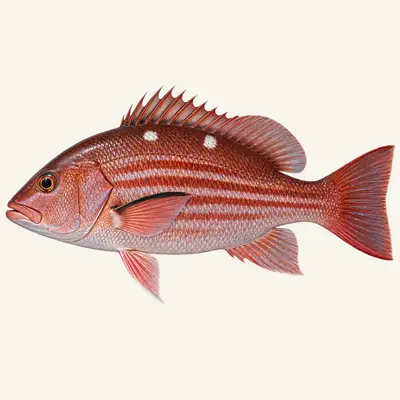
Everything that identifies this fish is on the juveniles. Below 30 to 35 cm it carries a large dark blotch high on the side, under the front of the soft dorsal. The blotch dilutes with growth, and a big one is plain red from the gill cover to the tail — no bar, no cheek line, no marked fin. The reference description of the species finds a single pattern worth naming, and it belongs to an animal that has not finished growing.
What is left is arithmetic. Ten spines and 14 soft rays in the dorsal, three spines and eight or nine rays in the anal, the scale rows crossing the back at an angle above the lateral line. Those figures are what separates this snapper from the other red ones of the western Atlantic; colour never does, and a fillet carries none of them.
The order of events matters as much at the counter as on the boat. The fish becomes hard to identify exactly as it becomes worth money, and that is the whole background to what its name means in the United States.
The water it needs
Two bottoms, two ages. Adults live over rock, across a depth band from 10 to 190 m with most fish between 30 and 130. Juveniles live somewhere else entirely, in shallow water over sand and mud.
Nothing in the adult habitat predicts the nursery, and the asymmetry between the two is the point. Hard bottom in this sea is patchy; soft bottom is continuous. A young red snapper is therefore spread thin across an enormous area while an adult one is concentrated on a few square metres of relief, and the two halves of the life cycle lie in the path of completely different fishing gear.
Areas
- Coral and rocky reefs
- Sunken wrecks
- Deep drop-offs
Techniques
- Bottom fishing on wrecks
- Vertical soft lure fishing
- Bottom longline
Baits
- Squid
- Shrimp
- Live fish
- Soft lure
What it eats
Fishes, shrimps, crabs, worms and cephalopods, plus a fraction of drifting material that includes tunicates and gastropods.
The worms are the informative entry. A fish that eats polychaetes is not holding station on a wreck waiting for something to swim past: it forages off the structure and onto the surrounding sand, which is where worms are. That also explains why baits as different as squid strips, cut fish and soft plastics all produce. Nothing in this diet points to a specialism, so persisting with one offering is a preference rather than a requirement.
How to catch it
The fishery is vertical and it is a fishery of marks — a wreck, a rock head, any hard relief inside the 30 to 130 m band. Sounder work makes the trip; knowledge of the shoreline does not.
One point deserves its own paragraph, because it decides whether a release means anything. A snapper brought up from 100 m has decompressed on the way. Its swim bladder has expanded, it cannot swim back down, and returning it at the surface without help leaves it floating there. Descending devices exist for this, and using one is the condition for the gesture to count at all.
The catch is landed fresh. This is among the most tightly managed fisheries in the Gulf of Mexico, for the recreational fleet as much as the commercial one, and the provisions differ by area and by year: they are worth checking with the fisheries authority before the trip rather than after it.
Conservation · Vulnerable (IUCN) — This species is threatened with extinction. Always release it (no-kill), handle it with the utmost care and check local rules — fishing for it may be prohibited.
Conservation
Fifty-seven years. A red snapper can reach that age, and the number disqualifies any reading of the stock over a single season. A population built out of half-century-old animals rebuilds over decades, and a strong year class shows up in the catch long after it was born.
The Gulf stock was fished beyond its capacity for a long period and is now closely protected. What makes the case instructive is that the pressure arrived from two directions at once. Cutting the directed fishery was not enough, because much of the juvenile mortality was happening in a different fishery, on a different bottom, with a different gear, aimed at a different animal: the shrimp trawl working the shallow soft ground where the young fish live. Trawling was accused of destroying young snappers and has been restricted on that basis. Both levers had to be pulled, and neither one alone would have shown a result.
Maturity spreads unusually widely. First spawning has been recorded anywhere from 25 to 47.5 cm, averaging near 39. A spread that wide means a 40 cm fish may have spawned several times or none, and that no single length describes the species anywhere in its range.
Regulations
Check the local regulations in force (legal size limits, closed seasons, bag limits).
For guidance only. Legal sizes, quotas and open seasons vary by location and season: always check the local regulations in force before fishing.
Other names
In the United States, red snapper is not a loose description but a market name with an owner, and the owner is this species. It is the label the regulated seafood nomenclature assigns to Lutjanus campechanus, and substitution beneath it — other snappers, tilapia, unrelated deepwater fish — has been documented often enough that the words on a menu say more about the counter than about the animal.
The scientific name has its own trap for anyone reading older work, where the species appears as Lutjanus aya. Rivas showed that the Bodianus aya of Bloch, 1790, from which that name descended, is not a snapper at all and probably belongs among the drums. The discarded name did not point at an earlier description of this fish. It pointed at another family.
campechanus names the Campeche Bank, on the Mexican side of the Gulf. It is the one geographic commitment in the name, and it is the right one.
Sources: fishbase.se · api.gbif.org