Rusty jobfish
Aphareus rutilans · Lutjanidae
- Saltwater
- Coastal
- Medium
- Size
79–110 cm
- Weight
5.6–11 kg
- Lifespan
16 years
- Depth
100–330 m
Where to fish
- Reef
- Rocky shore
Habitat icons: Flaticon
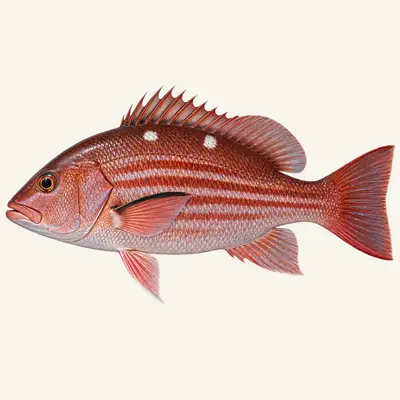
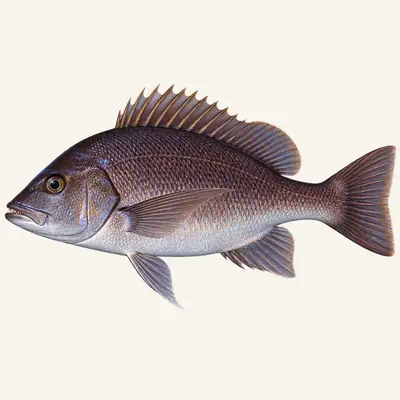
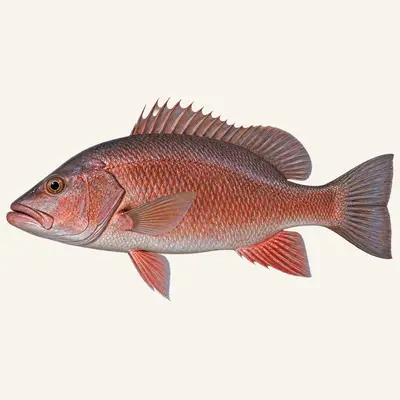
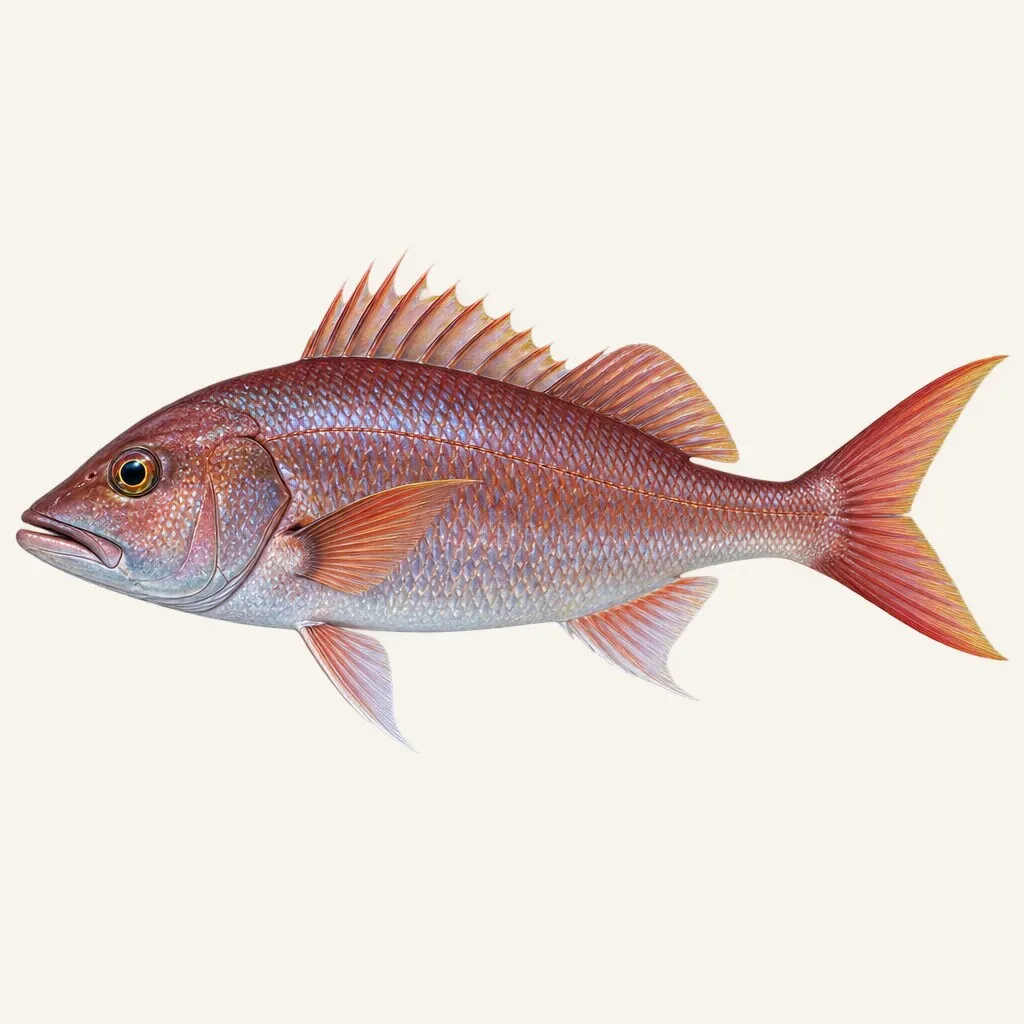
The rusty jobfish is characterized by its uniform russet-brown coloration, large slightly iridescent scales, and the slender profile typical of pelagic lutjanids. It hunts in open water and along deep reef slopes throughout the tropical Indo-Pacific.
Calendar
Recorded in 8 countries
Australia · Indonesia · Japan · Mayotte · Mozambique · New Caledonia · Philippines · Solomon Islands
GBIF occurrence records — native and introduced populations combined.
Its range
Indo-Pacific, from East Africa to the Hawaiian Islands, north to the Ryukyus and the Ogasawaras, south to Australia, between 35°N and 35°S. The band is almost perfectly symmetrical about the equator, which is what a purely thermal limit looks like when no continent gets in the way.
One record sits outside all of that: Port Alfred, in the southeast Atlantic, on the South African coast. It is worth reading as a boundary observation rather than as a second population. That stretch of coast is where the Indian Ocean turns the corner of the continent, and it is where Indo-Pacific species are found in Atlantic water — carried round, not established there. A single locality at the exact point where two oceans exchange water is the signature of a range edge, not of a range extension.
Identifying it
Everything diagnostic about this fish is in its mouth, and the description makes four separate statements about it.
The premaxillae are not protrusible: they are held by a frenum, so the upper jaw stays where it is when the mouth opens. The teeth in the jaws are extremely small, and the diagnosis adds that they are minute in large adults — the animal's dentition gets relatively less substantial as it grows, not more. The roof of the mouth is toothless. And in at least some specimens the inside of the mouth, the gill chamber and the gills are a shining silver, with the margin of the maxilla black against it.
Behind that mouth sits the count that completes the picture: 49 to 52 gill rakers on the first arch, in two groups of 16 to 19 and 32 to 35. That is a great many rakers for a fish with almost nothing to bite with, and the two facts answer each other. There is very little here for gripping and a great deal for retaining.
The gill openings extend far forward of the eye, which is consistent with the rest — a wide aperture on a head built to move water.
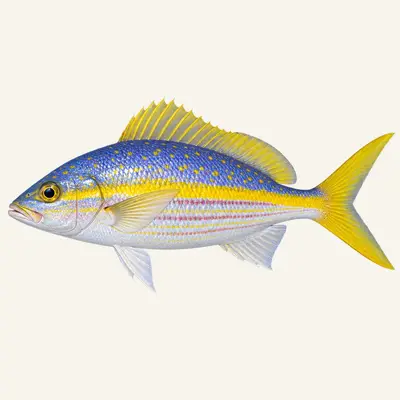
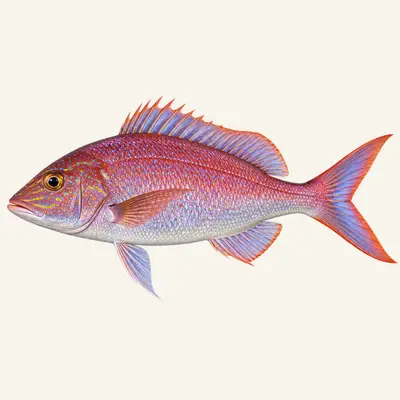
The remaining characters are ordinary snapper build. A long body, compressed from the sides. A projecting lower jaw. A flat space between the eyes, and a maxilla with neither scales nor ridges on it. Both vertical fins end in a lengthened final ray, drawn out past the one in front of it, and the tail is forked. There are 10 dorsal spines and usually 11 soft rays, three anal spines and eight rays, and 69 to 75 tubed scales along the lateral line. Colour runs from blue-grey or mauve to overall reddish, with yellowish to reddish fins, the pelvics and anal sometimes whitish.
The water it needs
Reefs and rocky ground, and the depth entry is a range without a shallow end: 100 to 330 m.
The behavioural note is the one to act on. The species is recorded in pelagic as well as benthopelagic water — that is, in open water away from the bottom as well as just above it. It is not a fish of ledges and holes. A slender, laterally compressed body carried in the water column is what the description amounts to, and it is a different animal from the heavy-bodied snappers that live inside structure on the same slope.
Areas
- Reef slopes
- Rocky drop-offs
- Strong current areas
- Deep hard bottoms
Techniques
- Vertical jigging
- Deep live-bait fishing
- Coastal trolling
- Natural bait fishing
Baits
- Colored metal jigs
- Live fish
- Squid
- Fish fillets
What it eats
Fishes, squids and crustaceans.
Set that against the jaw and it becomes a mechanism rather than a list. A predator taking mobile prey with minute teeth and a toothless palate has no way to grip anything; it cannot hold a fish while it repositions, and it cannot cut a piece from something too large. Everything it eats has to go in whole and in one movement, which puts the whole burden on acceleration and on the volume the mouth can open to, rather than on the reach and the bite that most predators of that diet rely on.
The high raker count is the other half of the same design. Whatever comes in with the rush of water is held back, and the fish keeps what a set of teeth would otherwise have had to secure.
How to catch it
The fish lives in the water column as much as against the bottom, and that decides where a bait or a lure should be working. A rig sitting on the ground is fishing below a species recorded as pelagic; anything worked in the twenty or thirty metres above the relief is fishing where it actually is. Vertical jigging and live or dead baits held off the bottom are the methods that follow from the biology, and they are unusual approaches to a snapper.
The mouth has a consequence for terminal tackle. A fish that engulfs rather than seizes takes a whole bait in one movement, so a large single hook set inside the offering will find purchase where a small one riding outside it has little to catch on. No wire is called for — there are no cutting teeth here — and the loss of a fish will come from the hook hold rather than from a parted trace.
The size figures are worth having before the trip. Fish are ordinarily taken at about 79 cm standard length, and 16 years is the greatest age on record for the species. A fish of that length inside that lifespan is growing fast by the standards of the deep slope, and it means a large specimen here is not necessarily an old one.
Conservation
The species is better placed than most of the fishes taken alongside it, and the reason is the pair of numbers above. Sixteen years is a short life for a slope animal, and a common capture of 79 cm means the fishery is working the upper part of the size range rather than the bottom of it. A stock that turns over in that time replaces removals within a period a management measure can actually be tested against.
What is missing is the figure that would let anyone act on this. There is no recorded length at first maturity for the species — no estimate and no observed range. Every size-based rule that can be written for a fish, and every calculation of how much of a landing consisted of animals that had bred, starts from that number, and here it does not exist.
The exposure that remains is shared rather than specific. This fish is taken by the same deep handline and bottom gear that works the rest of the slope community, and it arrives in the same mixed landings. A commercially fished species without a maturity figure, counted inside a catch that pools several deep snappers, is not a species anybody can say much about — and the reassuring biology above is an argument for why it is probably fine rather than evidence that it is.
Regulations
Check the local regulations in force (legal size limits, closed seasons, bag limits).
For guidance only. Legal sizes, quotas and open seasons vary by location and season: always check the local regulations in force before fishing.
Other names
English has two names for this fish and they describe two different parts of it. Rusty jobfish takes the reddish end of a colour range that also includes blue-grey and mauve. Silvermouth takes something the diagnosis records explicitly — the shining silver lining of the mouth and gill chamber — and which is invisible until the fish is landed and the gill cover lifted. One name works at a distance and is unreliable; the other is precise and requires the animal in your hands.
Jobfish is a group word covering this genus and Pristipomoides, and it is worth knowing that it does not describe a mouth. Those two genera differ on exactly that point: the premaxillae are fixed by a frenum here and protrusible there. Whatever the label originally meant, it does not sort the fishes by their jaws.
In Hawaii the species is lehi, and it is a valued part of the deep-water catch there.
Rutilans means glowing red, which picks the same end of the colour range as the English name — leaving the blue-grey and mauve specimens, which are equally in the description, without a name in any language.
Sources: fishbase.se · api.gbif.org