Thicklip grey mullet
Chelon labrosus · Mugilidae
- Saltwater
- Coastal
- Medium
- Size
32–75 cm
- Weight
0.4–4.5 kg
- Lifespan
25 years
- Depth
2–15 m
Where to fish
- Estuary
- Beach
- Rocky shore
Habitat icons: Flaticon
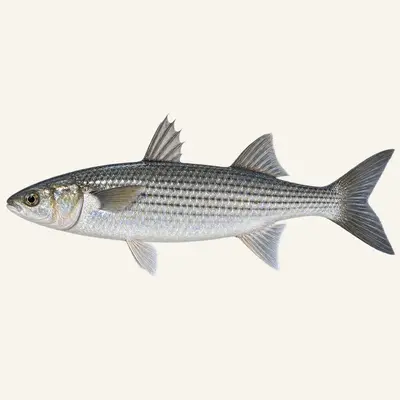
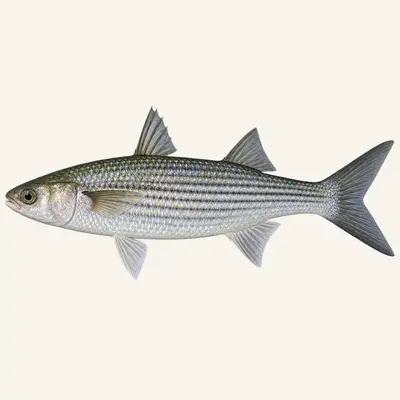
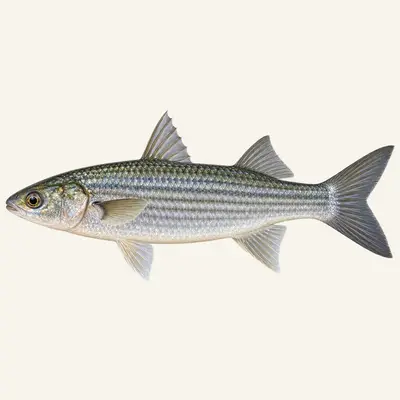
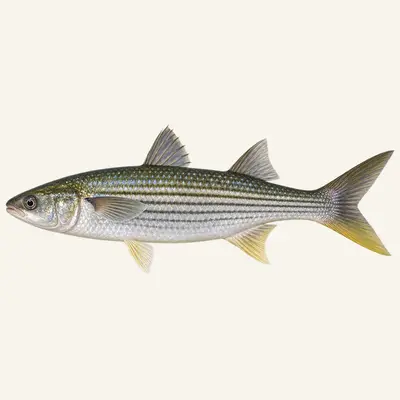
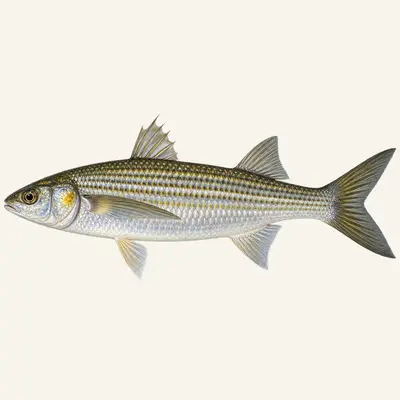
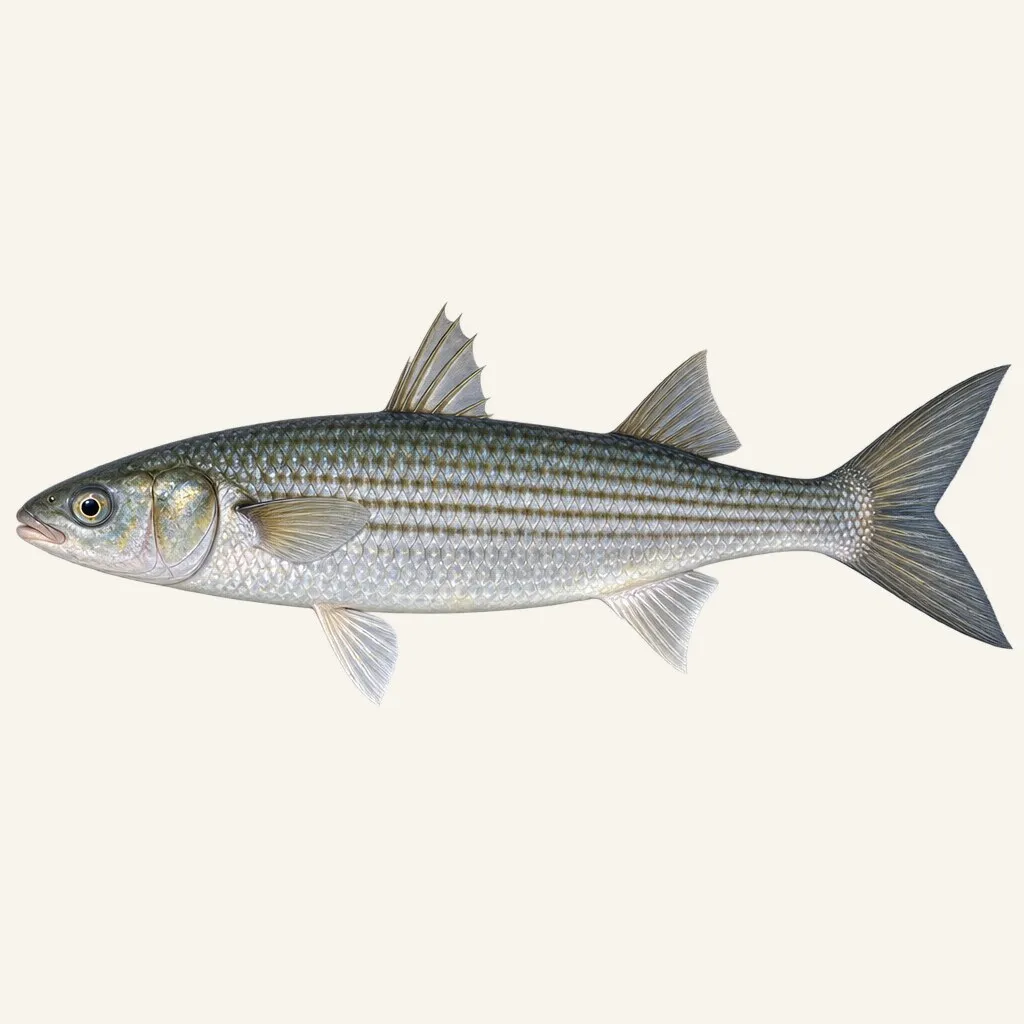
The thicklip grey mullet is a robust mugilid recognisable by its thick, crenellated upper lip from which it takes its name. Its back is grey-green, the flanks silvery with dark stripes; it frequents rocky coasts and estuaries.
Calendar
Its range
Iceland, the Faroes and southern Norway at the top, Cape Verde at the bottom, with the Azores marking the western edge, and the Mediterranean and Black Sea basins as well.
The northern half of that range is worth noting for what it says about temperature tolerance. Most of this group is thought of as a warm-water assemblage; this species reaches Iceland. It also makes occasional migrations, tending to move north through the summer as the water warms, so the northern part of the range is seasonal rather than permanently occupied.
Identifying it
The upper lip is thick and fleshy, and it is the whole identification. On the other grey mullets sharing the same harbours the lip is thin. Nothing else about a mullet is diagnostic at a glance — the body is the same elongated silver shape in every species of the group — so the lip is where the eye goes first and where it should stay until the answer is clear.
Five spines in the first dorsal, seven to nine soft rays in the second, three anal spines with eight or nine rays. Those counts are the counts of the genus. They will confirm that a fish is a mullet and they will not tell which one.
Breeding
Spawning happens at sea, in winter, and the eggs and larvae drift in the open water column. Nothing about that part of the cycle happens where the fish is normally seen.
What happens next is dated to the month, and it is the most specific piece of information available on the species. At about 2 cm the young move into coastal lagoons and estuaries between April and June, and they go back out to sea over the summer.
Read that as a schedule rather than a preference. The lagoon is not somewhere the juveniles happen to end up; it is a compulsory stage with an opening and a closing, occupied for a matter of weeks. A cohort that cannot get in during those weeks does not get another attempt.
Females grow larger than males. First maturity comes at about 29.5 cm.
The water it needs
Shallow, and more shallow than its relatives: the recorded depth band is 2 to 15 m. Adults hold inshore water in schools and go readily into brackish lagoons and into fresh water.
The freshwater habit is not a curiosity to be mentioned once. Fish are met in estuaries and up into the lower reaches of rivers, which makes this a marine species that is sometimes caught a long way from anything anyone would call the sea. Salinity is simply not one of the variables that constrains it.
Depth is. A fish whose ordinary domain stops at 15 m has no deep-water refuge at any point in its life, and everything that happens to shallow coastal water happens to it.
Areas
- Estuaries and coastal marshes
- Quays and jetties
- Rocky shores
- Brackish lagoons
Techniques
- Bread float fishing
- Fine waggler fishing
- Light coastal feeder
- Estuary float fishing
Baits
- Stale white bread
- Bloodworm
- Corn
- Green seaweed
- Bread paste
What it eats
Adults live on benthic diatoms, epiphytic algae, small invertebrates and detritus. Juveniles eat zooplankton and nothing else.
That is a complete replacement of one diet by another, not a broadening of it. The young fish filters particles out of open water; the adult scrapes films off sediment and off submerged surfaces. The feeding apparatus, the choice of ground and the daily routine all change with it, and the two stages have almost nothing in common except the body they occupy in succession.
The thick lip belongs to the second of those lives. A mouth built to work a surface at a shallow angle is a mouth for grazing, and it explains both what the fish eats and why it cannot be caught the way a predator is caught.
How to catch it
A grazer does not attack. It draws in, tastes and expels, so the baits that work are soft, doughy or vegetable — bread, paste, weed, a fine worm — and anything designed to imitate a fleeing prey animal is beside the point.
The bite follows from the same anatomy and it is the real difficulty of the fishing. A float barely dipping, held down for a second and released, is often the only signal a fish will ever give. Striking early takes the bait out of the mouth; striking late gives it back.
The marks are the calm, shallow, sediment-loaded places: harbours, estuary flats, river mouths, the inside of breakwaters. The tolerance of fresh water carries the search well upriver, further than the species has any obvious right to be.
Two calendar entries matter. The April-to-June window puts small fish into the lagoons in quantity. And the summer northward drift moves the adults, so a northern coast fishes better late in the season than early.
Conservation · Near Threatened (IUCN) — This species is in decline. Release your catch quickly and handle it with care — wet hands, as little time out of the water as possible.
Conservation
The break point is the lagoon, and it has a date on it. A 2 cm fish that finds no accessible brackish water between April and June is lost, and the adult stock at sea shows nothing of that loss for years afterwards.
Which means the pressure on this species need not involve fishing at all. Coastal lagoon development, and the closing of the narrow channels that connect a lagoon to the sea, act directly on recruitment without a single adult being touched. The habitat that fails is not the habitat the fish is caught in.
Longevity finishes the concealment. A lifespan of 25 years means a population can go on presenting good fish for a very long time after it has stopped renewing itself. Counting adults is not counting reproduction, and in this species the gap between the two can be a couple of decades wide.
Regulations
Check the local regulations in force (legal size limits, closed seasons, bag limits).
For guidance only. Legal sizes, quotas and open seasons vary by location and season: always check the local regulations in force before fishing.
Other names
Thicklip grey mullet in English, which names the diagnostic character directly and is therefore one of the more useful common names in the group. Thick-lipped grey mullet appears with the same meaning.
Grey mullet as a bare term is the problem. It covers half a dozen species along the same coasts, separated in practice by the lip, the eye or the presence of a spot at the pectoral base, and no part of the market name records which check was made. The related grey mullets are sold interchangeably, and the flesh gives nothing away.
Spanish lisa, Italian cefalo bosega, French mulet lippu. Labrosus means thick-lipped, so the scientific name says exactly what the English one does.
Sources: fishbase.se · api.gbif.org