Thinlip grey mullet
Chelon ramada · Mugilidae
- Saltwater
- Coastal
- Medium
- Size
35–70 cm
- Weight
0.4–2.9 kg
- Lifespan
10 years
- Depth
10–20 m
Where to fish
- Estuary
- Rocky shore
Habitat icons: Flaticon
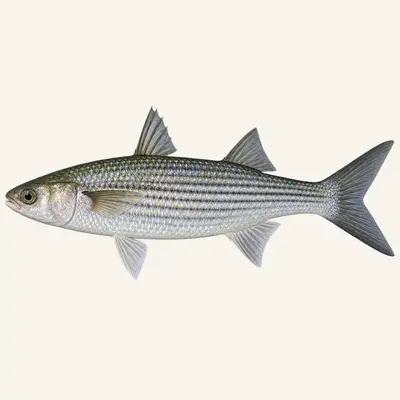
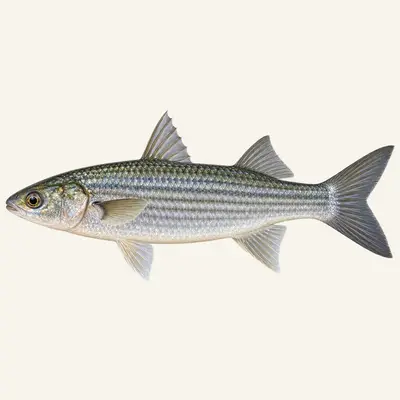
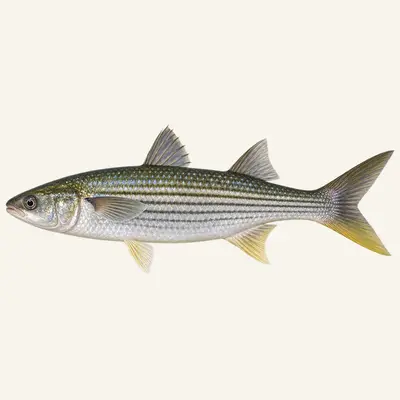
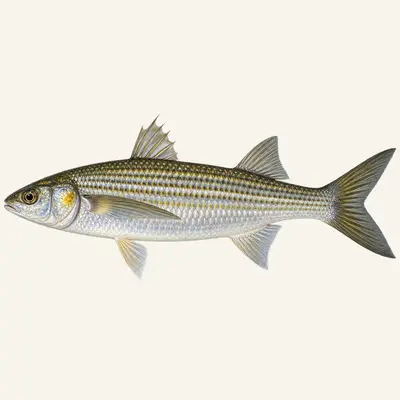
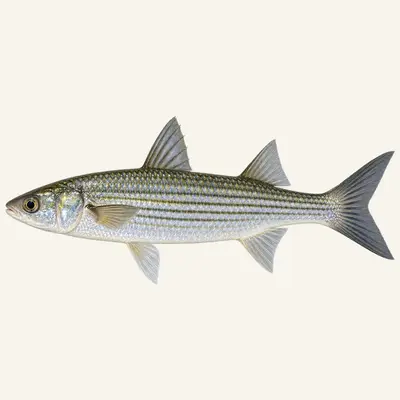
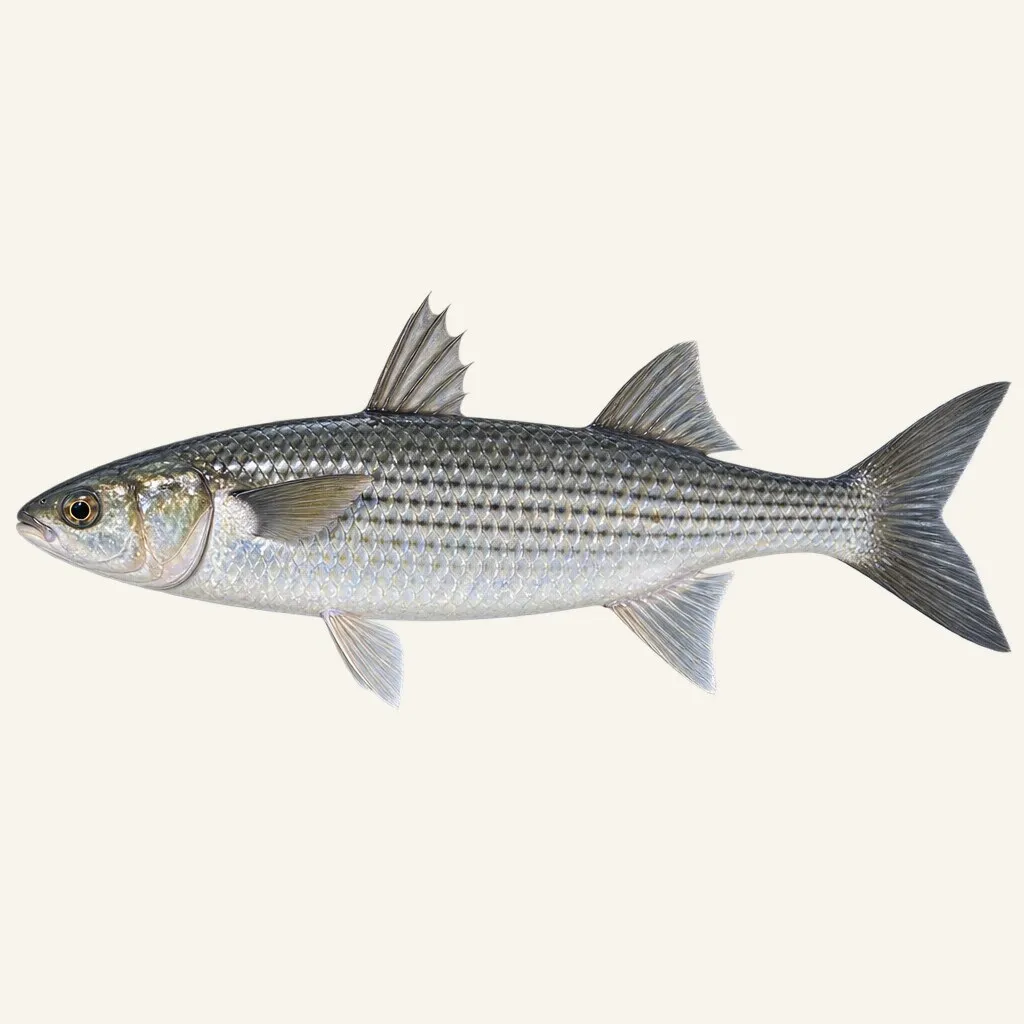
The thinlip grey mullet is a slender mugilid with faint golden lines on silvery flanks and a distinctive golden spot on the operculum. Euryhaline, it penetrates deep into estuaries and coastal lagoons.
Calendar
Its range
Southern Norway to Cape Verde on the eastern Atlantic seaboard, plus the Mediterranean and the Black Sea.
There is a correction to carry with that. Records of the species from tropical waters rest on misidentification. The range genuinely ends where the list ends, and any occurrence claimed further south should be treated as an unresolved identification rather than as an extension of the map.
Identifying it
The head is heavy and flattened along the top, above the eyes. It is a character that can be felt as much as seen, and running a thumb across the crown of a mullet is a quicker check than any count. The snout is short and blunt, the mouth small.
The pectoral fins are set high on the flanks rather than low on the belly, which is worth having in reserve when the head shape is ambiguous. The two dorsal fins are well separated, the first carrying four or five spines against the five of its relatives — the only count in the genus that occasionally helps.
Large scales, grey along the back and flanks, white underneath, and a fusiform body with no marking anywhere on it. Four to five dorsal spines, then seven to 10 soft rays. The anal fin has three spines and eight or nine rays.
Breeding
The adults leave the rivers and estuaries and gather in groups at sea, close to the coast, to spawn between September and February. The eggs are shed free, float, stick to nothing, and develop offshore.
The young then colonise the shoreline and the estuaries — not a lagoon on a fixed date, but the littoral zone itself, wherever it is reachable. That is the difference between this fish and its congeners: the nursery is the coast, and it is continuous rather than a seasonal door that opens and closes.
Adults thereafter run up into the lower parts of rivers and drop back down to the sea to breed. This is a catadromous cycle, the mirror image of a salmon's, and it puts the estuary at the centre of the animal's life rather than at the edge of it.
First maturity arrives at about 26 cm, in a range of 25 to 32. The maximum recorded age is 10 years.
The water it needs
Adults are pelagic in shallow coastal water, 10 to 20 m, and move into lagoons and the lower reaches of rivers in schools. The temperature band is 8 to 24 degrees.
And they are often found in polluted water. That is stated plainly in the literature and it should be stated plainly here, because it explains something no other fact about the species does: why this is frequently the one fish of any size present in a commercial dock, an industrial canal or the tidal reach of a city river. Water that has driven everything else out has not driven it out.
Juveniles occupy the same shoreline and estuary ground, so pollution tolerance applies across the whole life cycle rather than to the adults alone.
Areas
- Coastal lagoons
- Shallow estuaries
- Marinas
- River mouths and mudflats
Techniques
- Floating bread fishing
- Waggler fishing
- Surface feeder
- Ledger fishing in lagoons
Baits
- White bread
- Bloodworm
- Cooked rice
- Cooked corn
- Green seaweed
What it eats
Epiphytic algae, detritus, small bottom and planktonic organisms — and pelagic fish eggs and larvae.
That last item does not belong to the picture of a grazer, and it is the most interesting line in the diet. A fish with a small mouth and no teeth worth the name is consuming other species' reproduction from the water column. It is not a predator by any ordinary description, and it removes larvae anyway.
The switch between diets happens at a measured size. Zooplankton up to about 3 cm standard length, then bottom animals and plants from there on. The threshold is narrow and once crossed it is not recrossed.
How to catch it
Docks, canals, river mouths and the lower reaches of rivers. This mullet is fished where the built environment meets the water, and in those places it is often the only fish present that is worth targeting at all.
Grazing dictates soft baits — bread, paste, weed — and it dictates the way a bite is read. A fish that draws food in and blows it out again gives one of the least emphatic indications in fishing, and the tackle has to be light enough to show it.
The pollution tolerance is information with two edges and both belong on the page. It puts a large fish within reach of anyone with access to a harbour wall. It also means that fish has spent its life in water carrying whatever the catchment carried, and an animal that grazes sediment and detritus is feeding at exactly the point where contaminants settle. Whether a capture from a given stretch is worth eating is a question about the stretch, not about the species.
The spawning window from September to February is when the adults leave the rivers and mass near the coast, which changes where they are rather than making them easier to catch.
Conservation · Near Threatened (IUCN) — This species is in decline. Release your catch quickly and handle it with care — wet hands, as little time out of the water as possible.
Conservation
The catadromous cycle sets the requirement, and it is a requirement about movement rather than about water quality. The estuary has to be passable in both directions and the lower river has to be reachable. A weir or a lock that a mullet cannot get past removes the species from the whole basin behind it, whatever condition the sea outside is in.
Against that, the tolerance that makes the fish unpleasant to think about is also what makes it durable. It persists through water-quality failures that eliminate other species, which is why it is so often the last sizeable fish in a degraded estuary. That is a symptom to be read as one. A river holding nothing but this mullet is not a river in good health.
A lifespan of 10 years is short for the group, and it cuts in the species' favour: a population that turns over in a decade can rebuild from an improvement in a way that a fish living two and a half times as long cannot.
Regulations
Check the local regulations in force (legal size limits, closed seasons, bag limits).
For guidance only. Legal sizes, quotas and open seasons vary by location and season: always check the local regulations in force before fishing.
Other names
Thinlip grey mullet in English, and the name is defined by opposition — it exists to say that this is not the thicklip. Thin-lipped grey mullet is the same fish.
French mulet porc, Spanish morragute, Italian cefalo calamita. The French alternative name refers to the big head, which collides directly with the flathead grey mullet Mugil cephalus, a different species with a similar-looking skull.
Two further traps in English. Grey mullet on a slab or a menu identifies nothing below the level of the group, and the species is farmed commercially as well as fished, so provenance is not implied by the name either. And the word mullet is used in some English-speaking regions for the unrelated red mullets, which are not mullets at all.
Sources: fishbase.se · api.gbif.org