Longtail tuna
Thunnus tonggol · Scombridae
- Saltwater
- Big pelagics
- Medium
- Size
70–145 cm
- Weight
5.1–36 kg
- Lifespan
19 years
Where to fish
- Offshore
Habitat icons: Flaticon
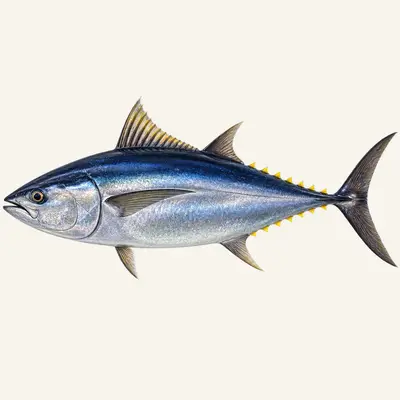
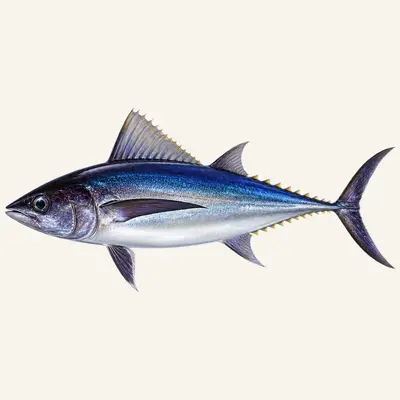
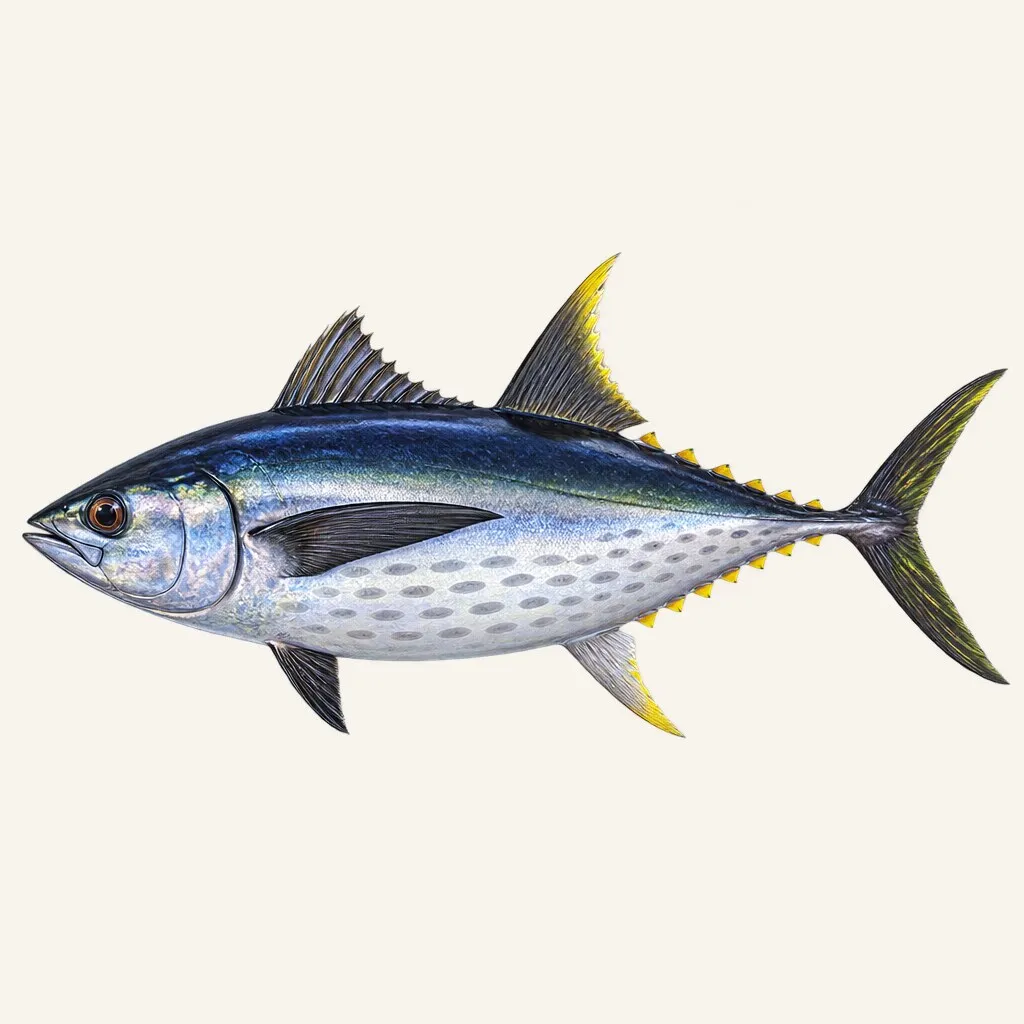
The longtail tuna is a medium-sized tuna of tropical and subtropical Indo-Pacific waters, distinguished by its immaculate white belly free of spots or marbling. Its compact body with blue-green reflections on the back allows it to chase pelagic fish schools in open water.
Calendar
Its range
The range covers the Indo-West Pacific, from the Red Sea and East Africa to New Guinea, north to Japan and south to Australia, with reports from New Zealand.
Its shape comes out of two refusals. The species is neritic and will not leave the shelf, which rules out the open ocean. And it avoids very turbid water along with low-salinity areas such as estuaries. The map is therefore a coastal band punched with holes at the mouths of the large rivers, where the sediment load and the drop in salinity push it away at exactly the moment when other coastal fish are gathering there.
Identifying it
The swim bladder is absent, or reduced to a vestige. That is rare in the genus, it is verified by opening the fish, and it goes with a life spent on the continental shelf, where neutral buoyancy counts for less than it does out in the blue.
From outside, the belly pattern is the best sign. The lower flank and abdomen are silvery white and carry colourless elongate oval spots set in horizontal rows — not the transverse bars of the bluefins. Two patterns, two orientations, and the contrast is immediate.
The fins are dark, which is equally distinctive. Dorsal, pectorals and pelvics are blackish, and so is the caudal, with yellow-green streaks running through it; only the tip of the second dorsal and the anal are washed with yellow, the anal itself is silvery, and the finlets are yellow with grey margins.
Greatest body depth falls under the first dorsal, which stays lower than the second. The pectorals are short to moderately long. There are 39 vertebrae.
The format is small for a Thunnus: 70 cm for an ordinary capture.
One number refuses to fit the rest — nineteen years. A fish of 70 cm that lives nearly as long as a bigeye of two and a half metres is not a fast-growing miniature tuna but a slow animal in which every year class counts.
The water it needs
The ground begins around 10 m and stops where the shelf does. That is the constraint worth holding on to: the entire water column available to this fish is the one the shelf provides, tens of metres rather than the hundreds an oceanic tuna passes through in a day. Schools form and vary in size.
Areas
- Coastal pelagic waters
- Around islands and shoals
- Thermal fronts
- Passes and straits
Techniques
- Surface trolling
- High-speed metal lures
- Live bait fishing
- Vertical jigging
Baits
- Live baitfish
- Metal lures
- Jig head
- Artificial squid
What it eats
Fishes, cephalopods and above all crustaceans, with a marked share of stomatopod larvae and prawns. That crustacean component is heavier than in the offshore tunas and matches the bottom-driven productivity of the coastal ground it keeps to.
How to catch it
This is the accessible tuna. It does not leave the shelf, which puts it within range of boats that would never go out looking for a yellowfin, and its usual size allows tackle scaled to it rather than to a fish four times heavier.
Two markers follow from what it will not put up with. Loaded or freshened water holds none of them: after a spate, the fish are outside the turbid plume and not inside it. Conversely, the places where clear oceanic water comes up against the shelf are where the schools concentrate.
Conservation
The species supports a substantial commercial fishery across the Indo-West Pacific, and nobody knows what that removal amounts to. At the appraisal of July 2021 the available data did not allow either the trend of the stock or its level to be established.
Two things make the ignorance expensive. Nineteen years of life implies a turnover slower than the size of the animal suggests. And fidelity to the shelf places it inside the territorial waters of dozens of states, where the fisheries are artisanal, numerous, scattered and poorly recorded — precisely the conditions under which no reliable catch series can be reconstructed.
Regulations
Check the local regulations in force (legal size limits, closed seasons, bag limits).
For guidance only. Legal sizes, quotas and open seasons vary by location and season: always check the local regulations in force before fishing.
Other names
Longtail tuna in English, after the peduncle and the tail. French says thon mignon, startling for a fish that is nothing of the kind in absolute terms but accurate about where it sits among its relatives.
The name to watch is Australian. Local usage there calls this fish northern bluefin tuna, a phrase applied elsewhere to genuine bluefins, and it should be discounted on sight when reading regional statistics: a table that mixes the two is setting a shelf fish of a few tens of kilos beside an ocean crosser of several hundred.
Sources: fishbase.se · api.gbif.org