Skipjack tuna
Katsuwonus pelamis · Scombridae
- Saltwater
- Big pelagics
- Medium
- Regulated
- Size
80–110 cm
- Weight
8.9–35 kg
- Lifespan
12 years
- Water temp.
15–30 °C
- Depth
0–260 m
Where to fish
- Rocky shore
- Offshore
Habitat icons: Flaticon
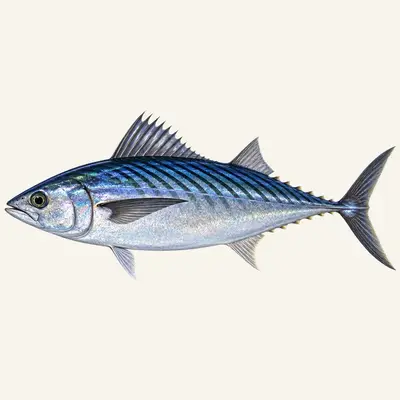
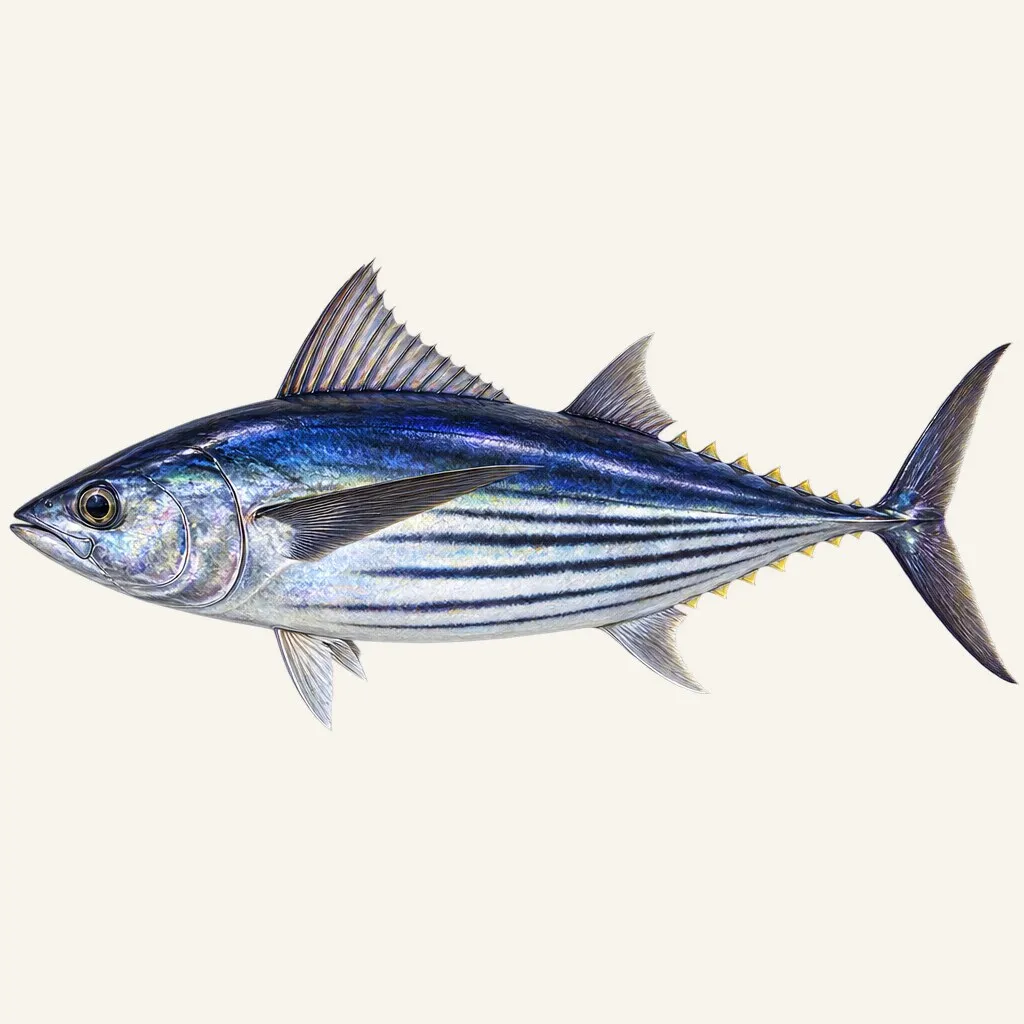
Skipjack tuna - a highly migratory pelagic species whose belly carries four to six dark longitudinal stripes, found in tropical and subtropical waters of all oceans.
Calendar
Recorded in 63 countries
Angola · Argentina · Australia · Bahamas · Belize · Brazil · British Indian Ocean Territory · Cameroon · Canada · Cape Verde · Chile · Colombia · Comoros · Congo - Brazzaville · Côte d’Ivoire · Cuba · Ecuador · Equatorial Guinea · Faroe Islands · France · French Polynesia · French Southern Territories · Gabon · Germany · Ghana · Greenland · Guinea · Guinea-Bissau · Iceland · India · Indonesia · Ireland · Japan · Kenya · Liberia · Madagascar · Mauritania · Mauritius · Mayotte · Mexico · Mozambique · Netherlands · New Zealand · Nigeria · Norway · Philippines · Portugal · São Tomé & Príncipe · Senegal · Seychelles · Sierra Leone · Solomon Islands · Somalia · South Africa · Spain · Sri Lanka · Svalbard & Jan Mayen · Taiwan · Tanzania · United Kingdom · United States · Western Sahara · Yemen
GBIF occurrence records — native and introduced populations combined.
Its range
The range is bounded top and bottom and open on both sides. It runs from 63°N to 47°S and spans every meridian on the globe, in water between 15 and 30 degrees. What holds the northern and southern edges in place is temperature, and those edges move with the season rather than sitting on any coastline.
The interesting consequence concerns where the fish breeds. Larvae are restricted to surface water in that same 15 to 30 degree envelope — the identical band the adults occupy — and spawning in the tropics is continuous. There is therefore no separate breeding ground to speak of, no run to a particular sea at a particular month, and no place on the map that carries the reproduction for the rest of the range. The species spawns wherever it happens to be warm enough, which is most of where it lives, most of the year.
Identifying it
Four to six dark bands run lengthwise along the belly and the lower flank. Position settles it: the marks are underneath the animal, on a body that is plain dark purplish blue over the back and plain silver down the sides, with nothing written on either.
Those bands do not look the same in the water as they do on deck. The published account notes that on a live specimen they may appear as broken lines of dark blotches, where a landed fish shows them continuous. A photograph taken underwater and a description written at the rail can therefore disagree without either being wrong, and it is worth knowing which one is in front of you.
The count that decides a doubtful fish is on the first gill arch: 53 to 63 rakers. It is a high figure and it survives gutting, so it remains available long after the colour has gone.
The rest is a set of proportions. The two dorsal fins are separated by a gap no wider than the eye, and the second is followed by seven to nine finlets, the anal by seven or eight. Pectorals are short and carry 26 or 27 rays. Between the pelvic fins sit two flaps. There are 41 vertebrae, and the teeth are small, conical and set in one row. The skin is bare apart from the lateral line and the shoulder corselet, and each side of the tail base carries a strong keel with a smaller one above and below.
Breeding
A female in breeding condition in tropical water spawns almost every day.
That is not a figure of speech in the record but the way the reproductive cycle is described, and it is the single most consequential thing known about the species. Eggs go out in successive portions rather than in one release, the season runs right through the year in the tropics, and eggs and larvae then drift in open water with no further investment from either parent.
Maturity arrives at about 41 cm, with reported figures between 40 and 45. The common capture is around 80 cm, and the oldest fish on record was 12 years old. An animal that starts breeding at half the length it is ordinarily caught at, and then breeds daily for the rest of a short life, is built to replace itself faster than almost anything of comparable size in the open ocean.
The water it needs
Offshore water, from the surface down to 260 m, with the working part of that near the top.
The aggregating behaviour is what the animal is known for, and the list of things it aggregates with is unusually specific: birds, drifting objects, sharks and whales. The gatherings are noisy and visible from a distance, breaking the surface with jumping, feeding and foam.
Read that list slowly, because two of the four items are predators. Sharks and whales are not neutral structure, and the record separately notes that large pelagic fishes prey on this species. Whatever the fish is getting out of the association, it is not safety. The common property of a bird, a log, a shark and a whale is that each of them is a discontinuity in a body of water that has almost none, and each of them concentrates something. The tuna is at the end of that chain and pays a price to be there.
Areas
- Tropical open sea
- Around FADs and wrecks
- Thermal fronts
- Coastal pelagic waters
Techniques
- Surface trolling
- Brightly colored lure fishing
- Handline at school
- Light jigging
Baits
- Small baitfish
- Colorful soft lures
- Metal lures
- Natural squid
What it eats
Fishes, crustaceans, cephalopods and molluscs, and cannibalism is common.
Put that beside the reproduction and the two facts describe the same water. A school spawns daily; the eggs and larvae stay pelagic in the layer the school occupies; and the adults in that school eat their own kind. The first hazard a skipjack larva meets is not a distant predator but the fish that produced it, and the species' own aggregation is simultaneously its nursery and one of its nurseries' main losses.
How to catch it
Finding the fish is the whole exercise and the signs are all above the surface: working birds, anything adrift, broken white water, fish clearing it. Nothing about the presentation is delicate once a school is located.
The gear described in the record is modest — trolling on light tackle with plugs, spoons, feathers or strip bait. Light tackle, for a tuna, is the phrase worth noticing. This is not an animal that has to be beaten with heavy gear, and the trip is decided by search time rather than by what is on the reel.
One consumption note belongs here. Ciguatera poisoning has been reported from the species, which is unexpected for a fish that spends its life away from any reef, and the reports concern fish eaten close to where they were landed rather than the enormous canned volume the species mostly becomes. The hazard follows the ground, not the label, and it is a question for the port.
Regulated — Often governed by quotas, size limits, seasons, or reporting rules.
Conservation
The biology is not the pressure point. Daily spawning, maturity at half the common capture length and a life of twelve years give a population that recovers from removal quickly, and the fish absorbs an annual catch that no slow-maturing tuna could survive.
The pressure point is the method, and it comes straight out of the habitat section. The species is located by its habit of gathering under and around anything that interrupts open water. A fishery organised around that habit does not catch a school in isolation; it catches whatever else has assembled at the same object — juvenile tunas of other species, sharks, turtles, the assortment that a drifting structure collects over days. The cost of the technique is carried by animals with none of this one's capacity to recover.
There is a second thing worth holding on to. This tuna is prey as much as predator: large pelagic fishes feed on it, and it is one of the animals that converts small offshore life into something big enough for a marlin or a shark to use. Tonnage taken out of it is taken out of the middle of that chain, and the effect appears in species nobody was fishing for.
Regulations
Check the local regulations in force (legal size limits, closed seasons, bag limits).
For guidance only. Legal sizes, quotas and open seasons vary by location and season: always check the local regulations in force before fishing.
Other names
Skipjack tuna in English, and among the six names this catalogue carries it is the odd one out. French, Spanish, Italian and Portuguese all name the stripes — striped-belly bonito, listado, tonnetto striato, bonito-listrado. German steps sideways and calls it the true bonito, a name that positions the fish against its relatives rather than describing it. English alone names a behaviour: the fish skipping across the surface, which is the thing you actually see first.
The scientific name comes from Japanese. Katsuo is the fish; dried, smoked and shaved, it becomes katsuobushi, the base of dashi and one of the most widely eaten forms of any fish anywhere. The genus name took that word directly, which makes this one of the few large marine fishes whose binomial was built out of a fishing culture's own vocabulary rather than out of Latin description.
Sources: fishbase.se · api.gbif.org